What is another name for an elliptical path?
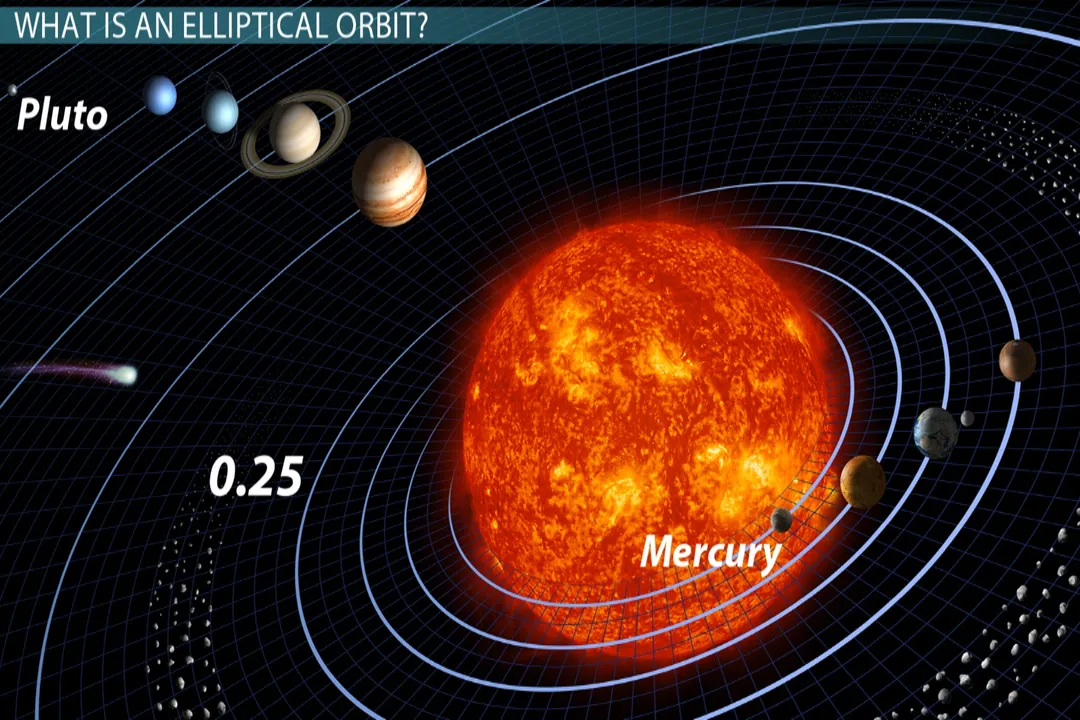
The inquiry into finding an alternative designation for a path traced in an elliptical manner quickly guides us from general geometry into the precise language of celestial mechanics. While the geometric shape itself is universally known as an ellipse, [1] when we discuss objects moving along this path under the influence of gravity—whether a planet around a star or a satellite around a planet—the most common and technically precise alternative name is an elliptic orbit. [4] You might also encounter terms like an eccentric orbit [4] or simply recognize the general description of an oval path, [3] but for closed, repeating paths governed by a central force, elliptic orbit is the established term in physics. [4] Even the word orbit itself is defined as the usually elliptical path one celestial body takes in revolution about another.
# Geometric Shape
At its foundation, an elliptical path is a curve defined by a specific geometric property. An ellipse is essentially a squashed or flattened circle. [5] Unlike a circle, where every point on the edge is the exact same distance from the center, an ellipse is defined by two special points called foci (the plural of focus). [5][9] For any point on the ellipse, the sum of the distances from that point to both foci remains constant. [7] This constant sum property is what mathematically guarantees the smooth, closed, oval shape. [7]
In the context of orbits, the object being orbited—the Sun, for instance—resides at one of these two foci. [2][4] The path traced by the orbiting body is not uniform; it varies in its degree of "squashiness." This variation is quantified by a value called eccentricity (). [5] A perfect circle has an eccentricity of exactly zero (). [2][5] As the path becomes more elongated or "squashed," the eccentricity increases. [5] If the eccentricity reaches exactly one (), the path is no longer closed; it becomes a parabola, representing an object passing by only once, like some comets. [2][4] Therefore, an elliptical orbit is mathematically defined as any closed path where the eccentricity is strictly less than one (). [2][4] Even a circle is technically considered a special case of an ellipse, though one with no flattening. [2][7]
# Orbital Mechanics
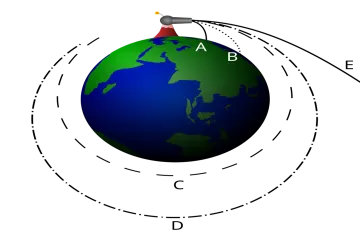
The reason these paths are almost universally elliptical in nature, rather than perfect circles, is a direct consequence of the interplay between two fundamental principles: the object's desire to maintain its straight-line motion (momentum) and the attractive force of gravity. [1][5] An object in motion seeks to continue in a straight line, as described by Newton’s first law. [1] Gravity, however, exerts a constant pull toward the central body. [1] The orbit we observe is the result of this perpetual tug-of-war. [5] If the forward momentum is too large relative to the gravitational pull, the object speeds past into an open, non-repeating trajectory (like a hyperbolic orbit). [1][7] If the momentum is too small, gravity wins, and the object crashes. [1][5] When these forces are perfectly balanced, the object is perpetually "falling" toward the center but moving sideways fast enough that it continuously misses. [1]
When the balance is achieved imperfectly, or when the initial conditions dictate it, the result is an ellipse. [6] The fact that the planets in our Solar System follow these paths was a revolutionary discovery made by Johannes Kepler in the early 17th century. [2][5] His work laid the mathematical foundation for understanding these celestial "elliptical paths". [2][5]
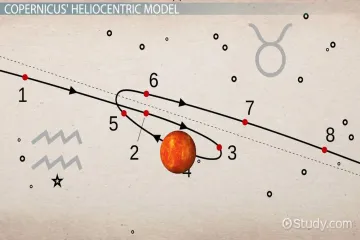
# Kepler Laws Foundation
Kepler's findings distilled the complex interactions of gravity and motion into three succinct, observable laws, which describe the movement of any body tracing an elliptic trajectory [3] around a primary mass. [2]
# First Law Shape
Kepler's First Law is perhaps the most direct answer to our question about the path's name. It explicitly states that all planets move in elliptical orbits around the Sun, with the Sun situated at one of the focus points. [2] This means that the distance between the orbiting body (like Earth) and the central body (the Sun) is constantly changing throughout the orbital period. [2]
For Earth, this change is subtle. Our planet's orbit has an eccentricity of about $0.0167$, which is extremely close to zero, leading many to mistakenly visualize it as a perfect circle. [5] Contrast this with Mercury, which has an eccentricity over ten times greater, making its path noticeably more elongated or oval. [2][5] The term oblong orbit from thesauri confirms this visual description of a more pronounced ellipse. [3]
If we consider a spacecraft executing a Hohmann transfer orbit—a common, fuel-efficient method to move between two circular orbits—that transfer path is, by definition, an ellipse. [4] The initial and final points of the transfer correspond to the apsides of that elliptical path. [9]
# Second Law Speed
Because the distance to the central body changes in an elliptical path, the orbital speed cannot remain constant. [2][5] This variable speed is codified in Kepler's Second Law, which is often described in terms of areal velocity. [2]
The law dictates that a line joining a planet and the Sun sweeps out equal areas during equal intervals of time. [2] In practical terms, this means:
- When the orbiting object is closest to the central body, it is moving at its fastest velocity.
- When the orbiting object is farthest from the central body, it is moving at its slowest velocity. [7]
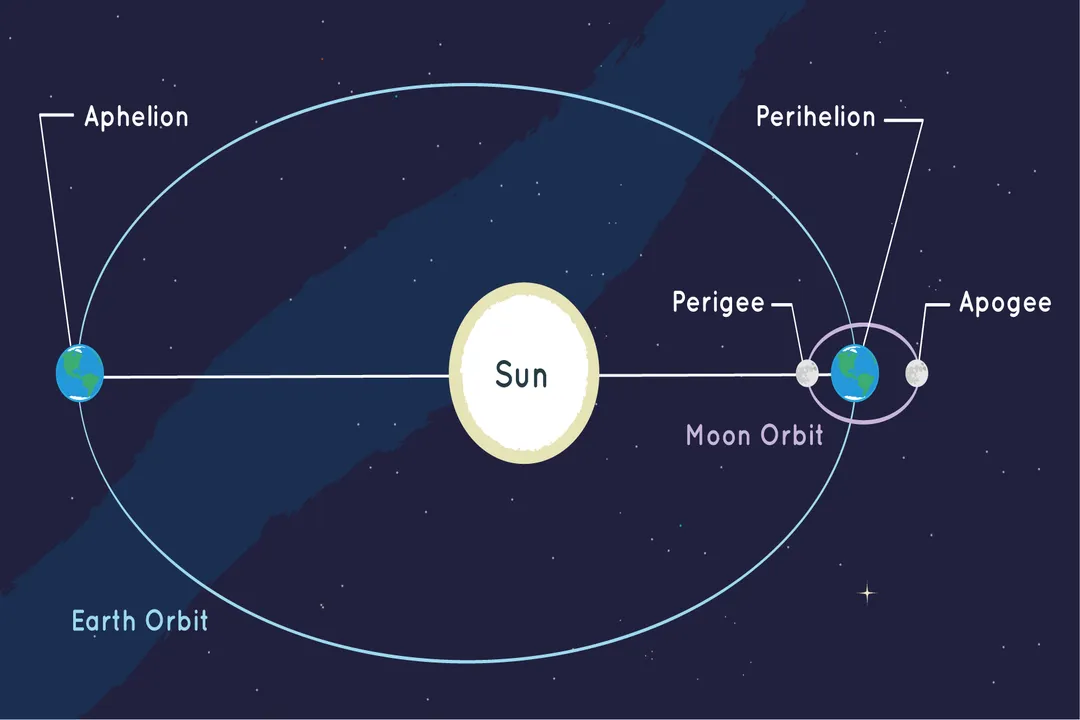
The points of closest and farthest approach have specific names tied to the central body. The closest point is called perihelion when orbiting the Sun, or perigee when orbiting Earth. [1][5][9] The farthest point is aphelion (Sun) or apogee (Earth). [1][5] This continuous variation in speed is a defining characteristic of any path that is an eccentric path or eccentric orbit. [3]
It is interesting to consider the implications of this varying speed on spacecraft navigation. When planning missions to, say, Mars, which has a moderately higher eccentricity than Earth, the timing of engine burns becomes critical. To raise an orbit's altitude (or move to a farther orbit), the most efficient burn occurs when the spacecraft is already at its highest point (aphelion in that transfer ellipse), accelerating just enough to circularize the orbit at that new, higher distance. [7] Conversely, the fastest speed, reached at perihelion, is the ideal point to apply a braking burn if the goal is to drop into a lower orbit. The path is not just an alternative name; it dictates the timing of every energetic maneuver. [7]
# Third Law Period
The third mathematical relationship Kepler derived links the orbital period (), the time it takes for one complete revolution, to the size of the ellipse. [2] Specifically, Kepler's Third Law relates the square of the orbital period () to the cube of the semi-major axis (). [2][4] The semi-major axis is half the length of the longest diameter of the ellipse. [5]
The relationship is expressed in a proportionality:
Here, is the gravitational constant and is the mass of the central body (or more accurately, the sum of the masses of both bodies, though the central mass is usually dominant). [2][4] A significant point to note, which derives from this formula, is that for a given semi-major axis, the orbital period is independent of the eccentricity. [4] This means that two different elliptical paths that share the same longest diameter will take the exact same amount of time to complete one revolution around the central mass.
# Eccentricity Quantified
The concept of eccentricity is central to understanding how elliptical a path is. It serves as the metric distinguishing a near-circle from a significantly flattened oval. [5]
# The Eccentricity Scale
The sources consistently place eccentricity on a scale:
- : Perfect circle.
- : Elliptical orbit. This covers all stable, closed, periodic paths. [2][4]
- : Parabolic trajectory (open path, one-time flyby). [2][4]
- : Hyperbolic trajectory (open path, high-speed flyby). [4]
The differences between planetary eccentricities are stark, even if they all look nearly circular to the naked eye. [5] The Earth’s is very small. [5] This low value means that while we do move slightly faster at perihelion (closest approach in early January) and slower at aphelion (farthest point in early July), [1] the effect on our climate is minor compared to the effect of the Earth’s axial tilt. [4]
Conversely, objects like comets, such as Halley's Comet, exhibit extremely high eccentricities. [4] Their path is dramatically "squashed," meaning they spend a very long time near their aphelion in the cold outer reaches of the system, only to whip incredibly close to the Sun at perihelion at tremendous speed. [4]
# Velocity and Energy Relationships
The elliptical path dictates a specific relationship between velocity and distance, which is encapsulated in the vis-viva equation, which uses the semi-major axis () and the instantaneous distance () between the two bodies: [4]
where is the orbital speed and is the standard gravitational parameter (). [4]
This equation makes it mathematically clear why speed varies. As (the current distance) decreases, the term increases, thus increasing the entire expression under the square root, leading to a higher velocity . [2] When approaches its minimum value (perihelion), is maximized. [2] When approaches its maximum value (aphelion), is minimized. [2]
Furthermore, the specific orbital energy () for a closed, elliptical path is always negative. [4] This negative energy signifies that the system is bound—it requires an input of energy (a propulsion burn) to increase that energy value to zero (a parabolic escape path) or positive (a hyperbolic escape path). [4] The energy is entirely dependent on the semi-major axis, not the eccentricity, as long as the axis remains the same. [4]

# Real World Applications
The concept of an elliptical path is not confined to the Solar System's planets; it describes a wide variety of physical situations governed by an inverse-square law of attraction, which mathematically requires conic sections (circles, ellipses, parabolas, hyperbolas) as solutions. [4]
Satellites orbiting Earth follow elliptical paths, experiencing periodic shifts in altitude. [1] A satellite in a Molniya orbit, often used for high-latitude communications, is specifically designed to be highly elliptical, spending a long time over a specific polar region—an application directly using the geometric properties of the ellipse to maximize coverage time. [4]
Even man-made orbital transfers are based on this geometry. A transfer orbit between two planets, or between Earth and a satellite, is almost always an ellipse designed to efficiently bridge the two bodies' orbital planes or distances. [4]
To provide a comparison to frame the concept of "elliptical path" versus "circular path," consider this: While we frequently discuss launching satellites into Geosynchronous Earth Orbit (GEO), which must be circular for the satellite to remain above a fixed point on the equator, achieving this perfect circularity is the hard part. [1] Many satellites are placed into an initial elliptical orbit and then use multiple, small engine burns over time to slowly "round out" the path to the required circular geometry. [7] This need for constant correction underscores that elliptical is the natural state resulting from initial velocity vectors, while circular is the special, less probable case. [7]
# Path of Motion
Understanding that an elliptical path is often called an elliptic trajectory [3] helps connect the static shape to the dynamic reality of motion. The path is continuous and repeating, tracing a specific curve defined by its foci. [7]
If you were to trace the path of an object starting from rest and dropping it toward a massive body (ignoring air resistance), the path it takes as it falls and then moves away would trace out a radial elliptic trajectory. [4] While this is technically a degenerate ellipse with a semi-minor axis of zero and an eccentricity of one, it demonstrates how the two-body problem, when initiated from a specific low-energy state (zero initial speed), results in a path conforming to the family of conic sections. [4]
For those engaged in conceptual planning for orbital mechanics, treating the orbit as an oblong path forces an important change in mindset compared to a circular one. In a circle, you only worry about thrust magnitude to change altitude. In an ellipse, thrust must be applied with precise timing relative to position:
- A burn at perihelion (fastest point) raises the aphelion (slowest point).
- A burn at aphelion (slowest point) raises the perihelion.
This manipulation of the two extremes of the ellipse is the core technique for transferring between orbits, making the geometric parameters of the ellipse—the semi-major axis () and eccentricity ()—the key variables in mission design, even when the path itself is just referred to as "the orbit". [4] The alternative name, elliptic orbit, is thus not just a synonym for shape but a shorthand for a specific set of physical rules that govern velocity and energy.
# Conclusion on Names
To summarize the nomenclature surrounding an elliptical path, the most contextually relevant alternatives are elliptic orbit in astrophysics and the pure geometric term ellipse in mathematics. [1][4] While descriptive terms like oval orbit or elongated path accurately convey the visual appearance, they lack the formal precision of the terms derived from Kepler's laws. Whether one calls it a path, an orbit, or a trajectory, the underlying reality is the same: a path bound by gravity, shaped like a squashed circle, with the central mass sitting at one focus, dictating a speed that varies continually between its closest and farthest points. [2][5]
This single mathematical shape, the ellipse, is the natural outcome of gravity acting on an object given a specific initial velocity, making it arguably the most common, yet least perfectly circular, path in the cosmos. [2][5]
#Citations
Elliptic orbit - Wikipedia
Orbits - | The Schools' Observatory
ELLIPTICAL ORBIT Synonyms: 77 Similar Words & Phrases
Elliptical Orbits Definition, Equations & Example - Lesson | Study.com
What is another word for elliptical? - Answers.com
ELI5: What is an elliptical orbit? : r/explainlikeimfive - Reddit
What Is an Orbit? | NASA Space Place – NASA Science for Kids
orbit - English Spelling Dictionary - Spellzone
Elliptical orbit - AP Physics C: Mechanics Key Term - Fiveable