What is the difference between path and orbit?
The path an object takes through space, influenced by fundamental forces like gravity, is a concept familiar even to those who have never studied celestial mechanics. Yet, the terms used to describe this motion—specifically path and orbit—carry distinct, though often overlapping, scientific meanings. Understanding this subtle demarcation reveals a great deal about the nature of motion governed by gravity.
# General Movement
In the broadest sense, any curve traced by an object moving through space under the influence of a force can be called a trajectory or a path. [3] This term is extremely general. For instance, when you throw a baseball, its downward arc toward the ground is its trajectory. [1] It has a clearly identified initial point (your hand) and a final point (the ground). [3]
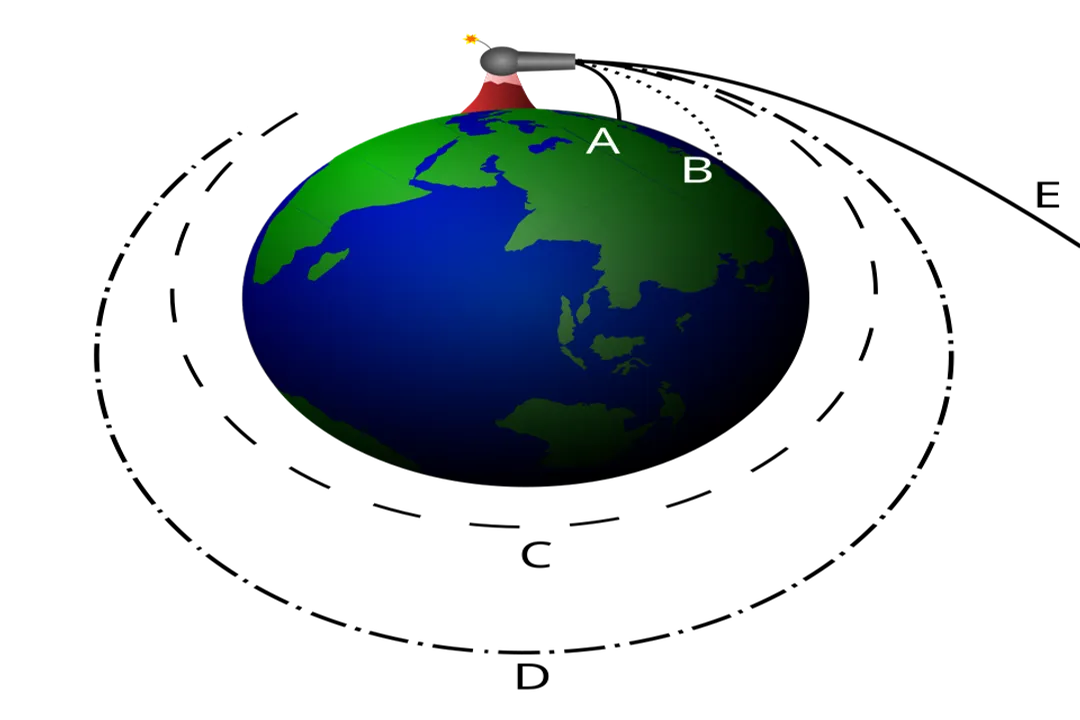
In the context of celestial mechanics, the concept of the path is further illuminated by a thought experiment credited to Isaac Newton: firing a cannonball from a mountaintop. [1] If the initial speed is low, the projectile follows a curved path and strikes the Earth (A or B in the classical illustration). [1] This path is a segment of a curve, interrupted by impact, meaning it is not a stable orbit. The same principles of motion apply, but the path ends prematurely. [1]
# The Nature of Orbit
An orbit, by contrast, typically implies a regular, repeating path that an object takes around another object due to an attracting force, such as gravity. [2][4] An object following an orbit is known as a satellite. [2]
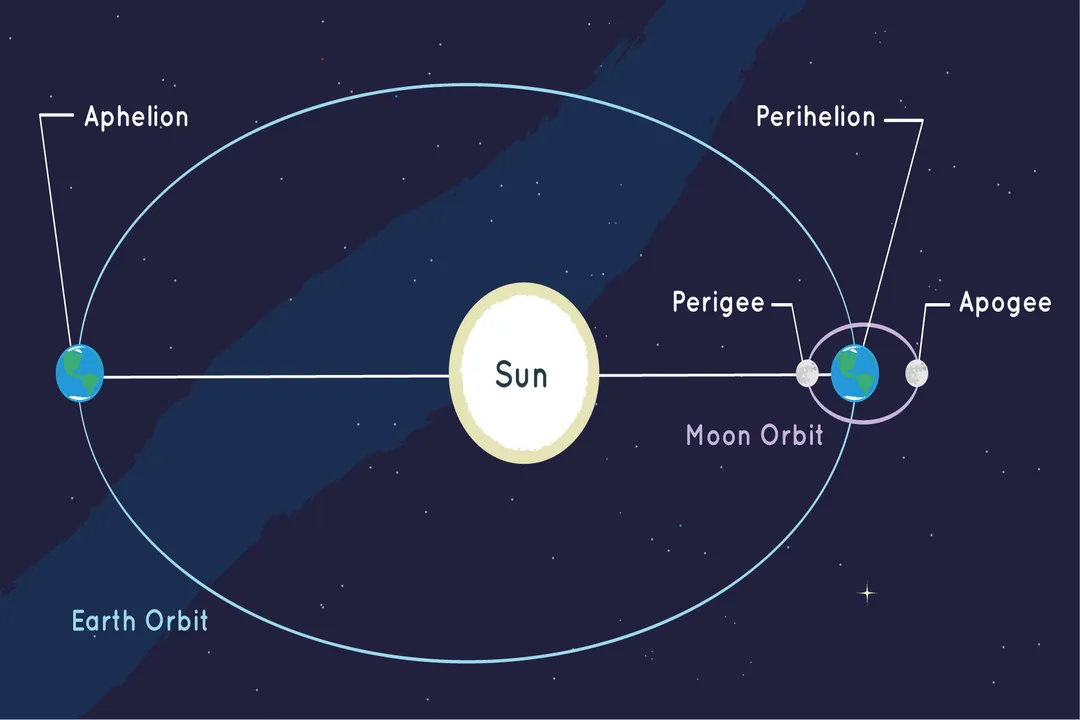
This concept shifts the focus from a finite trajectory to a sustained, predictable loop. In the solar system, planets orbit the Sun, and moons orbit planets. [2][4] For most practical calculations in astronomy, these orbits are closely approximated by an ellipse, with the central body located at one of the ellipse’s foci. [1] A special, simpler case of an elliptical orbit is a circular orbit, where the two foci coincide. [1]
The defining characteristic of an orbit, in its stricter sense, is that the object is gravitationally bound to the central body and avoids collision, due to a balance between its forward momentum and the inward pull of gravity. [2]
# Energy and Conic Sections
The distinction between what we call a "path" and what we term an "orbit" is fundamentally rooted in the total energy of the moving object. When only two bodies interact under gravity, their resulting path will always follow one of the conic sections—ellipse, parabola, or hyperbola. [1]
- Closed Orbits (Elliptical/Circular): These paths have a negative total energy (kinetic energy plus potential energy). [1] Because the energy is negative, the object is gravitationally bound and will repeat its path indefinitely, making it a true, stable orbit. [1]
- Open Paths (Parabolic/Hyperbolic): These paths correspond to trajectories where the total energy is zero (parabolic) or positive (hyperbolic). [1] Objects on these paths are not gravitationally bound in the repeating sense; they either graze the central body and fly away (hyperbolic), or achieve the exact speed required to never return (parabolic escape). [1] While technically a hyperbolic path is a trajectory, it is sometimes still loosely termed a "hyperbolic orbit" in specialized literature. [3]
This energy state is a critical differentiator: A path that is merely a portion of an ellipse that ends in impact is not an orbit; a path that is the complete, closed ellipse is the orbit. [1]
One way to analyze this is to consider the gravitational potential well. To maintain a closed orbit, a satellite must possess a specific range of kinetic energy that is less than the energy needed to escape the well entirely. If a satellite’s speed is boosted slightly past the required velocity for a closed ellipse, its total energy becomes positive, and its path transitions from a closed, repeating ellipse to an open, non-repeating trajectory—a path out into space, even if it briefly curves around the primary body. [1]

# Path vs. Orbit in Context
While the mathematics supports classifying an orbit as a specific type of trajectory, common language and scientific practice maintain separate usages for the two terms, primarily based on periodicity and the object's purpose.
# Trajectory for Projectiles, Orbit for Natural Systems
In many applications, trajectory is the preferred term for paths that are not periodic or are short-lived. [3] This covers everything from a dropped object to a ballistic missile. [3] The very word orbit is often reserved for the motions of natural bodies like planets and moons, which suggests longevity and repetition. [3]
Conversely, in the realm of astrodynamics, the term orbit is meticulously applied to any planned path for a spacecraft, even if the plan involves a one-time escape maneuver. For example, a gravity assist maneuver uses a hyperbolic trajectory to change a spacecraft’s velocity and heading, often resulting in the craft not returning to the primary body. [1] However, mission planners calculate and define this maneuver using the formal set of Keplerian elements, which are the parameters designed to describe orbits. [1]
This difference in naming convention highlights a key difference in operational requirements. For a GPS satellite, its motion must be described by Keplerian elements—eccentricity, semi-major axis, inclination, etc.—because these parameters are stable over time (barring perturbations) and allow ground stations to broadcast its position to users. [1] The GPS system relies on the predictable, orbiting nature of the satellites to function. In contrast, calculating the path of a re-entering space capsule is a finite, initial-value problem designed to model an intersection with the atmosphere, not a long-term, repeating function. [1]
# Stability and Perturbations
A purely theoretical orbit, governed only by the gravity of two perfectly spherical bodies (a two-body problem), will repeat its path exactly and indefinitely. [1] However, real space is messy. Actual paths are affected by perturbations—slight external forces that cause the orbit's parameters to change over time. [1]
For the Earth's Moon, for instance, the Sun’s gravity introduces perturbations that cause apsidal precession (a gradual rotation of the major axis of the ellipse). [1] Even the Earth’s orbit around the Sun is affected by other planets. [1]
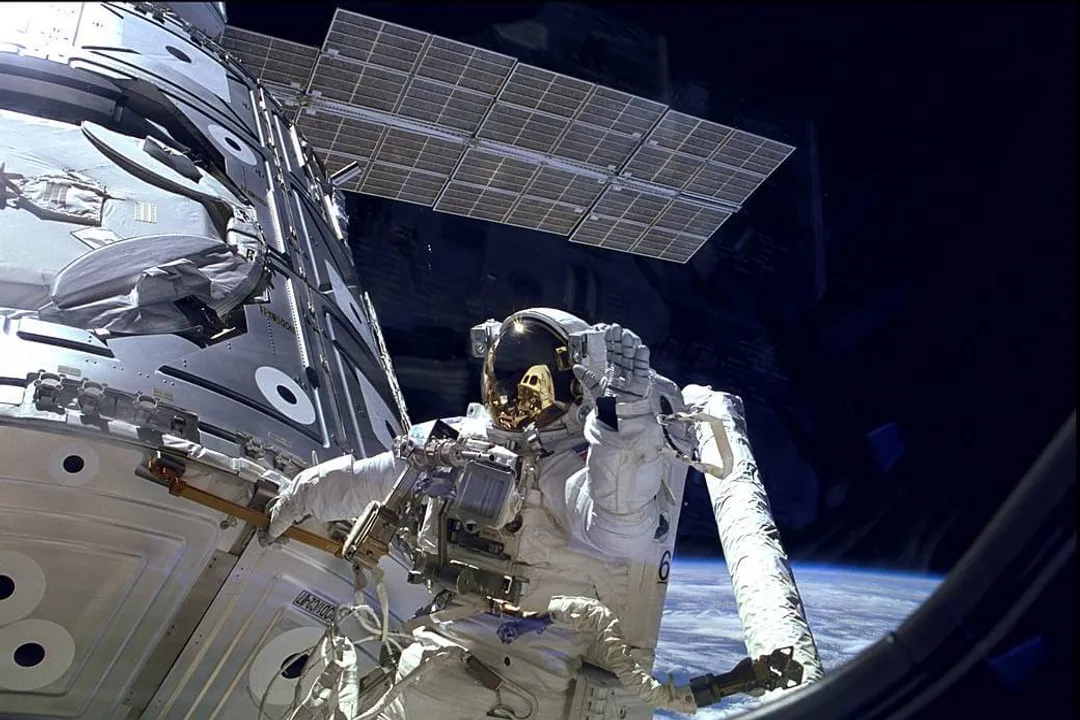
For objects in low Earth orbit, like the International Space Station (ISS), atmospheric drag constantly causes the path to decay, making the orbit less eccentric (more circular) each time it passes through the atmosphere. [1] The ISS must periodically fire its engines for a reboost to correct this decaying path and return it to its desired orbit. [1] In such cases, the path is a series of slightly altered, decaying ellipses, driven toward collision unless actively maintained as a repeating orbit.
Ultimately, while every object travels along a path or trajectory, an orbit signifies a path that is both curved by gravity and, by convention or design, closed, periodic, and self-sustaining over long timescales, or at least is calculated using the stable mathematical definitions derived for such closed motions.
#Citations
What Is an Orbit? | NASA Space Place – NASA Science for Kids
What exactly is an orbit? Is it a circular path or a Is it a 3 dimensional ...
What is the difference between the orbit and path of a satellite? How ...
Orbit - Wikipedia
Is trajectory the same as an orbit? - Physics Stack Exchange
What is an orbit?