What is a debunked theory that the Earth is the center of the universe with the Sun and planets revolving around it?
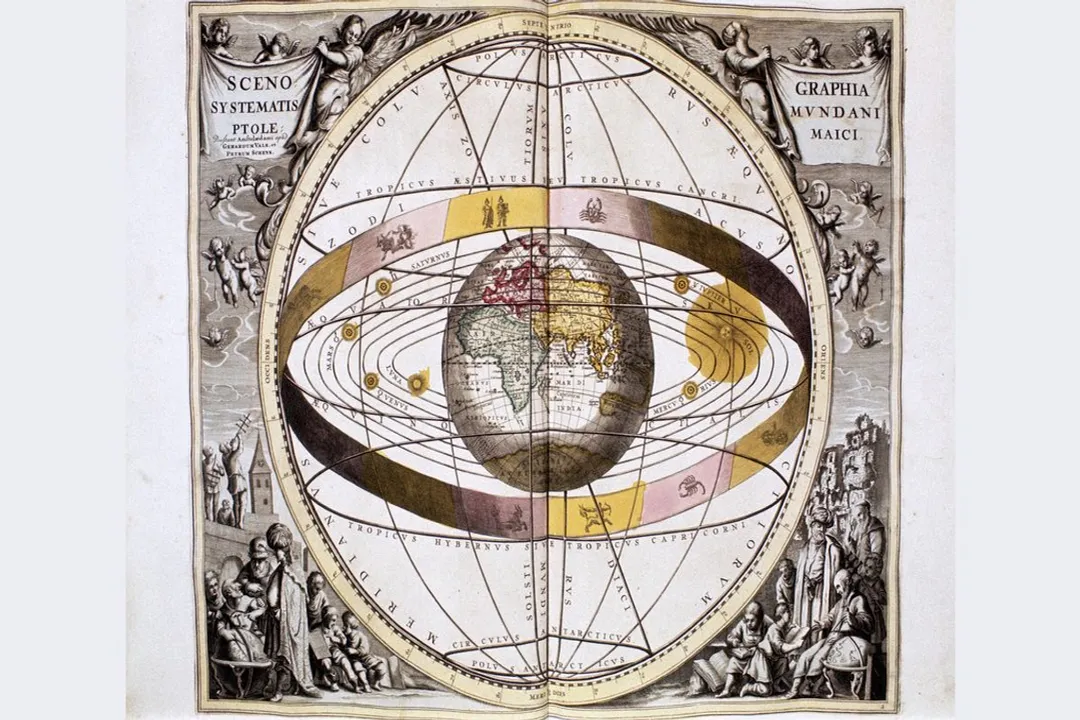
The idea that the Earth sits motionless at the center of creation, with the Sun, Moon, stars, and all the known planets tracing predictable paths around us, is a concept that once held sway over human thought for millennia. This system, known as geocentrism, was not merely a passing fancy; it was a sophisticated philosophical and mathematical explanation for the heavens developed over centuries, rooted in intuitive observation and the dominant paradigms of ancient thinkers like Aristotle and Ptolemy. [1][4][8] However, this grand celestial architecture has been definitively shown to be incorrect, replaced by the heliocentric model, where the Sun occupies the center of our solar system, and the Earth orbits it. [3][4]
# Intuitive Foundations
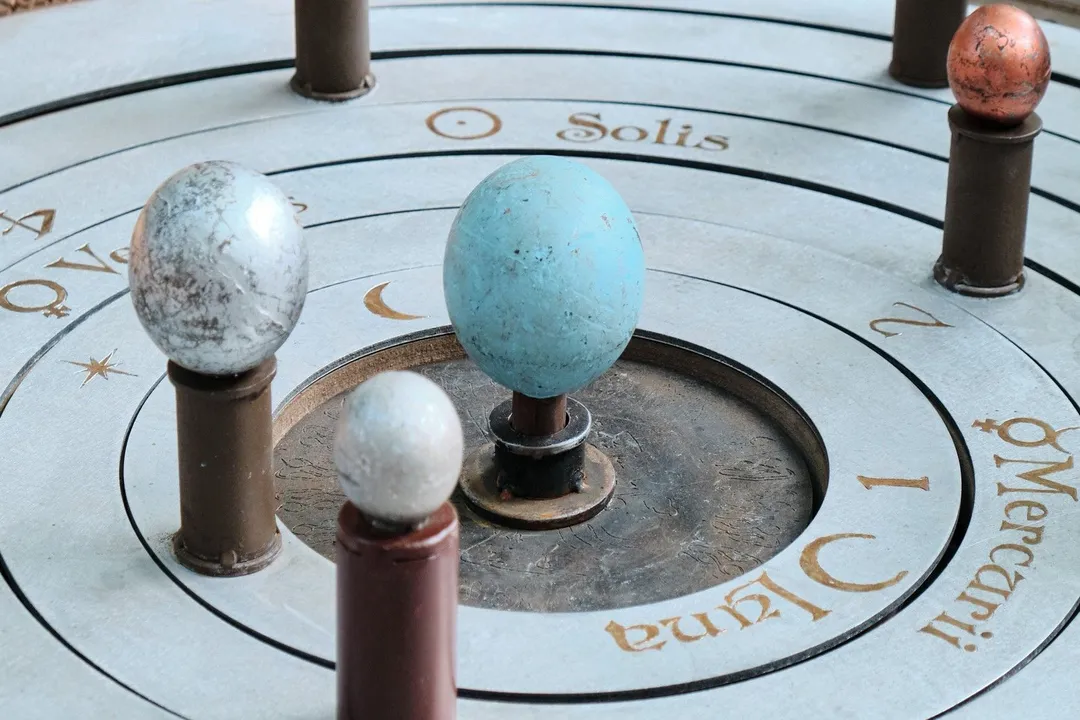
For early observers, the geocentric view was the only one that made sense based on everyday experience. Standing on the ground, we see the Sun rise in the east and set in the west; the Moon does the same; and the distant, seemingly fixed stars also wheel overhead throughout the night. [1] To suggest that the vast Earth was hurtling through space while we felt nothing would have seemed absurd. [9] This model fit neatly with philosophical beliefs that placed humanity and its world in the prime, central position within the cosmos. [8]
The formalized version of this worldview, often credited to the astronomer Claudius Ptolemy in the second century AD, provided an incredibly detailed, though ultimately flawed, map of the sky. [1][8] This Ptolemaic system was impressive because it successfully predicted the positions of the planets for centuries, allowing for consistent calendrical and astrological predictions. [1]
# Celestial Complications
The main challenge for the geocentric model was the retrograde motion of the planets, particularly Mars, Jupiter, and Saturn. [2][3] These planets occasionally appear to slow down in their eastward path across the sky, stop, move backward (westward) for a time, and then resume their forward motion. [1][3] In a simple Earth-centered system, this looping motion is inexplicable. [2]
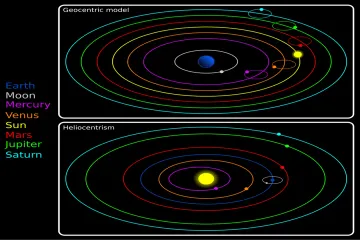
To save the Earth-centered concept, Ptolemy introduced complex mechanisms called epicycles. [1][4] A planet wasn't just orbiting the Earth; it was moving in a small circle (the epicycle), while the center of that small circle moved along a larger circle (the deferent) around the Earth. [4] Imagine a dot tracing a path on a spinning wheel that is itself revolving around a center point—that intricate path is necessary to explain the observed backward loops from a stationary Earth perspective. [1] While this layering of circles allowed for mathematical prediction, it required an ever-increasing number of these secondary orbits to account for new observational data, making the model exceedingly cumbersome and inelegant. [4][5]
# The Sun's Supremacy
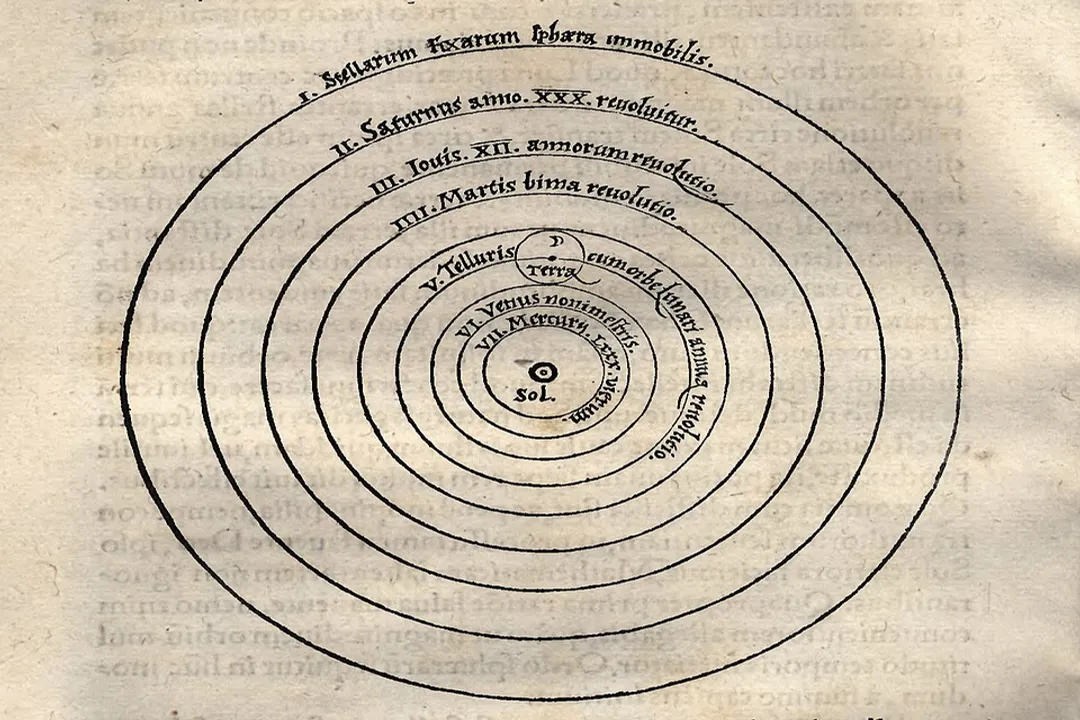
The pivotal shift away from Earth-centered thinking began in earnest with Nicolaus Copernicus in the sixteenth century. [4][8] Copernicus proposed a radically simpler arrangement: the Sun was stationary at the center, and the Earth was just another planet, orbiting the Sun and spinning on its own axis daily. [4][8]
This simple reordering immediately offered a natural explanation for the most vexing problem in the old system: retrograde motion. [2][4] From the heliocentric viewpoint, retrograde motion is an illusion, caused by the faster-moving Earth "overtaking" the slower-moving outer planets in their orbits, much like when you pass a slower car on the highway and it appears to move backward relative to your immediate surroundings. [2][3]
The difference in complexity between the two systems is stark. To model the solar system using the Ptolemaic apparatus required dozens of epicycles, deferents, and equants—a mathematical Rube Goldberg machine. [4] By contrast, the Copernican system required only the planets orbiting the Sun in simple circles (later refined to ellipses by Kepler). [4] This concept of finding truth through mathematical simplicity and elegance is sometimes referred to as the principle of parsimony in science.
# Observational Confirmation
While Copernicus provided the blueprint, the observational evidence needed champions to dismantle entrenched geocentric views. Galileo Galilei became that champion in the early seventeenth century, primarily through his use of the newly developed telescope. [4][8] His telescopic observations provided direct, undeniable evidence that contradicted the core tenets of the Ptolemaic model.
# Moons and Phases
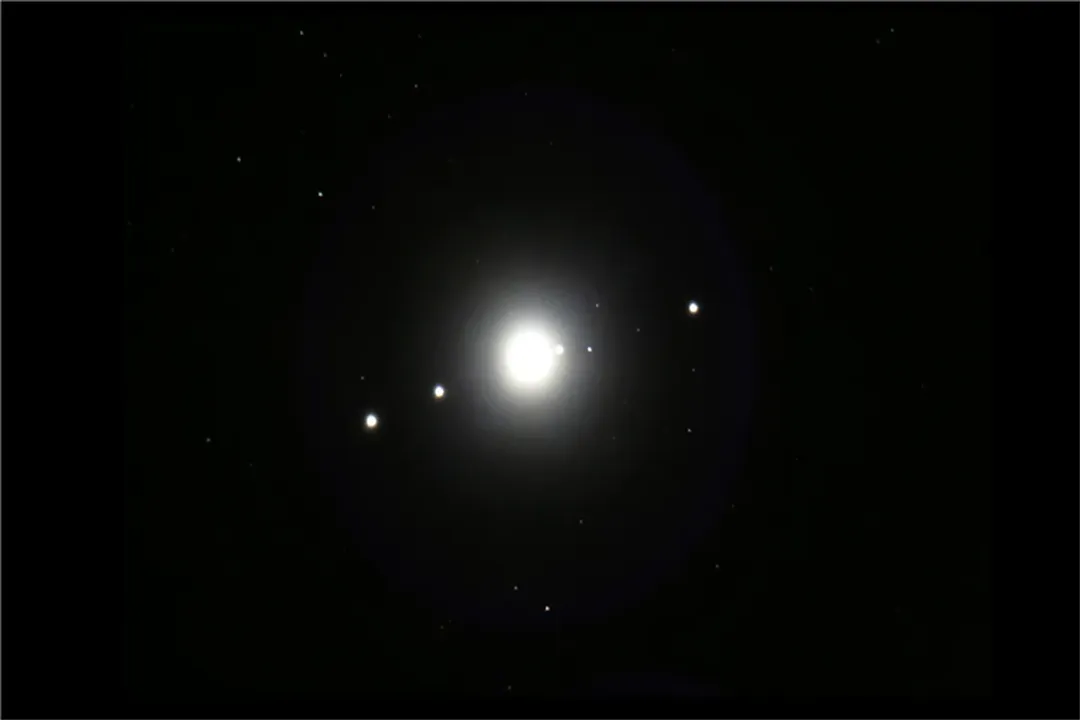
One of Galileo’s most damaging discoveries for geocentrism was observing four moons orbiting Jupiter. [4] If everything in the heavens orbited the Earth, there should be no other centers of revolution besides our own planet. [4] Jupiter clearly demonstrated an independent center of motion, acting as a miniature solar system.
Equally damaging were his observations of Venus. [4] Venus exhibits a full set of phases, from crescent to gibbous to full, similar to our Moon. [4] In a strict geocentric model, where Venus orbits the Earth inside the Sun's orbit, observers would only ever see Venus in crescent or new phases. Seeing Venus as fully illuminated, as Galileo did, proved it must be orbiting the Sun, placing it outside the Earth’s orbit at certain points in its cycle. [4] This was a physical nail in the coffin for the Earth-at-the-center hypothesis.
# The Frame of Reference Argument
Even after overwhelming evidence supported the Sun as the dynamic center of the solar system, some discussions—often philosophical or highly technical—have returned to the nature of reference frames. [9] After all, the laws of physics, such as Newton’s laws of motion, can be written using either a stationary Earth or a stationary Sun as the point of origin. If you perform physics calculations entirely within a closed system, the choice of who is considered "stationary" is, mathematically speaking, arbitrary at the most fundamental level of inertial frames. [9]
If we choose the Earth as the frame, we have to invoke tremendous, fictional forces (like the massive, accelerating epicycles) to explain why objects move as they do, essentially forcing reality to fit our intuitive starting point. [9] If we choose the Sun as the frame, the dynamics simplify dramatically, relying only on the known forces of gravity and inertia. [9]
This distinction is where true scientific utility emerges, and it's a subtle point often missed when simply stating "both frames work". [9] While you can write the equations of motion for a pendulum on Earth using the Earth as the center, the resulting equations are monstrously complex because you have to account for the Earth’s rotation, its orbit around the Sun, and the Sun's orbit around the galaxy—all as apparent forces or accelerations within your chosen frame. [9] When you correctly place the Sun at the origin, these complex, fictitious forces vanish, leaving behind the elegant, universal laws of gravitation and motion that govern the entire cosmos. [9] In physics, the frame that requires the fewest ad hoc, imaginary forces to describe reality accurately is universally accepted as the superior, more physical description.
To illustrate this gulf in descriptive power, consider a simple mapping exercise. If we were to plot the path of Mars for one year from Earth's perspective in the geocentric model, we would need at least one large circle (deferent) and one medium circle (epicycle) to get a rough approximation, and likely many more for precision. [4] If we switch to the heliocentric view, Mars simply traces an ellipse (or a near-circle for simplified modeling) around the Sun. [4] The difference between mapping a chaotic series of nested loops versus a single, smooth path highlights why the heliocentric perspective is not just a preference, but a necessity for an accurate physical model.
# Enduring Legacy and Misconceptions
The transition from geocentrism to heliocentrism was more than just an astronomical correction; it was a profound cultural and philosophical upheaval, often termed the Copernican Revolution. [4][8] It forced humanity to reconsider its place in the universe, moving our world from the privileged center to a mere speck orbiting one of countless stars. [8]
It is worth noting that outside the mainstream scientific consensus, arguments for a form of absolute geocentrism persist, often rooted in interpretations of religious texts or specific physical models that seek to reconcile observations with an unmoving Earth. [7] However, these models are not supported by the cumulative body of evidence gathered through modern physics, astrophysics, and direct observation of other planetary systems and galaxies, which consistently show that we are participants in a dynamic, Sun-centered system. [1][3] The observational evidence amassed since the time of Copernicus—from Newtonian mechanics to general relativity—solidifies the Sun's central role in our local neighborhood. [3] The Earth’s orbit around the Sun is a measured, physical reality, not merely a matter of convenience for the mathematician. [9]
The scientific community, from the earliest proponents of the Sun-centered view to modern cosmologists, relies on the structure established by Copernicus and refined by Kepler and Newton. [3][4] The historical failure of the geocentric theory serves as a powerful lesson: sometimes, the most intuitive explanation is the least accurate, and accepting a more complex, less personally centered reality is the only path to true understanding of the cosmos. The data simply does not support the notion of the Earth being the center around which the rest of the solar system revolves. [1][2]
#Videos
Geocentric vs Heliocentric Model of the Universe - YouTube
#Citations
Geocentric model: The Earth-centered view of the universe | Space
Geocentric model: Easily debunked? : r/AskPhysics - Reddit
Geocentrism vs heliocentrism explained - BBC Sky at Night Magazine
Copernican heliocentrism - Wikipedia
Galileo Was Wrong! (And We All Know It, Somehow)
Geocentric vs Heliocentric Model of the Universe - YouTube
Why the Universe does not revolve around the Earth · Creation.com
Heliocentrism | Research Starters - EBSCO
Q: Is geocentrism really so wrong? Is the Sun being at the “center ...