What happens when a cloud collapses?
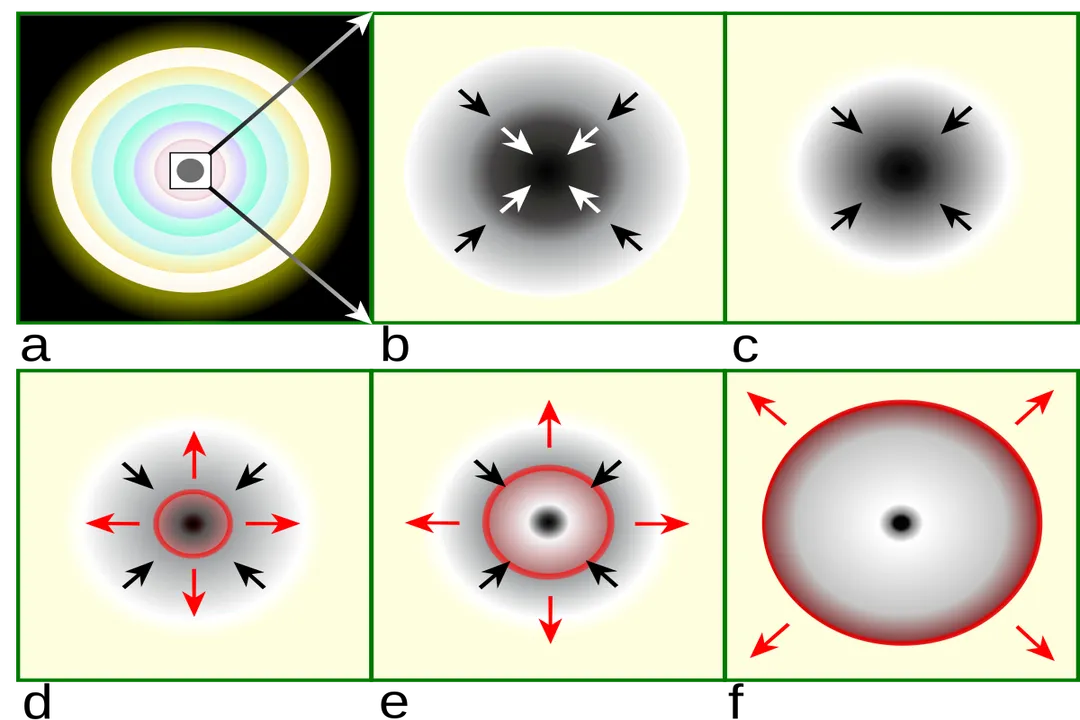
The sudden, dramatic implosion of a vast, cold cloud of gas and dust—a cosmic nursery where stars are born—is fundamentally governed by a struggle between inward gravitational pull and outward pressure forces. [1][3] When the self-gravity of a region within a larger molecular cloud exceeds the internal forces trying to keep it dispersed, the stage is set for gravitational collapse. [3] This process is not instantaneous; it is a dynamic sequence where the scale and mass of the collapsing entity determine the ensuing drama, culminating in the birth of a star or, perhaps, a stellar remnant. [2][4]
# Instability Triggers
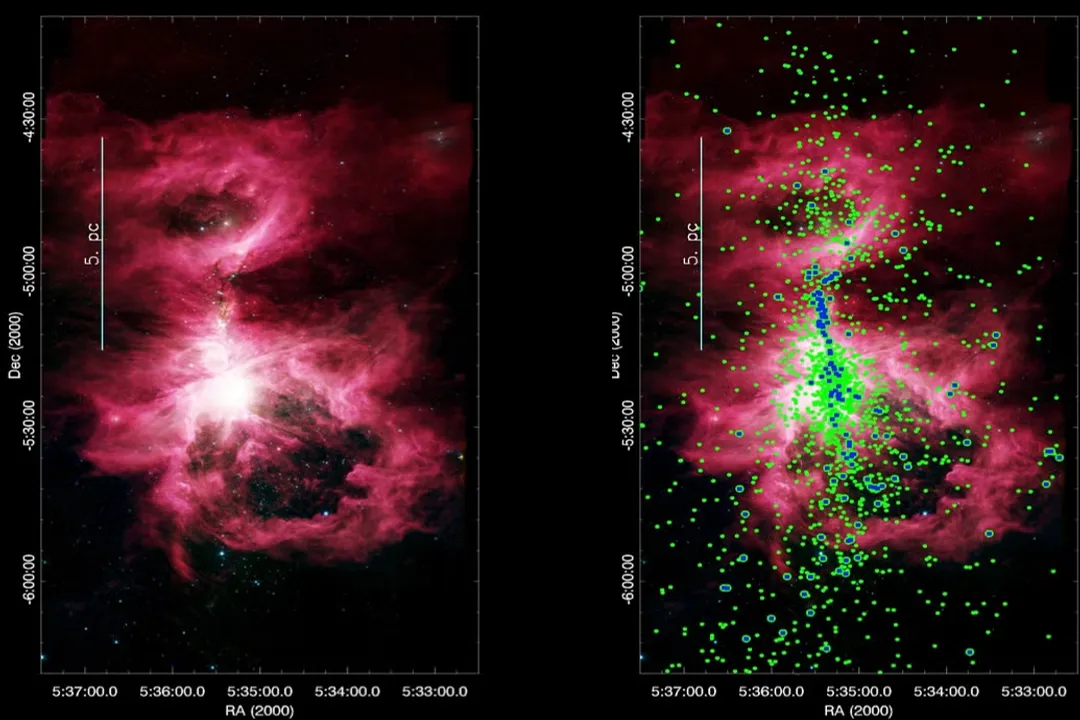
For a cloud to begin collapsing, it must first overcome its equilibrium. A cloud remains stable as long as the pressure gradient force, which pushes outward, balances gravity. [1] The tipping point is often described by the Jeans criterion, which defines the minimum mass—the Jeans mass ()—or the minimum size—the Jeans length ()—a clump must possess for self-gravity to dominate its internal thermal or turbulent pressure. [3]
If a region within the gas cloud is significantly colder or denser than its surroundings, its Jeans mass will be lower, making it susceptible to collapse. [2] External triggers can push a cloud over this threshold. These triggers can range from large-scale phenomena, such as a supernova shockwave sweeping through the interstellar medium, or even the passage of a spiral density wave in a galaxy, compressing the gas to the required critical density. [6][10] Once triggered, the initial collapse phase is often thought of as free-fall collapse, where the timescale is determined by the initial density of the material, assuming no significant opposing forces. [1][3]
# Dynamics of Free-Fall
The free-fall time, , provides a fundamental measure of how quickly gravity can contract a cloud before other forces (like thermal pressure or rotation) can significantly resist. [1] This timescale is inversely proportional to the square root of the initial density (): , where is the gravitational constant. [3] This relationship highlights a critical feature of star formation: denser regions collapse much faster than diffuse ones. [2]
For typical conditions in a cold molecular cloud core—perhaps $10^4$ particles per cubic centimeter—the free-fall time is on the order of hundreds of thousands of years. [2] Contrast this with a region already near stellar density, where collapse happens over mere years or even months. This difference in timescale profoundly impacts the resulting objects and accretion rates. [7]
| Initial Density () | Relative Density Factor | Approximate Free-Fall Time () | Implied Environment |
|---|---|---|---|
| $10^2$ atoms/cm$^3$ | years | Giant Molecular Cloud periphery | |
| $10^4$ atoms/cm$^3$ | years | Dense Cloud Core | |
| $10^8$ atoms/cm$^3$ | years | Pre-stellar core | |
| atoms/cm$^3$ | year | Inner circumstellar disk or very dense filament |
The free-fall model, while simple, provides the baseline for understanding the speed of collapse. [1] However, real astrophysical clouds are far from the idealized static spheres assumed in the basic free-fall calculation. [10]
# Fragmentation and Thermal Effects
As a cloud collapses gravitationally, its potential energy is converted into kinetic energy and heat. This heating is critical because it changes the internal pressure, which resists further collapse. [1] If the cloud can efficiently radiate away this generated heat, the pressure does not rise significantly, and the collapse can continue unimpeded in a process called isothermal collapse. [2]
# The Role of Opacity
The ability to cool is dictated by the cloud's opacity, which is how easily radiation can escape. In the initial, tenuous stages, the cloud is largely transparent to its own thermal radiation, allowing efficient cooling, which keeps the collapse rapid and isothermal. [3][9] As the density increases dramatically, however, the interior gas begins to trap its heat. This occurs when the core becomes opaque to infrared radiation, leading to a rise in internal temperature and pressure. At this point, the collapse transitions from being isothermal to adiabatic. [1] This adiabatic phase slows the infall until the core becomes dense enough to form a hydrostatic object—the protostar—that can resist gravity through thermal pressure. [2]
# Hierarchical Structure Formation
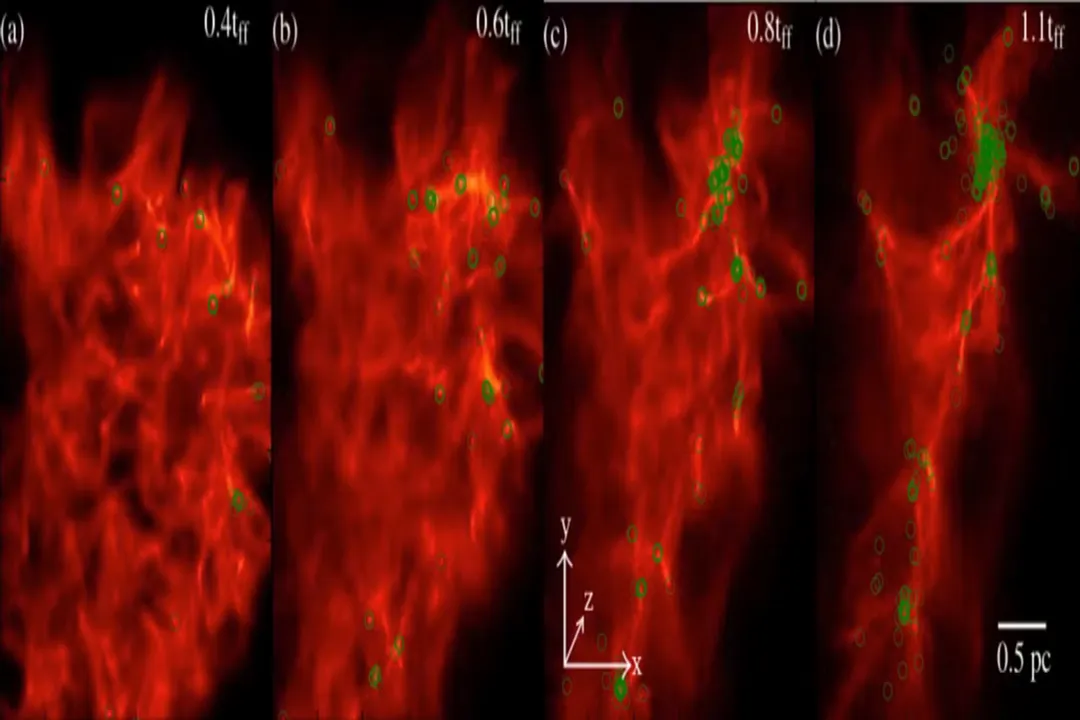
Crucially, the initial collapse rarely leads to a single, monolithic object. Molecular clouds are inherently messy, filled with turbulence and magnetic fields. [10] As the large cloud collapses, the density fluctuations within it grow, leading to a phenomenon called fragmentation. [6] Regions that cross their local Jeans limit begin collapsing independently, leading to the formation of many dense cores within the larger structure. [7]
This process is hierarchical: a large structure collapses, fragments into smaller collapsing cores, and those cores, in turn, may fragment further if the conditions allow. [6][9] This explains why stars are almost always found in clusters or associations, rather than isolated single births.
An interesting analytical consideration arises when comparing the idealized with timescales influenced by turbulence. While the classical free-fall time sets a lower bound, the presence of strong, large-scale turbulence—which can be a source of initial support—actually delays the collapse in many regions, causing the effective collapse time for the whole structure to be longer than the minimum calculated for the densest point. [6] Turbulence acts as a temporary pressure support until it dissipates or flows into the central object. [10]

# Shaping the Collapse
The geometry of the resulting structure is a major topic of study, particularly when considering whether the collapse yields a single spherical star or a more complex, elongated object. [5]
# Spherical vs. Elliptical Outcomes
If a cloud core were perfectly uniform, non-rotating, and unaffected by external forces, it would collapse almost perfectly spherically toward its center of mass. [1] However, astronomical clouds possess angular momentum due to their initial rotation and the rotation of their parent galaxies. [2][5]
As the cloud collapses, this angular momentum must be conserved, which forces the cloud to flatten perpendicular to its axis of rotation. [3] This flattening is what generates the characteristic disk structure seen around young stars. [2][4] If the initial collapse is dominated by high levels of turbulence that effectively "stir up" the core and distribute the angular momentum outward relatively evenly, the collapse can still lead to a relatively spherical protostar, provided the turbulence dissipates before significant flattening occurs. [5][10]
Conversely, if the initial rotation rate is significant, or if the angular momentum is concentrated in the central region, the result is a highly flattened structure, like a disk or perhaps an elliptical structure in an intermediate stage. [5] The complexity arises because rotationally-supported objects cannot collapse to a point; they reach a state of centrifugal equilibrium, forming a disk rather than a point mass. [1] The observed shapes are a direct readout of the balance between gravity and the initial distribution of rotational energy. [5]
# Dealing with Spin
Angular momentum management is arguably the most difficult problem in the late stages of collapse before ignition. [2] Simply having angular momentum is not enough; the system must find a way to shed it to contract further.
A key mechanism implied in the study of these systems is magnetic braking. [6] Magnetic fields threading the collapsing cloud core can couple the rapidly rotating inner region to the slower-moving outer envelope. As the inner region spins faster, it twists the magnetic field lines, transferring some of the angular momentum outward to the surrounding material. [6] This transfer allows the central mass to contract deeper toward the star-forming state. If magnetic braking is ineffective—perhaps because the initial cloud was too poorly ionized or the field too weak to couple effectively—the central object might stall at a larger radius, unable to contract further due to rotational support, potentially resulting in a wide binary system or a brown dwarf rather than a main-sequence star. [2][4]
A key insight here, often overlooked in simplified models, is the efficiency of magnetic angular momentum removal. If the mass accretion rate () is high, the central object accretes mass faster than the magnetic field can effectively torque away the angular momentum of the infalling material. This mismatch means that for very rapid star formation events, the magnetic torque may be overwhelmed, forcing the formation of a wider disk or binary pair simply because the gas can’t shed its spin fast enough to settle into a tight Keplerian orbit close to the nascent star. [6]
# The Stellar Endpoint
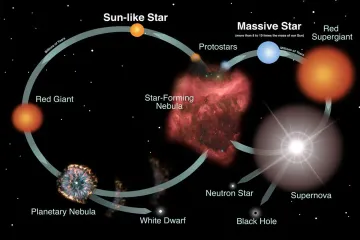
The ultimate fate of the collapsing cloud material is the formation of a star—a celestial body hot and massive enough to ignite sustained thermonuclear fusion in its core. [4] This occurs after the initial gravitational collapse has halted when the core pressure balances gravity, forming a protostar. [2]
The process involves several distinct, observable phases once the core becomes opaque:
- Core Formation: The first hydrostatic core forms when thermal pressure halts the rapid free-fall. [1][9]
- Accretion Phase: The protostar continues to grow by drawing in material from the surrounding envelope and the accretion disk. This phase is characterized by intense luminosity powered by gravitational energy released as material falls onto the stellar surface. [2]
- Bipolar Outflows: The intense accretion often triggers powerful outflows or jets emanating from the poles of the nascent star, often collimated by the magnetic field lines anchored in the inner disk. [8] These outflows are vital because they help clear away the remaining infalling envelope material, effectively setting a limit on the final mass of the star. [2]
If the mass that accumulates in the center is too small—less than about $0.08$ times the mass of the Sun—the core will never reach the temperature and pressure necessary for hydrogen fusion to ignite. In this case, the collapse ends with the formation of a brown dwarf, an object that cools down over time, effectively being a failed star. [4] The mass threshold for successful hydrogen burning is a direct consequence of the thermal dynamics established during the final stages of the collapse. [1]
# Initial Conditions Dictate Fate
The entire narrative of cloud collapse, from the initial instability to the final stellar type, hinges on the initial conditions of the molecular cloud fragment. [10] We can summarize the influence of these initial physical states:
| Initial Condition Parameter | Influence on Collapse | Effect on Final Object |
|---|---|---|
| Density () | Determines the free-fall timescale () | Faster collapse leads to higher accretion rates and potential for instability |
| Temperature () | Dictates initial pressure support | Lower makes the Jeans Mass smaller, encouraging fragmentation |
| Angular Momentum () | Resisted by centrifugal force | Determines the final radius of the central object and disk size |
| Magnetic Field Strength () | Provides magnetic pressure and torque | Controls the efficiency of angular momentum removal (magnetic braking) |
| Turbulence Level | Acts as temporary pressure support | Can delay collapse or homogenize the system, affecting final fragmentation patterns |
Understanding how these parameters interact is what separates simple models from realistic simulations. [6] For instance, if we consider a relatively "quiet" core—one with low initial turbulence and moderate rotation—the collapse proceeds relatively smoothly toward a single star. If we compare this to a highly turbulent core, the turbulence first needs to decay, potentially delaying the formation of the protostar by millions of years, but the resulting collapse might be more centrally concentrated once the turbulent energy has been converted into thermal energy or carried away by jets. [10]
To illustrate the importance of early dynamics, consider two identical spherical clouds, both exceeding the Jeans mass. Cloud A has a uniform initial magnetic field, while Cloud B has a field that is highly tangled and weak in the central volume. Cloud A, benefiting from organized magnetic braking, might efficiently shed angular momentum and form a single, small star. Cloud B, however, might form a dense, rapidly spinning central object surrounded by a large, rotationally-supported disk that cannot further contract magnetically, leading to the formation of a binary system where the two components were born from the rapid collapse of that initial massive disk. [5]
In essence, the collapse of a cloud is a competition between gravity, which seeks maximal concentration, and the inherent physical constraints of pressure, rotation, and magnetic fields, which resist that concentration. What we observe as a star, a planet, or even a failed star, is merely the stable configuration reached when the dominant resisting force finally balances the relentless crush of gravity. [3][4] The clouds collapse because gravity wins the initial tug-of-war, but how they collapse—and what they become—is determined by the messy physics hidden within that initial stellar nursery. [1][9]
#Videos
What Is Accretion In Cloud Collapse? - Physics Frontier - YouTube
#Citations
Collapsing Clouds - an overview | ScienceDirect Topics
Gravitational Collapse
Gravitational collapse - Wikipedia
The Outer Planets: A Star is Born
Can the collapse of a gas cloud lead to an elliptical structure?
molecular cloud collapse
In the context of the formation of stars, how is a gravitational collapse ...
What Is Accretion In Cloud Collapse? - Physics Frontier - YouTube
Chapter 5. Collapse and Fragmentation of Isothermal Clouds - ADS
How do star-forming clouds and star clusters arise? | Lee Hartmann