What gas are clouds made of?
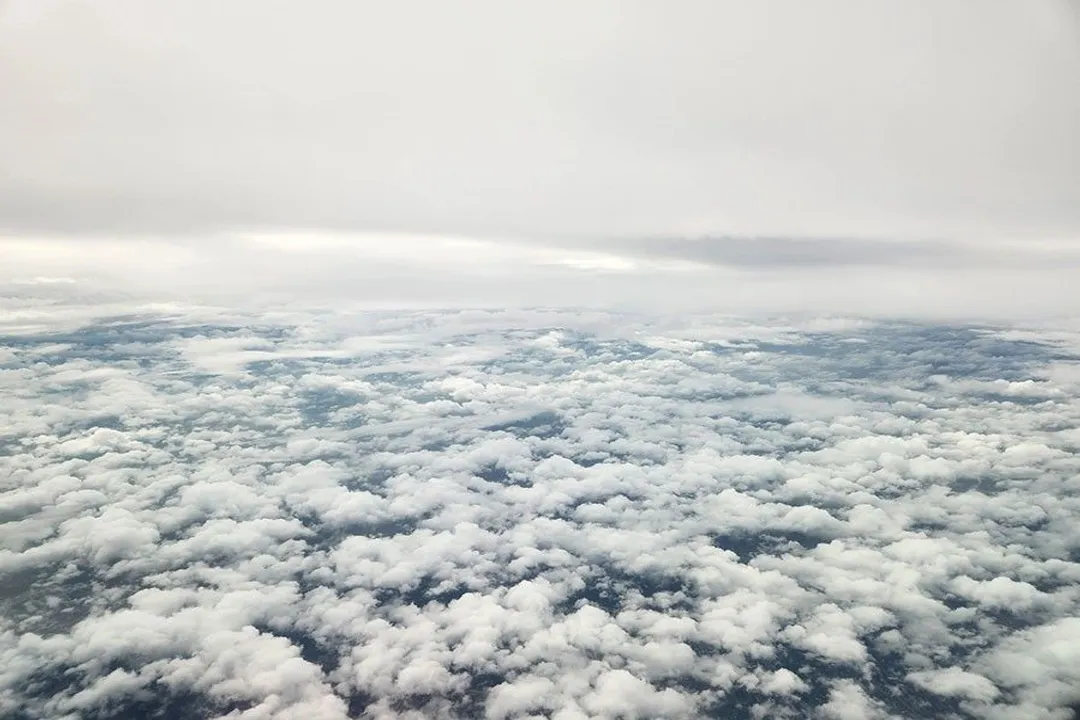
The air we breathe is a gas, and because clouds float so effortlessly high above us, it is easy to assume that the visible puffiness is also just a large, suspended mass of gas. However, this is one of the most common misunderstandings about the sky. The substance we look up at and identify as a cloud is actually not a gas at all; it is composed of liquid water or solid ice. [1][8] The air itself—the surrounding medium—is the gas, composed primarily of nitrogen and oxygen. [1]
# Air Composition
To understand what a cloud is made of, we first need to appreciate what it is not made of. The Earth's atmosphere is a massive blanket of gases, held in place by gravity. [1] This gaseous mixture is overwhelmingly nitrogen, around 78%, and oxygen, about 21%. [1] Argon, carbon dioxide, and trace gases make up the remaining fraction. [1] Water vapor, the gaseous form of water, is always present in this mixture, but its concentration varies widely depending on the location and altitude. [6] When we talk about the "gas" in the sky, we are referring to this mixture of nitrogen, oxygen, and water vapor. [1]
# Visible State
When conditions are right, that invisible water vapor transforms into something we can see: clouds. [2][6] A cloud is fundamentally a visible mass of minute water droplets or tiny ice crystals suspended in the atmosphere. [4][9] Think of it like steam rising from a hot shower; the steam is not the invisible water vapor that left the showerhead, but the condensed water droplets that have cooled enough to become visible. [7]
The critical distinction is that water in its gaseous state—water vapor—is invisible. [6] Once it cools enough to condense, it becomes visible liquid water or solid ice, which defines the cloud structure. [4] Therefore, the cloud itself is a collection of liquid or solid particles floating within the gaseous atmosphere. [1] Clouds are essentially the visible manifestation of atmospheric water in its non-gaseous form. [4]
# Formation Sequence
The birth of a cloud follows a reliable, multi-step process involving cooling and nucleation. [6] It begins with invisible water vapor rising into the atmosphere. [2] As this air parcel ascends, it encounters lower atmospheric pressure, causing it to expand and cool down. [6] This cooling process is essential because cooler air cannot hold as much water vapor as warmer air. [2][6]
When the air cools past a specific temperature, known as the dew point, the water vapor reaches its saturation point. [6] At this point, the water vapor must change its state from gas to liquid or solid. [2] However, pure water vapor doesn't just spontaneously form a droplet; it needs a surface to condense upon. [9] This brings us to the microscopic components essential for cloud visibility: aerosols. [9]
# Necessary Particles
These surfaces are provided by aerosols, which are microscopic solid or liquid particles suspended in the air. [9] These can include dust, pollen, salt from the ocean, or even tiny pollutants. [9] These particles act as cloud condensation nuclei (CCN). [6] The water vapor attaches itself to these nuclei, beginning the condensation process. [9] Millions of these tiny droplets or crystals clinging to aerosols cluster together to form the visible structure we identify as a cloud. [2][4]
If you observe a cloud forming on a cool, humid morning, you are watching billions of water vapor molecules transitioning from an invisible gas state to tiny, visible liquid spheres clinging to dust particles you cannot see. [9]
# Droplet Scale
The reason clouds remain aloft, seemingly defying gravity, is directly related to the size of these water components. [3] Even though the droplets are composed of liquid water—which is denser than air—they are exceptionally small. [3] A typical cloud droplet is incredibly minute, often only about $0.02$ millimeters in diameter. [4]
Because they are so small, these droplets have a very low mass and a high surface-area-to-volume ratio. [3] This allows them to remain suspended by the slightest upward air currents, such as rising thermals or gentle turbulence. [3] It is not that the cloud is a lighter-than-air gas; it’s that the liquid components are so small they are easily supported by the air motion, much like fine dust particles can hang in a sunbeam. [3] If these tiny droplets were to combine and grow significantly larger, their collective weight would overcome the air resistance, and they would fall as precipitation (rain or snow). [4]
# Altitude Influence
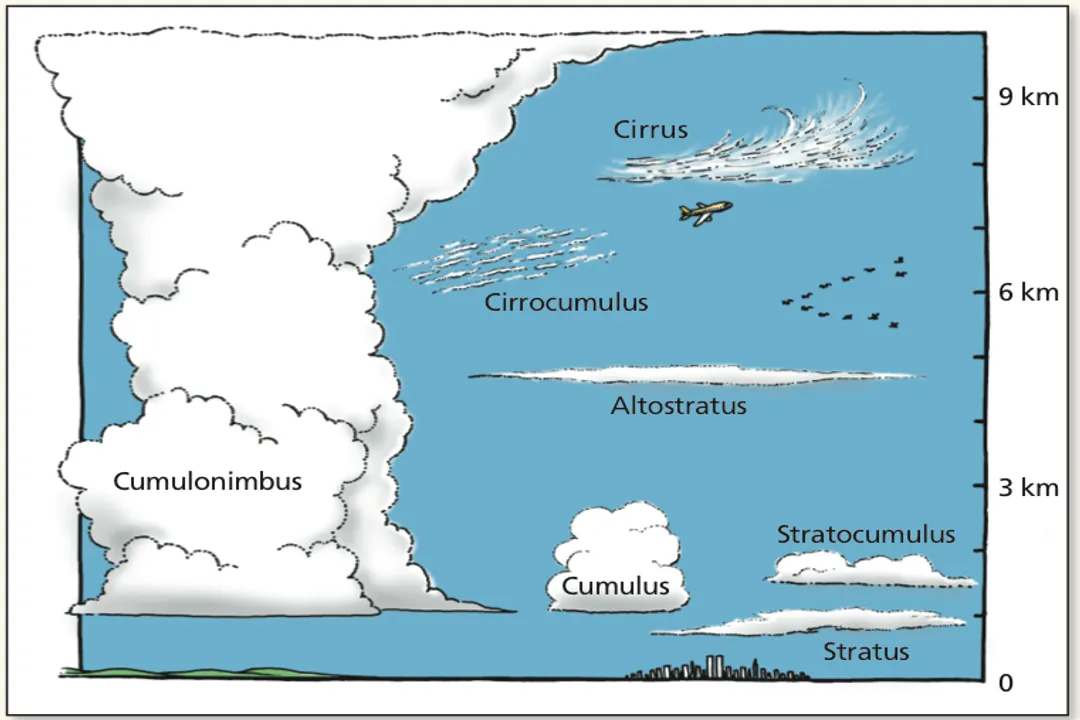
The temperature at which the cloud forms dictates whether it is made of liquid or solid water. [4]
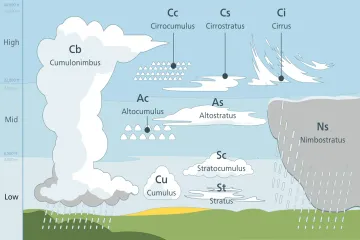
| Cloud Type Classification | Typical Altitude Range | Primary Composition |
|---|---|---|
| Low-level clouds (Stratus, Cumulus) | Below 6,500 feet | Liquid water droplets |
| Mid-level clouds (Altostratus, Altocumulus) | 6,500 to 20,000 feet | Mixed water droplets and ice crystals |
| High-level clouds (Cirrus) | Above 20,000 feet | Primarily tiny ice crystals (solid) |
High-altitude clouds, such as the wispy cirrus clouds, form where temperatures are well below freezing, meaning they consist almost entirely of ice crystals. [4] Lower, fluffier cumulus clouds are usually composed of liquid water droplets, though they may contain a mix depending on the temperature profile within the cloud structure. [4] Even within a cloud composed of liquid water, the surrounding medium—the air between the droplets—remains the same gaseous mixture of nitrogen, oxygen, and water vapor. [1]
# Contrasting Space Clouds
When discussing clouds, it is helpful to draw a contrast with astronomical phenomena, as the term "cloud" is used in very different contexts elsewhere in the universe. [5] On Earth, clouds are atmospheric water constructs; however, in space, scientists refer to molecular clouds. [5] These are vast interstellar clouds of gas, primarily hydrogen, and dust found in the space between stars. [5] They are incredibly diffuse, often containing only a few hundred molecules per cubic centimeter, compared to the trillions of molecules in a cubic centimeter of Earth's atmosphere at sea level. [5] While both involve collections of matter suspended in space, the Earth’s clouds are dense concentrations of condensed water, whereas molecular clouds are extremely sparse collections of gas and dust in the vacuum of space. [5]
# Buoyancy vs. Suspension
It can be tempting to think of a cloud as being "buoyant" like a helium balloon, suggesting the cloud material itself is lighter than the surrounding air. [3] This is incorrect. The gaseous component of the cloud—the air it is embedded in—has the same density profile as the air around it. [3] The reason the cloud doesn't immediately fall is due to the physics of small particle suspension, not gaseous buoyancy.
Consider a single liquid droplet of water. Air must push against it to prevent it from falling. For a large raindrop, the downward pull of gravity easily overcomes the drag force provided by the surrounding air, causing it to fall quickly. [4] For the microscopic cloud droplet, however, the opposing forces are perfectly balanced: the minute gravitational pull is counteracted by the air resistance acting on its extremely small surface area. [3] This dynamic equilibrium is maintained as long as the air currents are not actively sinking. [3] If you could isolate a single cloud droplet and place it in a vacuum chamber at sea level, it would fall instantly, just like any other piece of water, confirming it is not inherently a gas or lighter than air. This highlights that the visibility comes from condensation, but the suspension comes from microscopic scale physics rather than the material being in a gaseous state.
# Observing Condensation Thresholds
Understanding the composition helps us predict when and where clouds will form, which can be a practical observation skill. The transition from invisible water vapor (a gas) to visible liquid droplets (a cloud) happens very precisely at the dew point for a given pressure.
Here is a practical way to think about this when observing the weather: If you are hiking up a mountain, the temperature is dropping, and you notice the air becoming misty, you are crossing the local dew point boundary. [6] Before that point, the water in the air was invisible gas. Once you cross it, that same amount of water has condensed onto aerosols, and you are now inside a cloud. [9] For instance, if the air at the base of the mountain is and holding a high amount of water vapor, but at $1,500$ meters it cools to (the dew point), a cloud forms. If the dew point were slightly lower, say , the cloud base would form higher up, leaving the lower slopes dry. This sensitivity means that relatively small local changes in atmospheric temperature, driven by elevation or daytime heating, are the direct trigger for turning invisible gas into visible water suspended in the air. [2][6] This is why the base of cumulus clouds often appears flat—it marks the specific, uniform altitude where the lifting air parcels reached their saturation point simultaneously. [6]
# Distinguishing Gas from Liquid
It is vital to remember that clouds are not uniform mixtures where gas and liquid exist happily side-by-side in equilibrium in the same way steam mixes with air before cooling. Instead, the cloud is the liquid/solid component suspended within the atmosphere, which is the gas. [1] The gas is the medium; the cloud is the suspended matter. [4] The air contains water vapor, which is the potential building block for the cloud. When that potential is realized through cooling and condensation, the cloud material is formed. [2] If you were to somehow "squeeze" a cloud down until all the droplets merged into one large volume of water, the resulting mass would be incredibly small compared to the vast volume of atmosphere it currently occupies. Scientists estimate that even a thick cloud only contains about $0.5$ grams of liquid water per cubic meter of air volume on average. [4] The remaining $99.999%$ of that cubic meter is the surrounding nitrogen, oxygen, and other gases. [1] This minute water content explains why it takes significant aggregation (precipitation) for the water to overcome air resistance and fall. [4]
#Videos
NASA Spotlite: What are clouds made of? - YouTube
Related Questions
#Citations
Are clouds a gas, liquid, and/or solid? - Earth Science Stack Exchange
How Do Clouds Form? - NASA Science
How do clouds stay gaseous despite the fact that they are cold?
What Are Clouds? | Smithsonian Science Education Center
Molecular cloud - Wikipedia
How Do Clouds Form? - Let's Talk Science
NASA Spotlite: What are clouds made of? - YouTube
Are clouds a liquid or a gas? - Quora
DOE Explains...Clouds and Aerosols - Department of Energy