What are white clouds made of?
The visible mass floating across the sky, often admired for its shape or admired as a harbinger of rain, is not made of gas, despite being suspended within the gaseous atmosphere. Instead, white clouds are concrete, tangible collections of incredibly tiny particles: either liquid water droplets or ice crystals held aloft in the air. The surrounding air itself is transparent because the molecules are too small to effectively scatter visible light, but when water vapor condenses into these larger structures, they interact with sunlight to become visible, and most commonly, white.
# Visibles Particles
The fundamental building blocks of any cloud are condensed water. These are not the water vapor, which is an invisible gas, but rather the resulting liquid or solid phase. The exact composition depends heavily on the altitude and temperature of the air mass forming the cloud. Clouds floating lower in the atmosphere, like cumulus or stratus formations, are generally composed of liquid water droplets. These droplets are incredibly small, typically measuring between $0.0002$ and $0.01$ millimeters in diameter. For comparison, this is far smaller than a typical grain of sand.
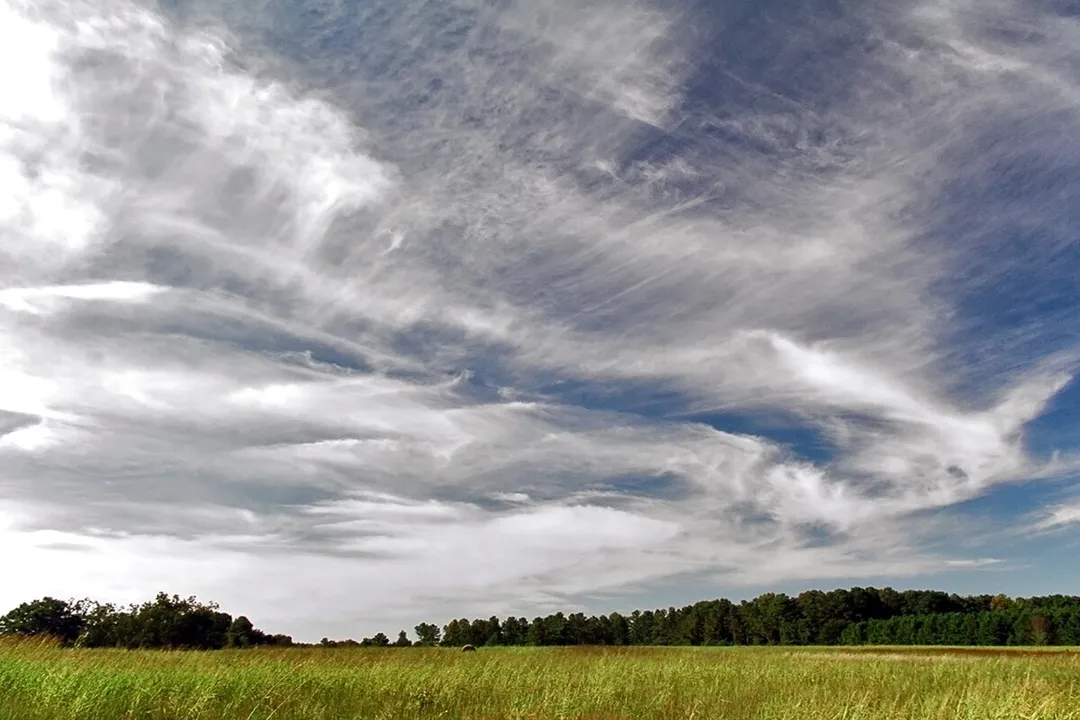
However, when we look up at the highest reaches of the troposphere, we encounter clouds made purely of frozen water. For instance, the thin, wispy cirrus clouds are composed entirely of minute ice crystals. Whether liquid or solid, the collective mass of these suspended particles is what creates the visible cloud structure.
It is this physical state—liquid or solid water—that separates the cloud from the air around it. The air, which is a mixture of gases like nitrogen and oxygen, is transparent because its constituent molecules are much smaller than the wavelengths of visible light, meaning they scatter light in a way that makes the sky appear blue, but the medium itself appear clear.
# Condensation Nuclei
For water vapor, which is naturally present but invisible, to turn into the visible droplets or crystals that form a cloud, it needs a surface upon which to condense. This process is not spontaneous in clean air; it requires microscopic airborne particles often referred to as condensation nuclei.
These nuclei are the seeds around which the water gathers. They are varied in origin, coming from natural sources like dust and sea salt flung up from the ocean, or from human activity, such as smoke or pollutants. Water vapor cools as it rises in the atmosphere, or as it mixes with cooler air masses, reaching its saturation point. Once saturation is reached, the water molecules adhere to these microscopic solid or liquid particles suspended in the air, growing larger until they form a detectable, visible droplet or crystal.
Think of it this way: water vapor needs an anchor to transition from gas to liquid or solid in the atmosphere. Without these nuclei, the air could hold far more invisible water vapor than it normally does, and cloud formation would be a much rarer event, even when humidity is high.
# Appearance Physics
The reason these water-filled clouds appear bright white to our eyes, rather than clear like the water in a glass, lies in how the water droplets interact with sunlight, which contains all the colors of the spectrum.
The process responsible is known as Mie scattering. Mie scattering occurs when the scattering particles—in this case, the water droplets or ice crystals—are roughly the same size as or larger than the wavelength of the light hitting them. Since cloud droplets are generally larger than the wavelengths of visible light (which range from about $400$ to $700$ nanometers), they scatter all wavelengths of visible light equally.
When all the colors of the spectrum—red, orange, yellow, green, blue, indigo, and violet—are scattered back toward an observer with equal intensity, the human eye perceives the resulting mix as white. This is a fundamental difference from why the sky is blue. The minuscule gas molecules in the atmosphere cause Rayleigh scattering, which preferentially scatters shorter, blue wavelengths far more effectively than longer, red wavelengths, making the sky appear blue. In contrast, the larger water particles in a cloud scatter everything uniformly, resulting in white.
It is interesting to consider how small variations in this scattering affect our perception. If you were to look at a cloud of extremely small droplets, theoretically, the scattering might lean slightly toward Rayleigh-like effects, but in typical cloud conditions, the dominance of Mie scattering ensures the white appearance. An excellent real-world comparison is fog or mist. Fog is essentially a cloud at ground level, composed of water droplets, and it is universally perceived as white or gray because the physics of light interaction is identical to that occurring high in the sky.
# Cloud Types
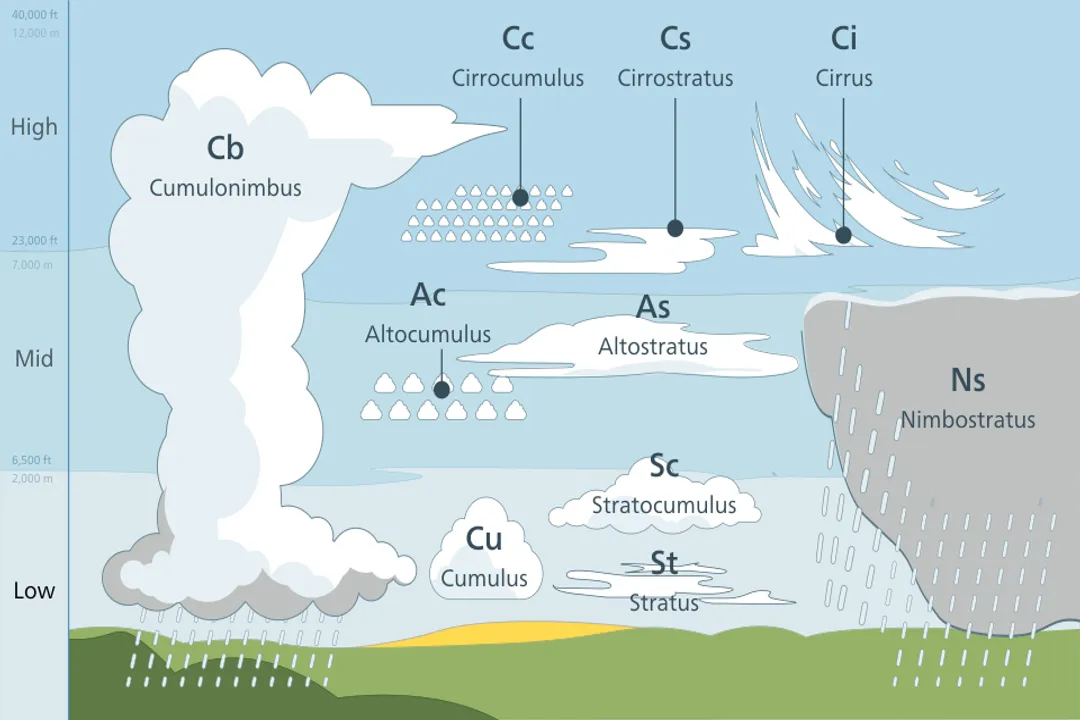
The atmosphere supports several major categories of clouds, often classified by their altitude and appearance, which correlates directly with their composition. Understanding these categories helps explain why a high, wispy cloud looks vastly different from a low, dense storm cloud:
| Cloud Type Category | Approximate Altitude | Primary Composition | Appearance Notes |
|---|---|---|---|
| High Clouds | Above 20,000 feet | Ice Crystals | Thin, white, feathery |
| Mid Clouds | 6,500 to 20,000 feet | Water Droplets and/or Ice | Varied, often layered or patchy |
| Low Clouds | Below 6,500 feet | Water Droplets | Near the surface, often uniform layers |
| Vertical Clouds | Span multiple layers | Water Droplets/Ice Crystals | Puffy, tower-like, associated with storms |
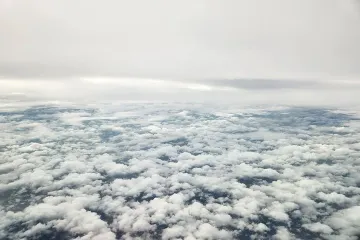
As mentioned, cirrus clouds are the classic example of high-altitude clouds, characterized by their delicate, hair-like structure, which stems directly from them being composed solely of ice crystals. Their very thin nature means sunlight passes through them easily, making them appear bright white against a deep blue sky. Conversely, the fluffy cumulus clouds that build up on a sunny day are primarily liquid water droplets and have distinct, defined edges due to rising air currents.
# Density and Darkness
If clouds are made of water droplets scattering all light equally to appear white, why do storm clouds look gray or even black from below? The answer lies not in a change in the material—they are still made of water droplets or ice crystals—but in the thickness and density of the cloud layer.
When a cloud is very thick or deep, the sunlight entering the top surface is scattered repeatedly by the sheer volume of droplets it encounters. As the light travels downward through the cloud, much of it gets scattered up and sideways before it can reach the base of the cloud where an observer is standing. The base of a very thick cloud, therefore, receives significantly less direct sunlight. Since less light is scattered out toward the ground, that part of the cloud appears darker, often taking on shades of gray or deep shadow. A thin veil of cloud scatters light efficiently from top to bottom, appearing brilliant white, but a massive cumulonimbus cloud acts like a giant, partially opaque filter, blocking most of the light from passing completely through.
If you are trying to gauge how imminent rain might be from a cumulus cloud, look closely at the area directly underneath. If the base is a brilliant, dazzling white, it means the cloud is efficiently scattering light and is likely still composed mostly of smaller droplets that haven't coalesced heavily. If the base appears slate gray or dark, it suggests the cloud has significant vertical depth and the droplets within are large enough and numerous enough to absorb or redirect most of the light before it can escape downward. This darkness is a visual cue that the condensation process has matured significantly within that specific mass of water.
The composition of a cloud, therefore, dictates its visual properties, from its visibility (requiring condensation nuclei) to its color (requiring particle size relative to light wavelength) and its darkness (requiring significant depth). These tiny water-based structures, suspended by atmospheric dynamics, are what give the sky its ever-changing, dramatic white forms.
#Videos
why are clouds white ? The Science Behind Cloud Colors Explained.
Related Questions
#Citations
Eli5: If water is transparent, why are clouds white? : r/explainlikeimfive
Cirrus cloud - Wikipedia
Of what gas are white clouds made up of? - Quora
Why are clouds white? - BBC Science Focus Magazine
Types of Clouds | NESDIS - NOAA
Cloud - National Geographic Education
why are clouds white ? The Science Behind Cloud Colors Explained.
Why are clouds white? - Met Office
CLOUD DEVELOPMENT