Why is there no fusion in a white dwarf?

The stellar remnants we call white dwarfs represent the quiet, dense end-state of stars similar in mass to our Sun. These stellar cinders are not merely dim stars; they are physical objects governed by rules far stranger than those that sustain a main-sequence star like the one currently in our sky. The most compelling puzzle surrounding these objects is why, despite being intensely hot when first formed—often tens of thousands of degrees Kelvin—they do not reignite nuclear fusion in their cores. To understand this silence, we must examine the conditions required for fusion and what fundamentally replaced those conditions in the dwarf's structure.[3][6]
# Stellar Inheritance
A white dwarf is what remains after a star, initially up to about eight times the mass of the Sun, has exhausted the fuel in its core and shed its outer layers into space, often forming a beautiful planetary nebula. [3][7] The remaining core is incredibly compact. To give some perspective, the mass of the Sun is packed into a sphere roughly the size of Earth. [6] This extreme compression means that a teaspoon of white dwarf material would weigh several tons. [5]
The material inside is not the familiar plasma found in active stars. While the exterior might still contain trace amounts of hydrogen or helium left over from the star’s outer layers, the interior, the furnace that once burned, is predominantly composed of the ash of previous fusion stages: mostly carbon and oxygen, though less massive progenitors might leave behind cores consisting primarily of helium. [3][5] Crucially, this remnant is incredibly hot when it first forms, radiating strongly because of the heat retained from the final stages of its previous life. [1] Yet, this heat is simply residual energy; it is not being actively replenished by fusion.[5]
# Pressure Contrast
In a star like the Sun, the outward push of gas pressure—generated by the heat from ongoing nuclear fusion—perfectly balances the inward crush of gravity. This balance, known as hydrostatic equilibrium, requires a specific temperature and density to keep the fusion reactions running efficiently enough to maintain the necessary pressure. [4] If the core cools, the pressure drops, gravity wins, the core contracts, compression heats the core, and fusion reignites, restoring equilibrium. This cycle keeps main-sequence stars stable for billions of years. [3]
A white dwarf has fundamentally broken this cycle. Gravity is still attempting to crush the star, but the pressure supporting it is no longer thermal gas pressure. Instead, it is a purely quantum mechanical phenomenon: electron degeneracy pressure. [3][5] This pressure arises because of the Pauli Exclusion Principle, which dictates that no two electrons can occupy the exact same quantum state. [3] In the super-dense environment of the white dwarf core, electrons are squeezed together as tightly as physics allows, creating an immense outward pressure that gravity cannot overcome, up to a point. [3][5]
The key distinction here, the reason fusion ceases, lies in the nature of this sustaining pressure. Thermal pressure is directly dependent on temperature: make the gas hotter, and it pushes harder. Degeneracy pressure, however, is largely independent of temperature within the white dwarf’s normal operating range. [3] Imagine trying to shrink a container filled with stiff springs versus a container filled with air. You can compress the air immensely just by heating it, but the springs (representing the degenerate electrons) resist compression based on their physical density, not their thermal state. If a white dwarf core attempts to contract because it is slowly cooling, the density increases, but the pressure resisting that contraction does not increase in a way that drives up the temperature sufficiently to restart fusion. The quantum lock is set. [3]
To ignite carbon fusion, for example, the core temperature needs to reach about Kelvin. [4] In a normal star, contraction provides this heat. In a white dwarf, the electron degeneracy pressure already supports the weight, preventing the necessary additional contraction and heating. [3] It’s a state of arrested collapse where the star has achieved a stable, albeit non-energetic, configuration.[2]
# Cooling Light
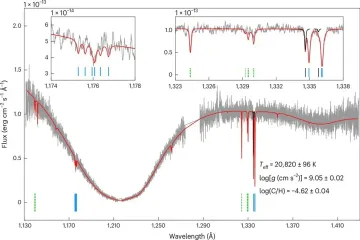
Since there is no ongoing power source—no hydrogen fusing into helium, no helium fusing into carbon—the white dwarf's luminosity is entirely dependent on its initial, immense reservoir of heat. [1][5] It shines simply because it is hot and gradually radiates that stored thermal energy out into the cosmos. [5] The light output decreases as the surface temperature drops over time. [6]
The cooling process is incredibly slow. Because the star is already so small, the surface area available for radiating heat is limited, and the energy density inside is enormous. [3] This slow burn means that a white dwarf can take billions, even trillions, of years to cool down to the point where it no longer emits visible light, eventually becoming a cold, dark black dwarf. [3][5] Considering the universe is only about $13.8$ billion years old, we have not yet observed a true black dwarf. [5] If we extrapolate the cooling rates observed in the oldest white dwarfs—which have surface temperatures well under $10,000$ K—it suggests that the first generation of white dwarfs, formed early in the galaxy’s history, are just beginning to approach the faint, red, or even brown end of the spectrum. [6] This offers an interesting perspective: virtually every white dwarf we see today is radiating borrowed time, a faint echo of a star's former glory, not an engine running on present fuel.
# Mass Threshold
While fusion cannot easily restart in the degenerate core, the maximum mass the white dwarf can sustain is a hard limit related to the pressure source itself. This limit is known as the Chandrasekhar limit, approximately $1.4$ solar masses (). [2][3] If a white dwarf were to somehow accrete mass from a companion star and surpass this limit, the electron degeneracy pressure would become insufficient to counteract gravity. [3]
When this occurs, the core collapses catastrophically. This collapse reignites fusion in a runaway fashion that the electron degeneracy pressure cannot halt, leading to a thermonuclear explosion—a Type Ia supernova. [2] In these explosive events, the carbon and oxygen that had been inert for eons fuse rapidly into heavier elements like nickel, releasing staggering amounts of energy before the entire object is blown apart. [2] This is a singular event of catastrophic fusion, not a sustained reaction, and it only happens when the quantum support mechanism fails completely due to overload. [3] It is the violent exception that proves the rule of stability below the critical mass threshold.

# Composition Differences
The initial mass of the progenitor star dictates the final composition, which in turn influences the exact physics of its degeneracy. [3] A low-mass star (like the Sun) forms a white dwarf whose core is mostly carbon and oxygen. [5] A slightly more massive star might have fused all its core helium into carbon, but not hot enough or long enough to start burning carbon, leaving a helium-core white dwarf. [3]
When we look at these objects, we are looking at elements forged in the late stages of stellar life—carbon, oxygen, and sometimes neon—locked in a dense state that forbids the subsequent reactions that would naturally follow in a non-degenerate environment. [3] It’s a frozen snapshot of stellar evolution. The energy required to move from one state to the next (e.g., carbon fusion) is so substantial that even the immense initial thermal energy of the freshly formed dwarf isn't enough to bridge the gap, and the degeneracy support prevents the contraction needed to generate the remaining heat.
| Progenitor Mass (Approx.) | Final White Dwarf Core Composition | Supporting Pressure Regime |
|---|---|---|
| Helium | Electron Degeneracy | |
| Carbon/Oxygen | Electron Degeneracy | |
| (and accretion) | N/A (Implodes or Supernova) | N/A |
This table helps illustrate the transition. As long as the core remains under the Chandrasekhar limit, the quantum resistance of the electrons dictates the structure, completely overriding the temperature-dependent pressure required for further nucleosynthesis. [3]
# The Longevity Factor
The universe has a finite time, currently estimated around $13.8$ billion years, since the Big Bang. [5] The white dwarf cooling timescale is often cited in the range of years or more for the coolest objects. [5] This massive disparity between the age of the cosmos and the cooling time highlights a fundamental truth about these objects: they are fundamentally long-term entities defined by their slow decay, not their dynamic processes. They are cosmologically immortal for now. The physical mechanism preventing fusion—the rigidity of electron degeneracy pressure—is so stable that the primary observable phenomenon is the slow draining of existing energy, a process that vastly outlives the current epoch of star formation and stellar illumination in the universe. [3] For practical astrophysics today, a white dwarf is defined by its endothermic state, a permanent monument to a star that simply ran out of expansion options allowed by thermal pressure.[1][5]
Related Questions
#Citations
What makes white dwarfs emit light? Is it continued fusion of ... - Reddit
Why doesn't nuclear fusion happen in a white dwarf? - Quora
White dwarf - Wikipedia
White Dwarf - ESA/Hubble
Do gamma rays escape from stars when turning into white dwarfs
White Dwarf Stars - Imagine the Universe! - NASA
The Sun's Transformation into a White Dwarf and Solid Carbon ...
Video: White Dwarf Definition, Facts & Characteristics - Study.com
[PDF] Monday, Oct. 27 - Astronomy at the University of Texas at Austin