What does every star start as?
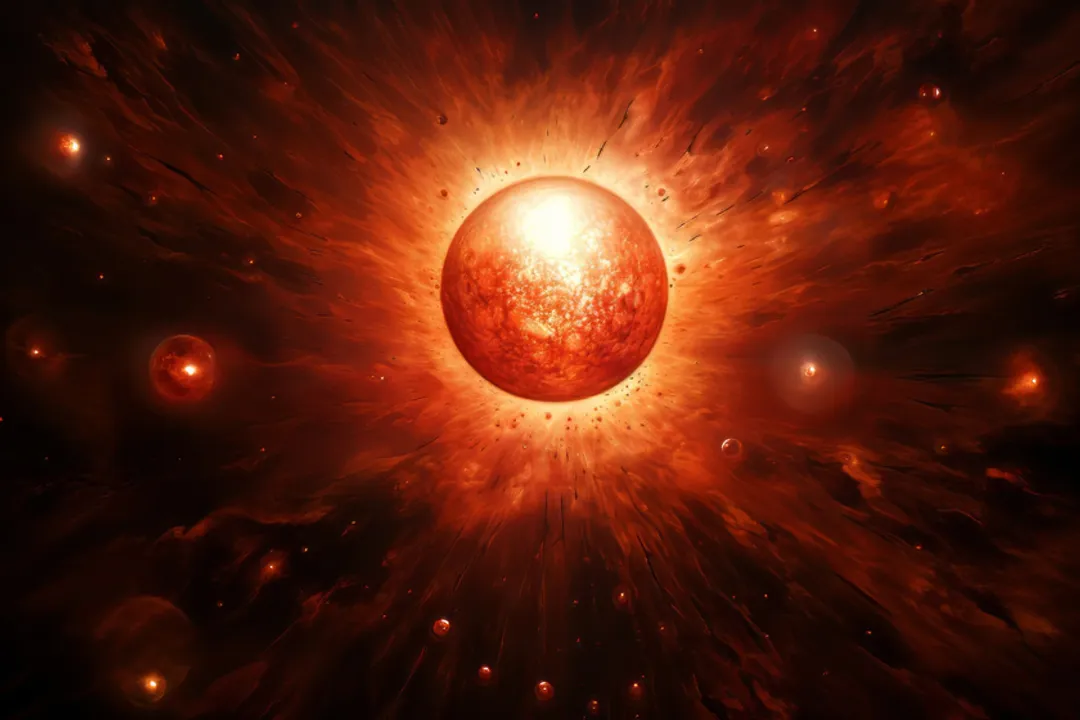
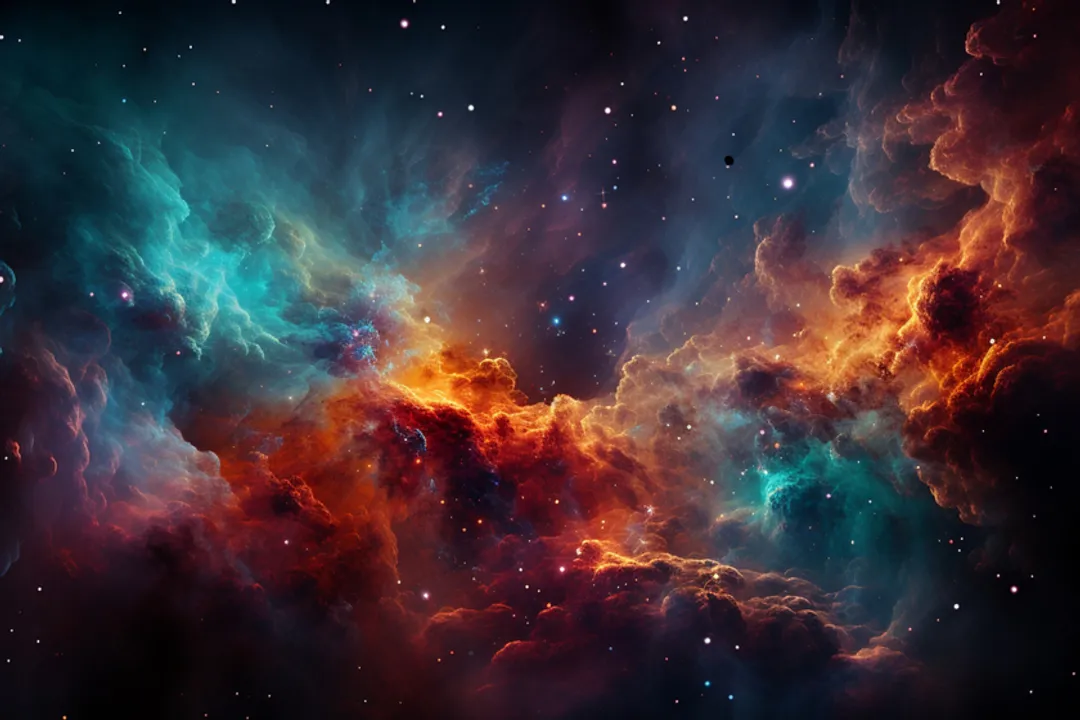
Every star, from the smallest, dimmest red dwarf visible only through powerful telescopes to the giants that blaze across the night sky, begins its existence in the same fundamental material: vast, cold clouds of gas and dust floating in space. [1][4] These colossal structures, known in astronomy as nebulae or, more specifically, Giant Molecular Clouds (GMCs), are the cosmic nurseries where stellar birth is initiated. [4][7] They are composed primarily of the universe's most abundant elements, mainly hydrogen and helium, mixed with trace amounts of heavier elements and microscopic dust grains. [1]
# Gas Clouds
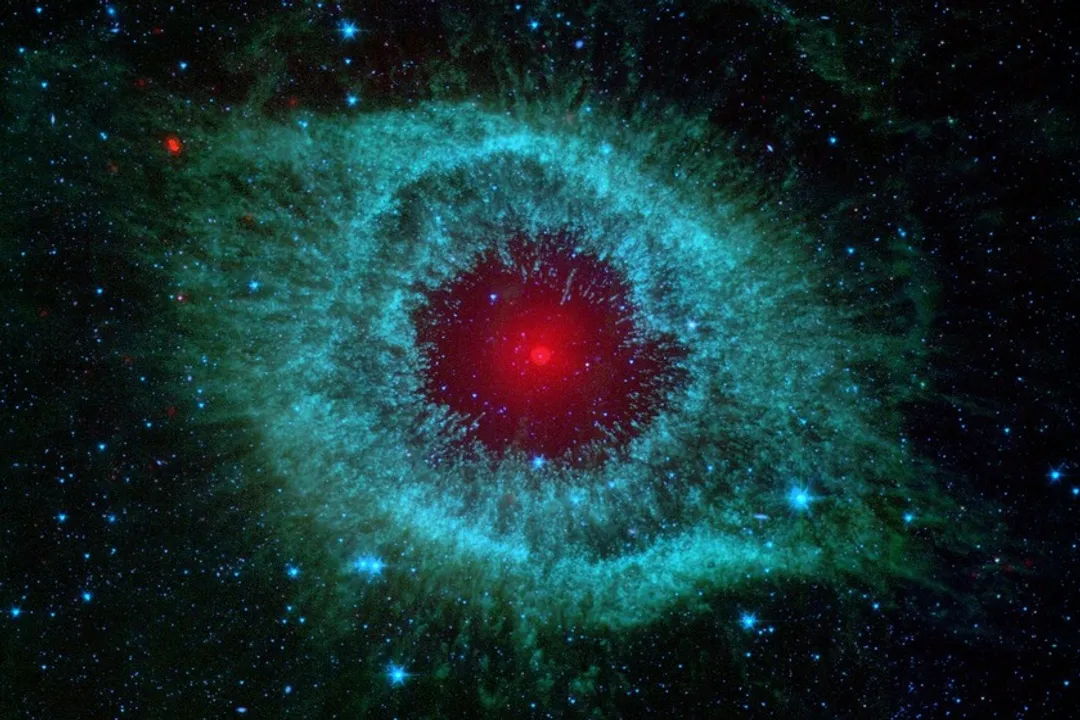
These stellar cradles are immense, spanning many light-years across the galaxy. [6] While they appear static from a distance, they are not uniform; they possess varying densities and temperatures. [4] The initial ingredients for a star are present within these cold, dark regions, sometimes referred to as molecular clouds because the gas is dense enough for molecules like H2 to form. [4] The temperature within these clouds is incredibly low, often just tens of degrees above absolute zero. [4] This coldness is important because it allows the particles to move slowly enough for gravity to begin winning the long struggle against the cloud's internal pressure.
# Gravity Starts
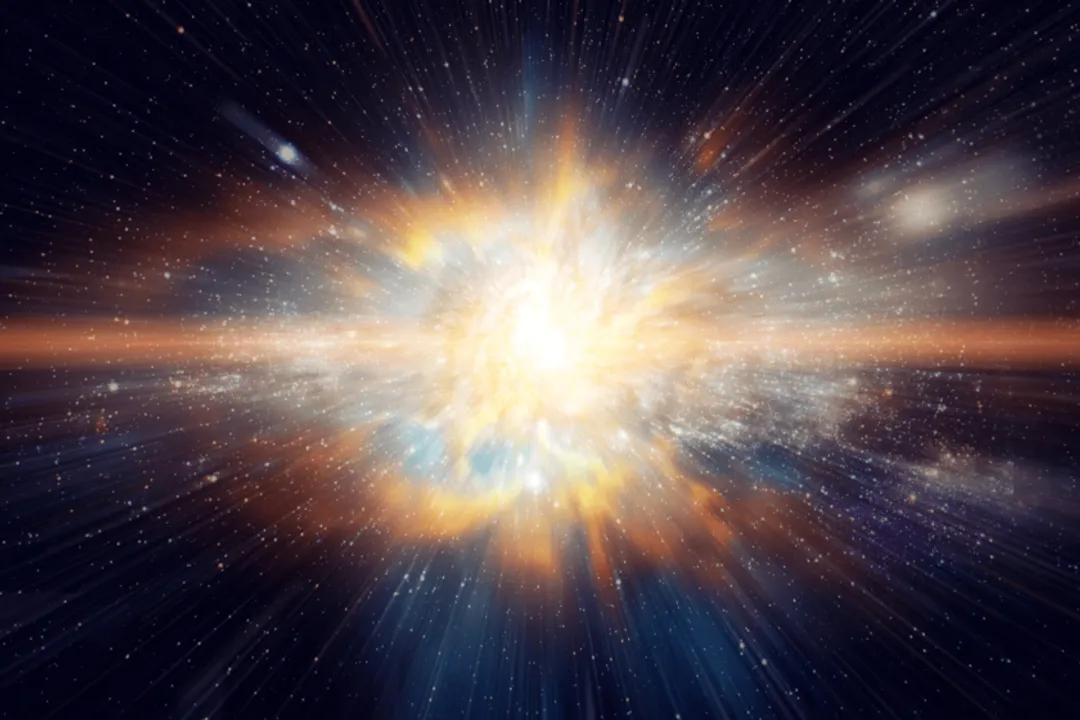
The transition from a diffuse cloud to a star requires a trigger—something to kickstart the collapse of a localized, denser region within the nebula. [4][6] This trigger can be the shockwave from a nearby supernova explosion, the gravitational influence of a passing spiral arm in the galaxy, or simply a point within the cloud that has naturally reached a critical density threshold, known in physics as the Jeans instability. [4] Once triggered, gravity takes over, pulling the surrounding material inward toward that dense center. [5][7]
As this enormous volume of gas and dust contracts, the initial loose clump begins to fragment into smaller, denser pockets. [4][6] Each of these contracting fragments is destined to become a star system, often with planets forming from the leftover material orbiting the central mass. [6] The material does not fall directly onto the center; instead, due to the conservation of angular momentum, it spins faster as it shrinks, flattening into a rotating disk around the growing core. [5]
# Pre Star
The object at the very center of this collapse is not yet a true star; it is known as a protostar. [5][7] The protostar gains mass steadily by drawing in the gas and dust swirling down from the surrounding accretion disk. [5] During this phase, the object gets hotter, but this heat is not yet generated by nuclear reactions; rather, it is produced by the conversion of gravitational potential energy into thermal energy as material slams into the core. [5] A protostar can shine quite brightly during this process, but its energy output comes entirely from this gravitational contraction. [5]
For a star similar in mass to our Sun, this long period of gravitational contraction—the pre-main sequence phase—can last for tens of millions of years. [5] This timescale highlights an interesting point about stellar formation: the less massive the future star is, the longer it takes for gravity alone to raise the core temperature high enough to ignite fusion. A star only a fraction of the Sun's mass might spend over a hundred million years contracting before it officially joins the ranks of true stars. [5][9] Conversely, extremely massive stars, which contract much more violently under their own immense gravity, can reach the ignition point in mere hundreds of thousands of years. [5]
The state of the protostar is defined by this balancing act. Gravity is squeezing the interior, causing the temperature to rise, but the gas pressure is pushing outward, resisting the crush. [5] This internal battle continues until the core reaches a specific, monumental temperature and density. [9]
# Fusion Ignites
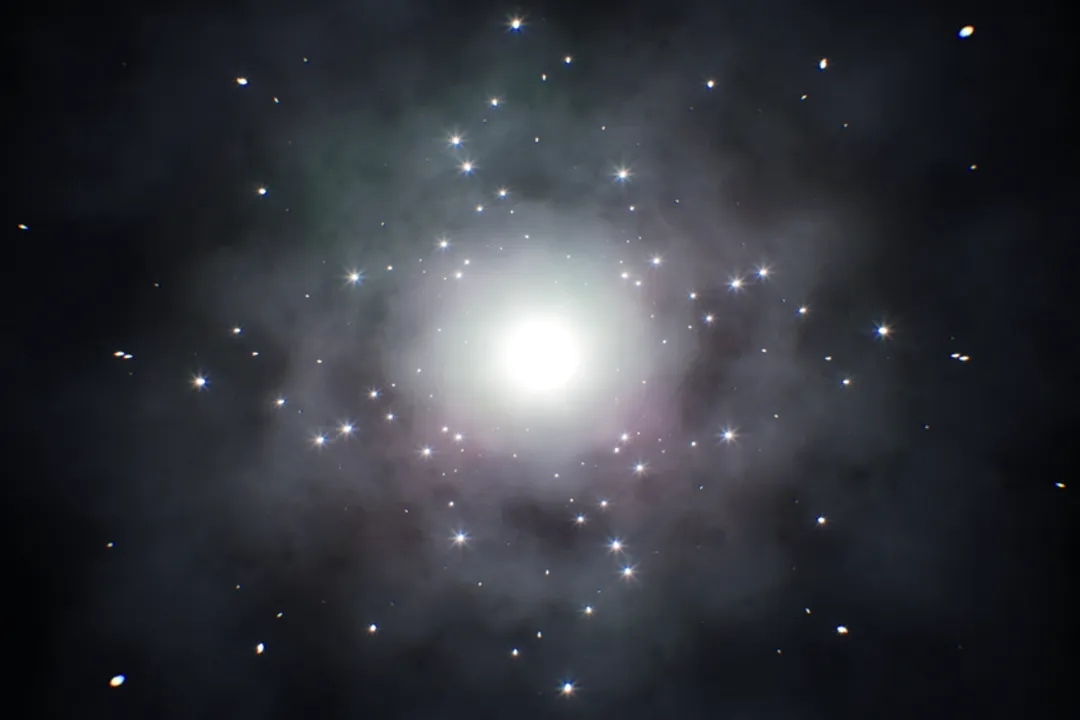
The defining moment for a star's "birth" is the initiation of sustained nuclear fusion in its core. [1][7] For a star like the Sun, the core temperature must reach approximately 15 million degrees Celsius. [5] At this extreme temperature and sufficient density, hydrogen nuclei begin to fuse together to form helium nuclei. [1][5] This process releases a tremendous amount of energy—the power source that will sustain the star for billions of years. [7]
Once fusion begins, the outward pressure generated by the released energy perfectly counteracts the inward crush of gravity. [9] This state of equilibrium is called hydrostatic equilibrium, and when it is achieved, the object officially lands on the Main Sequence of the Hertzsprung-Russell diagram. [1][9] This is the longest and most stable phase of a star’s life cycle. [2][3] The object has completed its start and is now a fully realized, shining star. [5][7]
To summarize the initial steps into a more structured view of what happens between the cloud and the Main Sequence:
| Stage | Primary Energy Source | Defining Characteristic |
|---|---|---|
| Nebula/GMC | None (Very Cold) | Vast reservoir of gas and dust [4] |
| Dense Core | None | Localized region where gravity begins to dominate [4] |
| Protostar | Gravitational Contraction | Rapidly increasing internal heat; surrounded by an accretion disk [5] |
| T Tauri Star (Sun-like only) | Gravitational Contraction | Visible stellar object undergoing violent surface activity before full fusion [5] |
| Main Sequence Star | Nuclear Fusion (H to He) | Hydrostatic equilibrium achieved [1][9] |
# Mass Dictates
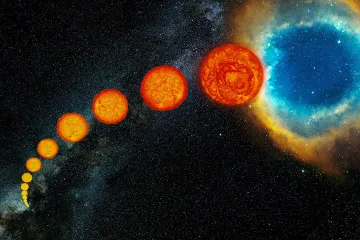
While the process of starting as a nebula and becoming a protostar is universal, the duration and the ultimate fate of the star are entirely dictated by the initial mass accumulated during the protostar phase. [2][6] The amount of material that falls into the core before fusion begins sets the star's characteristics for its entire existence. [5]
Stars fall into distinct categories based on this initial mass. Objects that gather less than about 8% of the Sun’s mass may never achieve the necessary core temperature for hydrogen fusion; these objects become Brown Dwarfs, often described as "failed stars," which slowly cool down over eons. [5]
On the other end of the spectrum, stars born with masses many times that of the Sun live incredibly fast and furious lives. [5][6] Their greater gravity leads to faster core temperatures and correspondingly quicker fusion rates. Where a Sun-like star spends roughly 10 billion years on the Main Sequence, a star twenty times the Sun's mass might exhaust its core fuel in only a few million years. [5][9]
Therefore, the question of what every star starts as leads to a slightly complex answer. Every star starts as a collapsing pocket of cold, dense gas within a nebula, evolving through the hot, contracting phase of a protostar. [4][5] However, the initial outcome of that collapse—the mass captured by the core—is the single most important determinant of the star's lifespan, color, and eventual end, whether it fades quietly as a white dwarf or ends its life in a spectacular supernova explosion. [2][6] The journey begins identically across the cosmos, but the destination diverges immediately based on that initial cosmic gathering of material.
Related Questions
#Citations
Star Basics - NASA Science
Stellar evolution - Wikipedia
Stellar Evolution - | The Schools' Observatory
Star Formation | Center for Astrophysics | Harvard & Smithsonian
The Life Cycle of Stars: From Birth to Stellar Legacy As ... - Facebook
A Star is Born: The Life Cycle of Stars | Wisconsin Space Grant ...
Life Cycle of Stars - BYJU'S
How Stars Form: A Star's Life Cycle in Six Stages - KiwiCo
The formation and life cycle of stars - AQA - AQA - BBC Bitesize - BBC
Life Cycle of a Star - Label Stars