What do stars burn after hydrogen?
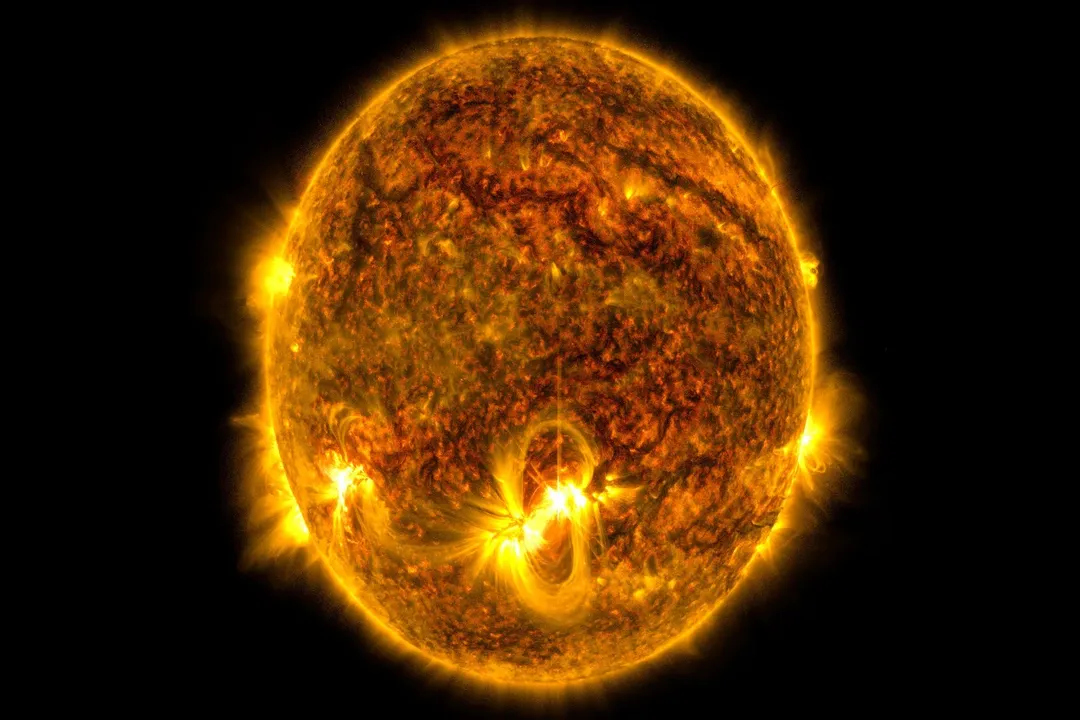
The life of a star is largely defined by what it is fusing in its core. For the vast majority of its existence, a star like our Sun is engaged in the slow, steady process of converting hydrogen into helium through nuclear fusion. [2][4] This period, known as the main sequence, is a time of relative stability, where the outward pressure generated by fusion perfectly balances the inward pull of gravity—a state called hydrostatic equilibrium. [2] However, this hydrogen fuel is not infinite, and when the supply in the core finally depletes, the star enters a period of dramatic structural change, seeking a new energy source to maintain its existence. [1][3]
# Hydrogen Lifetime
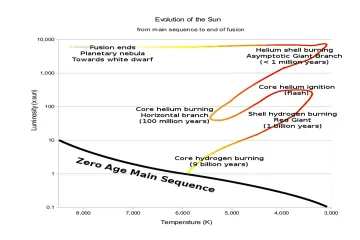
The duration a star spends fusing hydrogen is directly related to its initial mass. Smaller stars are famously frugal, burning their fuel slowly, allowing them to remain stable on the main sequence for billions, or even trillions, of years. [2] Our Sun, a mid-sized star, is expected to complete this primary phase after about 10 billion years. [2] Once the hydrogen nuclei in the central region are exhausted, the star can no longer generate the necessary outward pressure from that reaction to counteract gravity. [4]
# Core Contraction
When the core runs out of hydrogen fuel, fusion stops there, and gravity immediately begins to assert its dominance, causing the inert helium core to contract under its own weight. [1][3] This contraction is a critical turning point. As the core shrinks, the immense pressure causes it to heat up significantly. [7] This increase in temperature doesn't just affect the core; it heats the layer of unburnt hydrogen surrounding the core until it reaches the necessary temperature to initiate fusion there. [1][5] This process is often referred to as hydrogen shell burning. [1][5]
It is fascinating to consider this feedback loop: the failure of core fusion triggers the gravitational collapse that makes the surrounding shell hot enough to ignite, effectively postponing the star's death for a time. [3] For stars comparable in mass to the Sun, the core temperature must reach around 100 million Kelvin to overcome the repulsive forces between helium nuclei and begin the next phase of fusion. [3][8]
# Helium Ignition
Once the helium core contracts sufficiently and reaches the required extreme temperature and density, the star "ignites" its next fuel source: helium. [3] The primary reaction that follows is the triple-alpha process, where three helium nuclei (alpha particles) fuse together to form a single carbon nucleus, often accompanied by the formation of oxygen. [8] This process represents the next step in nucleosynthesis within the star. [8]
However, the onset of helium burning can be sudden and explosive in stars like the Sun—an event known as the helium flash. [3] After the flash, the star achieves a new, temporary equilibrium, now powered by helium fusion in the core, surrounded by the shell of hydrogen fusion. [1]
# Giant Expansion
The energy output during this post-main sequence phase is often greater than what the star produced during its main sequence life. [7] This surge in energy causes the star's outer layers—the envelope, which is mostly still hydrogen and helium—to swell outward dramatically. [7] The star increases substantially in size and its surface cools, leading to a massive, luminous object known as a Red Giant. [3] For our Sun, this expansion will eventually engulf Mercury and likely Venus, perhaps even reaching Earth's orbit. [3] The increase in radius is directly tied to the energy transfer from the new inner fusion zones to the outer layers. [7]
It's important to note the distinction between hydrogen burning and hydrogen fusing. While the core has stopped fusing hydrogen, the surrounding shell is actively fusing it, so the star is not entirely without hydrogen fusion, but the core fuel source has changed from hydrogen to helium. [5]
# Mass Differences
The subsequent steps in a star's life are strictly determined by its mass. Stars that begin with masses similar to the Sun will eventually exhaust their core helium supply, leading to the expulsion of their outer layers to form a planetary nebula, leaving behind a dense, hot core of carbon and oxygen—a white dwarf. [3] These lower-mass stars generally cannot achieve the core temperatures required to fuse carbon. [9]
In stark contrast, stars significantly more massive than the Sun—often defined as those eight times the Sun's mass or greater—possess enough gravitational power to force the core to continue contracting and heating after the helium is consumed. [9] These massive stars become Red Supergiants and proceed through a series of subsequent burning stages, fusing heavier and heavier elements in shells around an ever-growing inert core. [9]
If we consider the lifecycle of a truly massive star, the fusion sequence proceeds down the periodic table, layer by layer, with each stage being progressively shorter in duration than the last. [9]
# Layered Burning
For these titans of the cosmos, the elements burned in sequence, moving inward from the outer shells toward the center, look something like this after helium is exhausted:
- Carbon Burning: The core contracts again until carbon fuses into neon, magnesium, and sodium. [9]
- Neon Burning: Once carbon is spent, neon ignites, producing oxygen and magnesium. [9]
- Oxygen Burning: This stage follows, creating silicon and sulfur. [9]
- Silicon Burning: This is the final major stage before collapse, where silicon fuses rapidly into elements near the atomic weight of iron, such as nickel. [9]
Each subsequent stage requires significantly higher temperatures and pressures to overcome the stronger electrical repulsion between the heavier nuclei. [9] The entire life span of the star after the main sequence is relatively brief; while the hydrogen phase lasts for billions of years, the stages that follow—from helium burning to silicon burning—can occur over mere millions of years, or even decades for the final silicon burning phase. [9] The defining characteristic of this final stage is that fusion stops when the core is predominantly made of iron. [9] Iron is the cosmic dead end because fusing iron nuclei consumes energy rather than releasing it, meaning the star has no further source of outward pressure to fight gravity. [9]
When comparing the entire stellar life cycle, one can observe a striking paradox: the energy required to fuse heavier elements increases exponentially, yet the time available for those reactions shrinks dramatically. A star might spend 90% of its life burning hydrogen, but the final steps, leading to the iron core, might take less than a year. [9] This rapid descent into instability following the exhaustion of lighter fuels is what sets the stage for one of the universe's most violent events: a core-collapse supernova. [9]
#Citations
When a star runs out of hydrogen, it begins using helium as fuel. Is ...
Star Basics - NASA Science
Star Life Cycle - ASPIRE
The Life of a Star - How Stars Work - Science | HowStuffWorks
Hydrogen burning vs Hydrogen fusing - Astronomy Stack Exchange
How do stars consume hydrogen in nuclear fusion? - Facebook
Why does helium cause a star to increase in size after its hydrogen ...
The Elements: Forged in Stars | PBS LearningMedia
High mass star - Las Cumbres Observatory