How do stars burn in space if there is no oxygen?
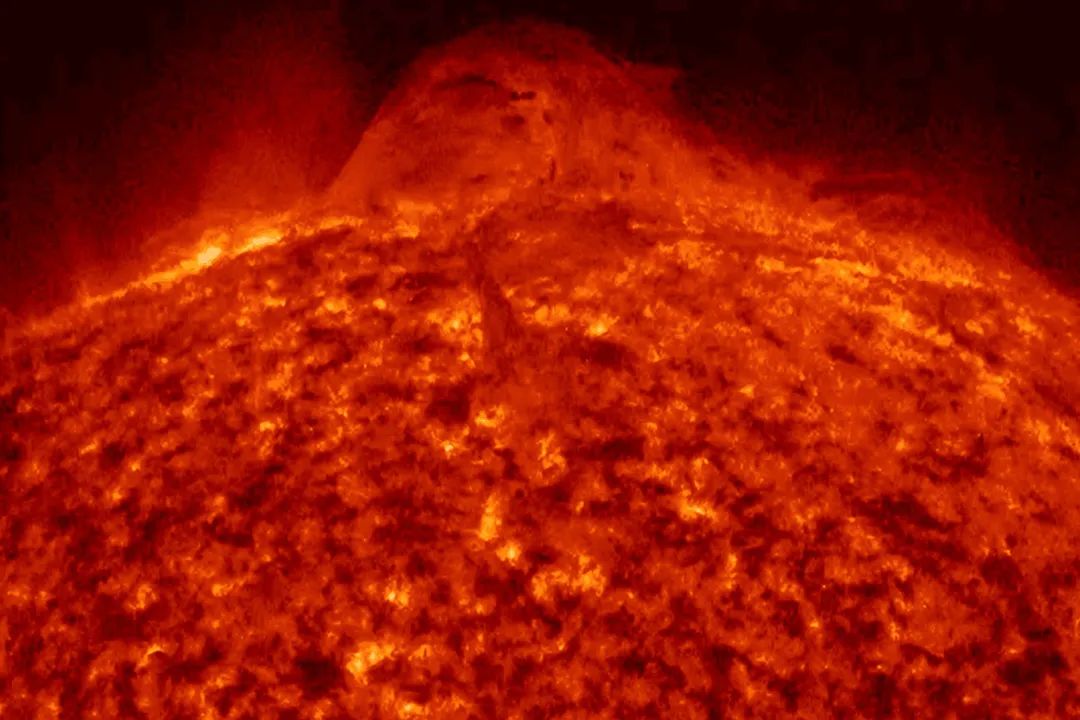
The fundamental difference between a star shining in the vacuum of space and a fire burning here on Earth comes down to the mechanism of energy release. When we see something "burning" on our planet—a log in a fireplace, a candle flame, or even a car engine—we are witnessing chemical combustion. [4] This process is an oxidation reaction, meaning it absolutely requires an oxidizer, which is almost always gaseous oxygen from our atmosphere, to combine rapidly with a fuel source. [4][8] Since the vast emptiness of space contains virtually no matter, let alone free oxygen, the Sun and other stars simply cannot sustain chemical fires. [4]
# Chemical Fire Myth
The common mental picture of the Sun as an enormous ball of chemical flame is a deeply ingrained but scientifically inaccurate metaphor. [8] If the Sun operated by combustion, it would have exhausted its fuel reserves incredibly quickly, perhaps in a few thousand years, because the amount of oxygen available in its vicinity is negligible. [4] Furthermore, if the Sun were a chemical fire, it would cease to shine the moment it drifted into a true vacuum, which is the opposite of what we observe. [8] The energy source must be internal and self-contained, requiring no external reactants from the surrounding void. [4]
# Nuclear Power Source
Stars generate their phenomenal light and heat through a process known as nuclear fusion. [2] This is not chemistry; it is physics on an atomic scale. Stars are overwhelmingly composed of the lightest element, hydrogen, with a significant amount of helium also present. [4] In the star's core, the nuclei of hydrogen atoms are slammed together with such force that they overcome their natural electrical repulsion and fuse to create heavier helium nuclei. [2]
This transformation is the essence of stellar nucleosynthesis. [7] While the total mass of the resulting helium nucleus is slightly less than the combined mass of the original hydrogen nuclei, the "missing" mass hasn't vanished. Instead, it has been converted directly into pure energy in the form of photons (light and heat), as described by Albert Einstein’s celebrated mass-energy equivalence principle, . [7] This self-contained manufacturing of energy from matter is what allows a star to shine consistently for billions of years. [2]
# Extreme Core Heat
The conditions required to initiate and sustain nuclear fusion are extreme, far beyond anything achievable in terrestrial laboratories outside of specialized fusion experiments. For hydrogen fusion to occur, the core of a star like our Sun must reach an absolutely staggering temperature—around 15 million degrees Celsius. [2]
This heat is only one part of the equation. The star's immense mass generates gravitational pressure that is equally crushing. [2] It is this immense pressure that forces the hydrogen nuclei close enough together for the extreme heat to provide the kinetic energy needed for them to overcome the Coulomb barrier (the electrostatic force pushing like charges apart). [2]
One interesting way to view this phenomenon is through the lens of the state of matter involved. Due to these incredible pressures and temperatures, the material in the solar core is not gas or liquid; it is plasma, where electrons are stripped away from atomic nuclei. This ionized soup behaves fundamentally differently than neutral gas, allowing the nuclei to interact directly at microscopic distances necessary for fusion to take hold, a prerequisite entirely bypassed by slow, low-energy chemical bonding [2][4].
# Oxygen Absence
The key takeaway when comparing stellar energy production to terrestrial fire is the role of the surrounding medium. A flame requires an external supply of oxygen to feed the reaction. [4] A star, conversely, carries all the necessary ingredients—hydrogen fuel and the gravitational energy source to compress that fuel—internally. [4][8] The lack of ambient oxygen in space is thus irrelevant because the star is not oxidizing; it is fusing. [4]
To put this into perspective, imagine trying to run a sophisticated fusion reactor on Earth by pouring wood chips into it. It would fail immediately. Stars operate under a completely different set of rules where the containment vessel (gravity) and the fuel source (hydrogen) are one and the same.
The stability derived from this internal process has profound implications for planetary life. If the energy output depended on the density of interstellar gas passing by—like how the intensity of a campfire depends on how much wood you stack on it—the Sun's output would fluctuate constantly, likely rendering Earth uninhabitable. [2] The long-term equilibrium achieved through fusion explains why the Sun has provided relatively steady energy for billions of years.
# Stellar Evolution
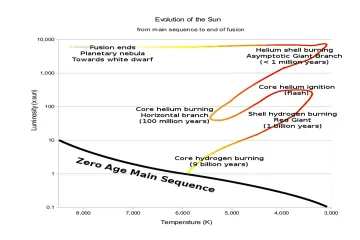
The process of fusing hydrogen into helium is not permanent, defining the active life stage of most stars. [7] As long as the core has hydrogen fuel available for fusion, the outward pressure generated by the released energy balances the inward crush of gravity, keeping the star stable on what astronomers call the main sequence. [2]
What happens next is entirely dependent on the star's starting mass. [7] For a star like the Sun, once the hydrogen in the core is exhausted, the balance tips. The core contracts and heats up further, triggering the fusion of helium into heavier elements like carbon and oxygen in subsequent stages. [7] This change often causes the star to swell dramatically into a red giant. [7] In contrast, much more massive stars go on to fuse progressively heavier elements in their cores, eventually creating elements up to iron, leading to much more dramatic endpoints like supernovae. [7] In any case, the star's eventual demise is a direct consequence of exhausting the fusible fuel it carried from its birth, not a failure to find an external oxidizer. [7]
A tangible way to grasp the sheer scale of this process is to consider the travel time of the energy itself. A photon created during a fusion event in the Sun’s core does not immediately stream out into space. Due to the incredible density of the plasma, that photon bounces around countless times, taking an estimated 100,000 to 170,000 years just to migrate from the core to the visible surface, the photosphere. [2] Only then does it escape as the sunlight we observe today. This immense internal diffusion time highlights how thoroughly insulated the reaction site is from the vacuum surrounding the star. [2]
#Videos
Brian Cox Answers How Stars Burn in Space | This Morning - YouTube
Ask John: How do stars burn? - YouTube
Related Questions
#Citations
How do stars burn if there's no oxygen in space? - Reddit
How can the Sun "burn"? - StarChild - NASA
How do stars (like sun) burn in space when there is no gaseous ...
Brian Cox Answers How Stars Burn in Space | This Morning - YouTube
People Are Asking If There Is No Oxygen In Space, How Is The Sun ...
Stellar nucleosynthesis - Wikipedia
People Are Asking If There Is No Oxygen In Space, How Is The Sun ...