What are the five characteristics of stars we use?

A star is a colossal sphere of plasma radiating light across the cosmos, and while our own Sun is just one among billions in the Milky Way galaxy, astronomers have developed precise methods to characterize these distant furnaces. [1] To make sense of the sheer variety of these celestial objects, scientists rely on a handful of core physical properties derived almost entirely from analyzing the light that finally reaches us. [2] Determining these five primary characteristics allows us to place a star within the cosmic context, gauge its power output, and even understand its life cycle. [4] These essential descriptors are its surface temperature (often inferred from color), its brightness (which involves luminosity and apparent magnitude), its physical size or radius, its mass, and finally, its chemical makeup, revealed through its spectrum. [1][2][3]
# Temperature Color
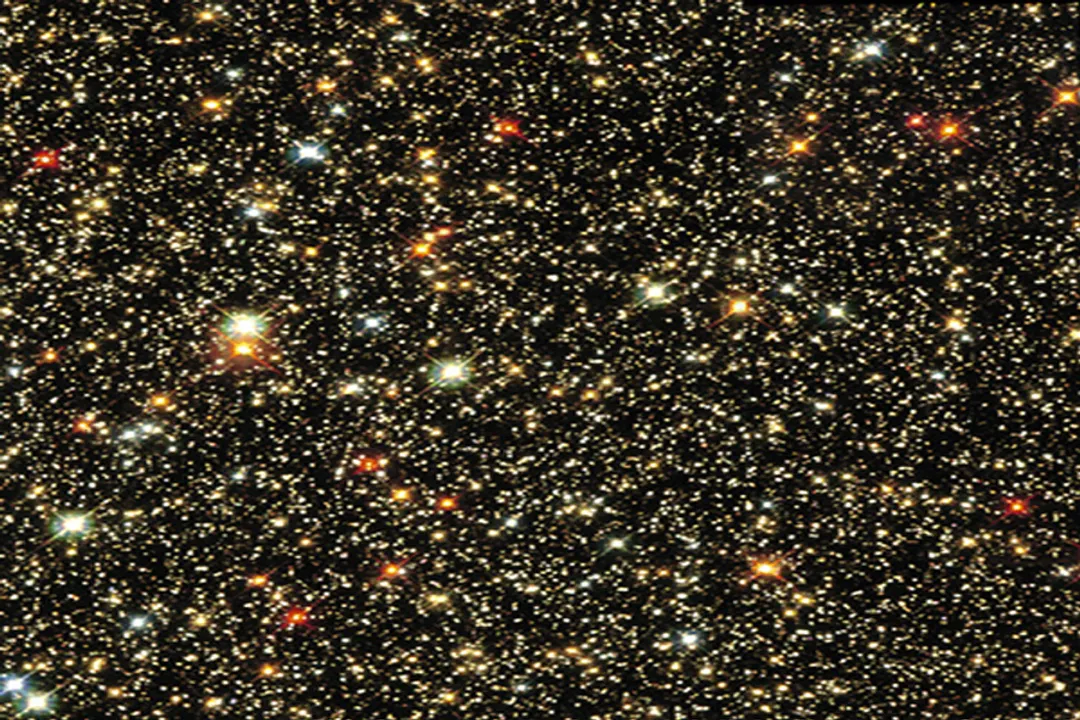
The most immediate visual cue we have when looking skyward is a star's color, and this translates directly into one of the most critical physical measurements: its surface temperature. [1][3] This relationship is rooted in the physics of blackbody radiation; fundamentally, the color of a star tells us its temperature. [4] Stars that appear cooler to our eyes emit light shifted toward the red end of the spectrum, while the genuinely hot stars radiate with a distinct bluish hue. [1][4] Stars that fall into the middle ranges, like our Sun, typically appear white or yellow. [1][3]
Astronomers quantify this temperature using the Kelvin scale, where zero Kelvin represents the theoretical absolute zero point, equivalent to -273.15 degrees Celsius. [1] On this scale, the coolest stars detectable are around , radiating a deep reddish light. [1] Conversely, the most energetic stars burn fiercely, reaching surface temperatures upwards of , [1] or in some cases, even exceeding for the O-type stars, as seen in the spectral classification tables. [4] Our own Sun maintains a surface temperature near . [1][3]
The technique used to determine these temperatures precisely, beyond simple visual inspection, involves photometry—the careful measurement of a star’s brightness across different specific wavelengths using color filters. [4] By mapping out how much energy is received at various wavelengths, astronomers can fit the data to a thermal radiation spectrum, which has a unique shape for every temperature. [4] This allows for a highly accurate determination of the surface temperature, even when the color differences between stars are very subtle to the naked eye. [4]
It is easy to glance at the night sky and think the color difference between a faint red dot and a brilliant blue point is solely about stellar age or distance, but the underlying physics dictates that the color is a direct readout of the thermal state of the star’s surface layers. [4] For instance, the prominent star Betelgeuse, a famous reddish giant, registers a temperature of approximately , whereas the blue star Rigel, visible in the same constellation Orion, is about four times hotter at . [4] This disparity in temperature, a mere factor of four in Kelvin, leads to a dramatic shift in observed color, showcasing the extreme sensitivity of spectral output to minute changes in surface heat. [4]
# Brightness Magnitude
When observing the sky, the most obvious difference between stars is how bright they appear—some are brilliant pinpricks, while others are barely visible. [4] This perception of brightness, however, is tricky because it depends on two different factors: how much light the star actually produces and how far away it is from the observer. [2][4]
The intrinsic energy output of a star is called its luminosity. [2] This is the total amount of energy radiated from the star's core, measured in units like Watts, though for astronomical comparison, it is often standardized against the Sun’s luminosity (). [2][4] A star’s luminosity is governed by its size and its surface temperature. [1]
The observed light reaching Earth is called apparent magnitude. [1][2][3] This measurement factors in the star’s luminosity and its distance. [2][4] If two stars have identical luminosities, the one farther away will have a larger (fainter) apparent magnitude. [3] Because knowing distance is often difficult, astronomers also use absolute magnitude, which is the star’s brightness if it were placed at a standardized, fixed distance from Earth, thereby reflecting its true luminosity without the masking effect of interstellar distance. [1][3][4]
The system used to quantify this brightness is the magnitude scale, a tradition dating back to the ancient Greek astronomer Hipparchus. [4] This system is famously counter-intuitive: the brighter the object, the smaller the number assigned to it. [4] Hipparchus initially ranked the brightest stars as "first magnitude" and the faintest he could see as "sixth magnitude". [4] Modern physics refined this system by finding that a first-magnitude star produces roughly 100 times the electrical current (energy) of a sixth-magnitude star. [4] This relationship was quantified such that a difference of five magnitudes exactly corresponds to a factor of 100 in brightness. [2][4] Consequently, a difference of just one magnitude equates to a brightness factor of , or approximately $2.512$. [4] For context, the Sun boasts an apparent magnitude of about $-23$, while the faintest stars visible to the unaided eye in a dark sky register around magnitude $6$. [2]
This leads to an interesting consideration when comparing stellar statistics. If we consider two stars with the same surface temperature (and thus the same color, say, both look yellow-white), but one has an apparent magnitude of $1.0$ and the other $6.0$, the brighter one is $100$ times more luminous as seen from Earth. [4] However, without knowing their respective distances—which requires measuring parallax, the apparent shift in position as Earth orbits the Sun—we cannot definitively say which star is intrinsically more powerful in terms of its actual energy generation (luminosity). [2][3][4]
# Stellar Size
A star's physical size, or radius, is another fundamental characteristic that astronomers measure, typically relative to the size of our own Sun (defined as ). [1][3] Stars exhibit an astonishing range in scale. Many stars fall near the Sun's size, but others are dramatically different. [3]
Stars that are significantly larger than the Sun are designated as giant or supergiant stars. [3][4] The source material offers the example of Rigel, which boasts a radius of . [1] At the other extreme are the incredibly compact remnants known as white dwarfs, which are often only about the size of Earth. [3] Even smaller are neutron stars, which measure only about . [3]
The radius is crucial because, when combined with temperature, it dictates the total energy output, or luminosity. [1] A star that is much larger than the Sun, even if its surface is slightly cooler, can produce vastly more light simply because it has an immense surface area from which to radiate energy. [4] The star Antares, for example, has an M-type spectrum and a cool temperature around —similar to a small, dim main sequence M star—yet its luminosity is $10,000$ times that of the Sun, requiring a radius nearly $500$ times larger than the Sun’s. [4] If placed at the center of our solar system, a star of Antares’ size would engulf the orbits of Mercury, Venus, Earth, and Mars. [4]
Measuring these radii is technically challenging because nearly all stars are too distant to resolve as a discernible disk through standard telescopes. [4] A primary method for obtaining this measurement involves studying eclipsing binary stars—systems where two stars orbit each other in a plane aligned with our line of sight. [4] As one star passes in front of the other, it causes a predictable dimming or "eclipse" of light. By precisely timing how long the light is blocked, astronomers can deduce the physical diameter of the eclipsing star. [4]
# Stellar Mass
Mass is perhaps the most defining characteristic of a star's life and fate, often measured in units of solar masses (). [1][4] While radius and temperature can often be determined by analyzing the star's light spectrum and photometry alone, measuring mass requires observing the star's gravitational influence on other objects. [4]
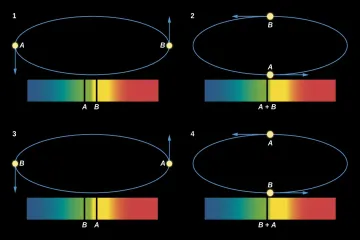
The most effective way to determine a star's mass is by observing it in a binary star system, where two stars orbit a common center of mass. [4] This observation relies on the Doppler effect: as a star moves toward Earth in its orbit, its spectral lines shift slightly to the blue end of the spectrum, and as it moves away, the lines shift toward the red. [4] By meticulously tracking these velocity changes over time, astronomers can apply Kepler’s laws of motion (or more complex calculations involving the Doppler shift) to calculate the stars’ masses. [4]
The data collected suggests a wide variation: a normal star like our Sun has a mass of . [4] Massive stars, like the O-type stars, can possess an average mass of . [4] Conversely, small stars like the M-type red dwarfs might have masses as low as . [4] An intriguing point to note is that size and mass are not perfectly correlated; two stars of very similar physical radii might have vastly different masses because their internal density can vary significantly. [1] The most massive stars compress their matter much more tightly than less massive, inflated giants.
# Spectral Composition
The final, key characteristic used for classification involves what the star is made of, which is determined by analyzing its absorption line spectrum. [2] When a star’s continuous spectrum of light passes through its cooler outer atmosphere, specific elements absorb photons at very precise wavelengths, leaving dark lines imprinted on the light spectrum. [4] These dark lines are the stellar fingerprint, revealing the chemical elements present in the star's outer layers. [2][4]
Early in astronomical study, the sheer variety of these spectra, sometimes showing thousands of lines, caused confusion. [4] Astronomers eventually devised a system, originally based on the strength of the hydrogen absorption lines, to categorize these observations. [4] This system evolved into the modern spectral classification sequence, which is now ordered primarily by temperature, running from the hottest to the coolest: O, B, A, F, G, K, M. [4] While the composition (and hence the exact line strengths) is tied to temperature in a complex way, the spectral class ( through ) provides a powerful, ordered index for stellar properties. [2]
The spectral class allows for rapid comparison of stellar attributes, as demonstrated by the established averages for these main sequence types: [4]
| Spectral Class | Color Example | Avg. Temp () | Avg. Mass () | Avg. Luminosity () | Key Feature |
|---|---|---|---|---|---|
| O | Violet | $> 25,000$ | $60$ | $1,400,000$ | Singly ionized helium lines |
| G | White to Yellow | $5,000 - 6,000$ | $1.1$ | $1.2$ | Neutral metallic atom lines (e.g., Sun) |
| M | Red | $< 3,500$ | $0.3$ | $0.04$ | Molecular bands () |
| [4] |
This historical ordering highlights how the five characteristics are intertwined. For instance, an star is not only the hottest but is also typically the most massive and most luminous among the "normal" hydrogen-fusing stars, while an star sits at the low end of those properties. [4]
# Plotting Properties
While these five characteristics—Temperature, Luminosity, Size, Mass, and Composition (via spectra)—can be measured individually, their combined relationship provides the deepest insight into stellar life. [2][4] The culmination of this effort is the Hertzsprung-Russell diagram (H-R diagram). [3][4] This graph plots a star’s luminosity (or absolute magnitude) against its surface temperature (or spectral type). [3][4]
The power of the H-R diagram is that most stars, the "normal" ones fusing hydrogen in their cores, cluster along a diagonal band known as the main sequence. [3][4] On this sequence, temperature and brightness increase in tandem: a hotter star burns more vigorously and is therefore inherently more luminous. [3][4] The diagram also clearly delineates stars that have evolved off this main track, such as the massive, luminous giants or the tiny, hot white dwarfs. [4] The ability to plot a star’s position on this diagram using just two of the core characteristics (temperature and luminosity) immediately allows astronomers to infer the other three (radius and mass, with composition further refining the placement). [4] This interconnectedness means that characterizing a star by just a few of these properties gives us a remarkably complete picture of its state and expected lifespan. [4]
#Citations
[PDF] Characteristics of Stars
The Properties of Stars
The Properties of Stars - NMSU Astronomy
Characteristics Of A Star - Sciencing