Was there a star before the universe?
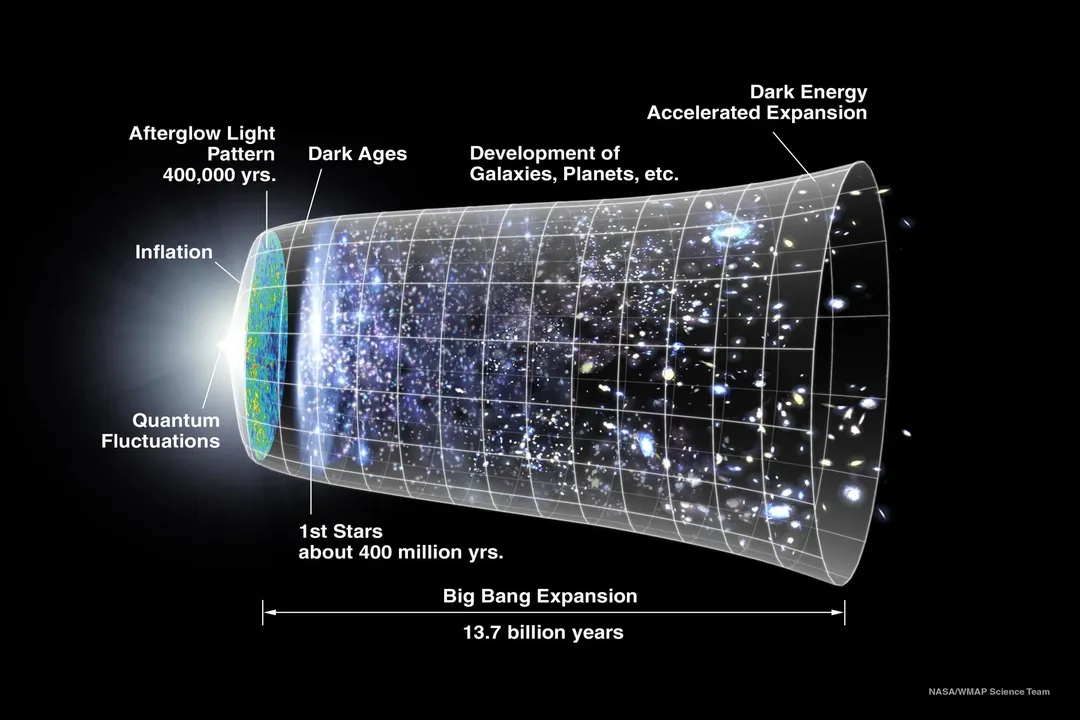
The notion that we might find a star older than the entire observable cosmos sounds like science fiction, yet for a time, astronomical data pointed directly toward this very conundrum. This startling possibility centered on a single, venerable object: the star designated HD 140283, often nicknamed the Methuselah star. [2][4] When initial calculations suggested its age might exceed the accepted age of the universe—currently pegged around $13.8$ billion years—it presented a genuine challenge to the reigning cosmological model, the Big Bang theory. [2][5][8]
# Stellar Age Paradox
The universe, according to measurements derived primarily from the Cosmic Microwave Background radiation and the expansion rate (Hubble constant), has a known lifespan. [8] If a stellar object exists that predates that boundary, it implies either the universe is older than we think, or our understanding of how stars form and evolve needs significant adjustment. [5][10] HD 140283 became the poster child for this potential crisis in astrophysics. [4] Early estimations placed its age at around $14.5$ billion years, or even older, creating an immediate conflict. [1][5]
The simple mathematics suggested a paradox: time cannot flow backward, and a star cannot have existed before the matter composing it coalesced from the initial plasma soup following the Big Bang. [10] This star, being so ancient, is what astronomers call a Population II star. [6] These ancient stars formed relatively soon after the Big Bang, before successive generations of stars had time to create and disperse significant quantities of heavy elements (what astronomers call "metals") into the interstellar medium. [6] Therefore, finding a metal-poor star that is too old is a sign that the entire cosmic timeline might be skewed.
# Methuselah Details
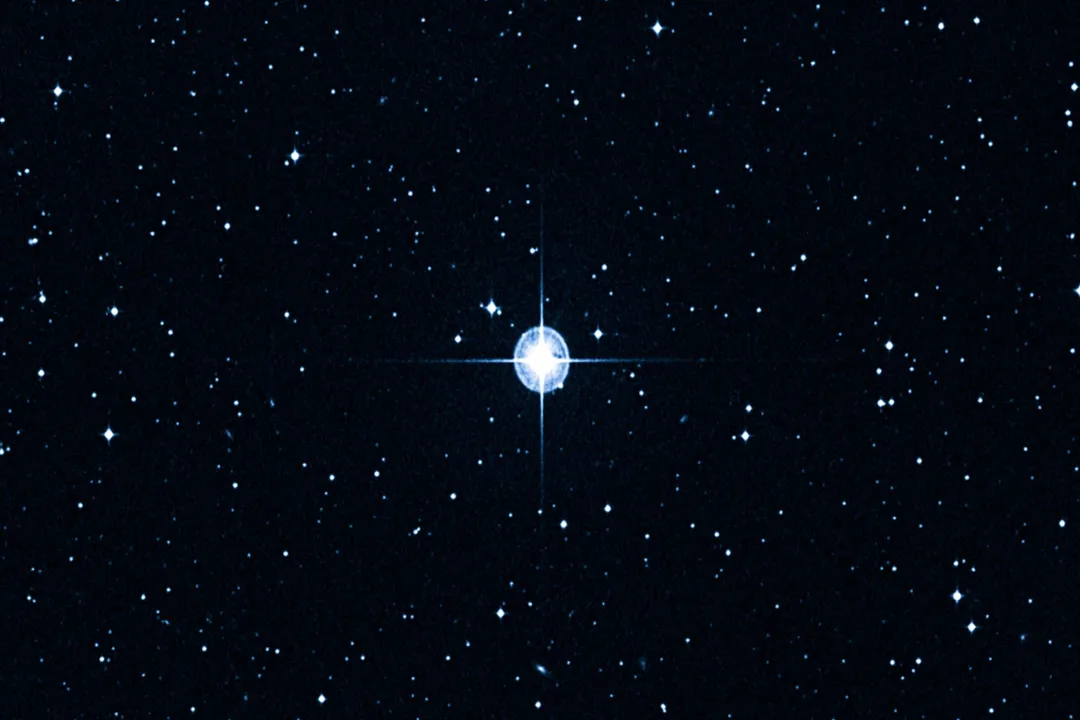
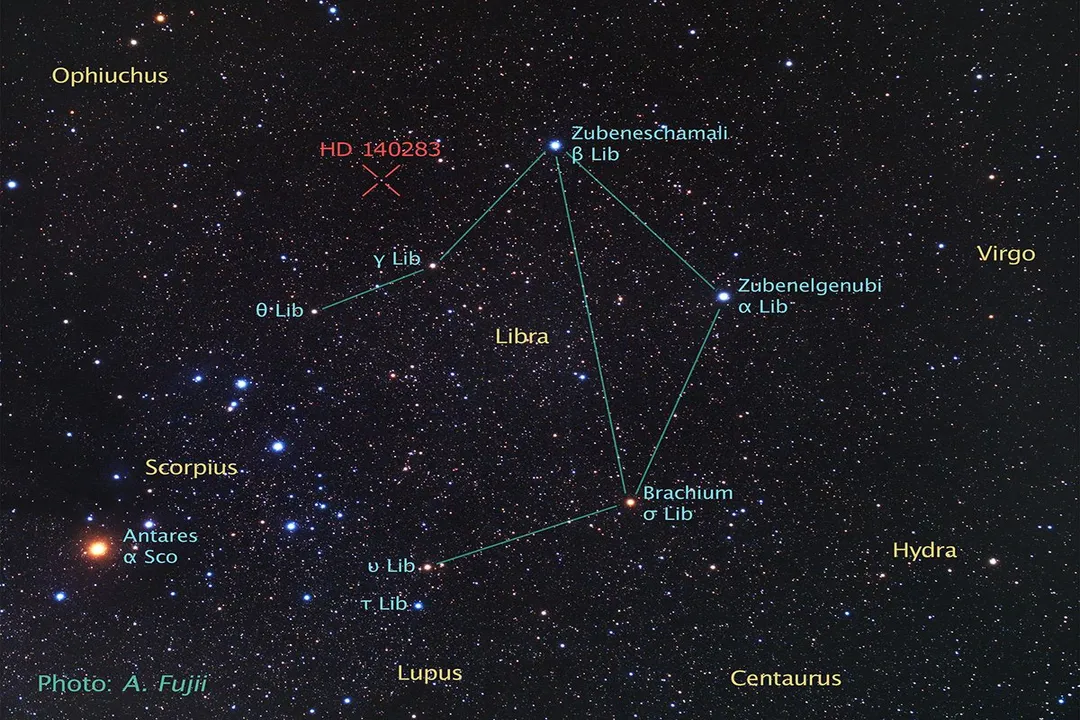
HD 140283 is not located in our immediate galactic neighborhood, residing about $190$ light-years away in the constellation Libra. [2] It is classified as a subgiant, meaning it has burned through the hydrogen fuel in its core and has begun evolving off the main sequence, swelling slightly as it moves toward becoming a red giant. [2]
Its composition is key to its age estimation. Because it is so old, it is extremely metal-poor, containing only about one-tenth the concentration of iron found in our Sun. [6] This scarcity of heavier elements confirms its primordial heritage. [6] To date a star, astronomers typically rely on two primary inputs: its physical characteristics (luminosity, temperature, size) and theoretical models of stellar evolution that predict how long it takes a star of that mass and composition to reach its current state. [3]
The primary challenge in dating HD 140283 came down to determining its precise distance and its exact abundance of oxygen, a key element that influences the rate of fusion and thus the burning time. [3] A slight overestimate of its initial mass, or an underestimate of its age due to slightly lower oxygen content, could easily push the calculated age past the cosmic limit. [3]
# Dating Refinements
When faced with a severe astrophysical contradiction, the first response is always to scrutinize the measurements. Scientists didn't immediately discard the Big Bang model; instead, they focused intensely on refining the parameters used to calculate the star’s age. [3][5] The relationship between a star’s distance and its calculated luminosity is highly sensitive; being off by even a small percentage in distance can translate to billions of years in age estimates for such old objects. [3]
Using data collected by the Hubble Space Telescope and improved stellar models, researchers managed to constrain the distance measurement more tightly. [3] By minimizing the uncertainty surrounding the star’s exact location and revising the theoretical models to better account for the small amount of oxygen present, the estimated age began to shrink. [3][5] The refined analysis brought the age estimate down significantly, placing it closer to $13.7$ billion years, with an error margin that overlapped with the universe's age of $13.8$ billion years. [3] This revision effectively pulled the Methuselah star back from being definitively older to being as old as the universe, thus dissolving the paradox. [2][5]
This entire episode serves as a fascinating example of how science self-corrects. The initial excitement about finding a pre-Big Bang relic quickly transitioned into a meticulous, data-driven effort to verify the initial, seemingly outlandish conclusion. [1][4]
The precision required in these measurements is staggering. To date a star $13$ billion years old to within a few hundred million years requires knowing its distance with an accuracy far surpassing typical stellar parallax measurements for objects that distant. [3] The initial estimates relied on older techniques, whereas the later, resolving measurements incorporated more sophisticated methods, essentially reducing the "uncertainty budget" to an acceptable level for the standard model. [5]
When we look at the difference between an initial estimate of $14.5$ billion years and a revised estimate of $13.7$ billion years, that $800$ million-year gap feels immense. [1] However, it is crucial to realize that for a star whose main-sequence lifespan is already near the maximum allowed by physics, error bars that span hundreds of millions of years are inherent to the technique, particularly when dealing with faint, old objects far from the Sun. [3]
# Cosmological Implications
If the initial dating had held true—if HD 140283 was definitively older than $13.8$ billion years—the implications would have been profound, perhaps forcing a look toward cyclical models of cosmology or theories involving a universe existing before the Big Bang. [8][10] These speculative models often suggest that our current universe is merely one iteration in an eternal sequence. [10]
However, the star’s continued existence within the accepted timeline, albeit right at the edge, is perhaps more informative. It acts as a powerful, real-world constraint on our models. The fact that the oldest objects we can measure align so closely with the predicted age of the universe reinforces the overall validity of the Big Bang model, contingent on accurate astrophysical data. [2][8] If we found numerous stars substantially older than the universe, the Big Bang theory would require a radical overhaul, but HD 140283 simply provided a necessary stress test. [2]
The evolution of a star like Methuselah tells us about the initial conditions of the cosmos itself. Since it formed so early, its chemical makeup—its low metallicity—is a direct fingerprint of the very first generation of stars that lived and died before it ignited. [6] This means that while the star itself did not precede the universe, it is a direct descendant of the universe's first stellar inhabitants, those "Population III" stars that we have yet to directly observe. [6] Its low-metal status anchors our knowledge of the earliest epoch of star formation within our universe.
# Looking Forward
The saga of the Methuselah star serves as a wonderful reminder of the dynamic nature of scientific consensus. What begins as a startling anomaly often resolves into a confirmation of existing theory once better data or improved methodologies are applied. [3] Astronomers will continue to refine the parameters for dating stars, especially those in the metal-poor category, as newer instruments come online. [5]
For general observers, the takeaway isn't that our universe is young, but that the tools we use to measure its history are constantly being sharpened. The $13.8$ billion-year figure is not arbitrary; it is a constantly refined estimate bound by the earliest observable relics, like HD 140283, which act as cosmic clocks. The true age lies somewhere within the error bars of our best measurements, and in this case, the clock hands ended up aligning perfectly with the universe's supposed birth certificate. [3]
#Videos
This Star Is Older Than The Universe and Scientists Can't Explain It
Related Questions
#Citations
Why (or how) is the age of the Methuselah Star older than ... - Reddit
HD 140283 - Wikipedia
Methuselah: The oldest star in the universe | Space
The Methuselah Star Seems Older Than the Universe - Facebook
This Star Is Older Than The Universe and Scientists Can't Explain It
Is the “Methuselah star” really older than the Universe? - Medium
The "Methuselah Star" does not disprove the Big Bang - Big Think
Is it true that a star known as “Methuselah star” existed before the ...
Early Universe - NASA Science
Could the Methuselah star be evidence that there was a universe ...