Is there a hidden world inside the earth?
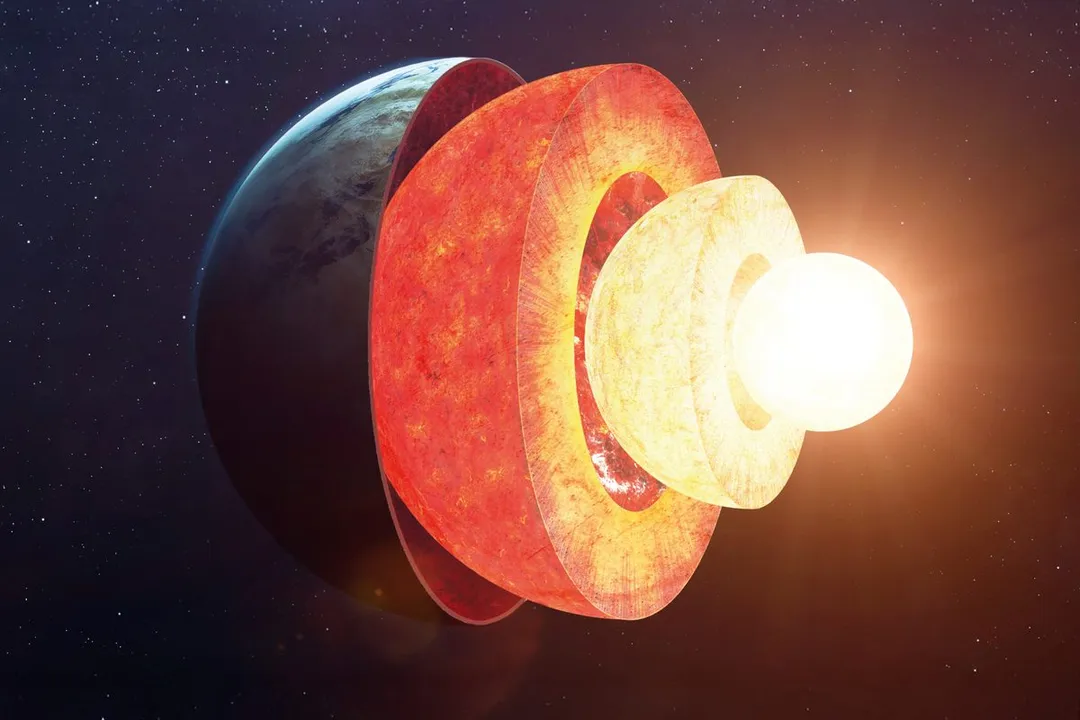
The persistent human curiosity about what lies beneath our feet fuels countless stories, yet the reality of Earth's interior, revealed through modern seismology and geology, presents a picture far stranger and more momentous than any fictional cavern. We look down not to find civilizations, but to uncover the remnants of cosmic collisions and material states that defy surface experience. While the idea of a secret, hollow realm populated by unknown beings remains firmly in the realm of speculative fiction, science points toward hidden worlds defined by extreme pressure, temperature, and historical violence deep within the planet’s structure. [3][5]
# Myths and Lore
The concept of an inner world isn't new. For centuries, cultures entertained notions of access points to the planet's interior, famously encapsulated in the Hollow Earth theory. [3] This belief posits that the Earth is entirely or partially hollow, sometimes suggesting it contains its own internal sun or is inhabited by advanced beings. [3] Some historical narratives proposed secret entrances near the geographic poles, mechanisms that have since been definitively ruled out by modern geophysical understanding. [3] Though these stories capture the imagination, they stand in stark contrast to the dense, layered reality we have mapped using the echoes of earthquakes.
# Actual Structure

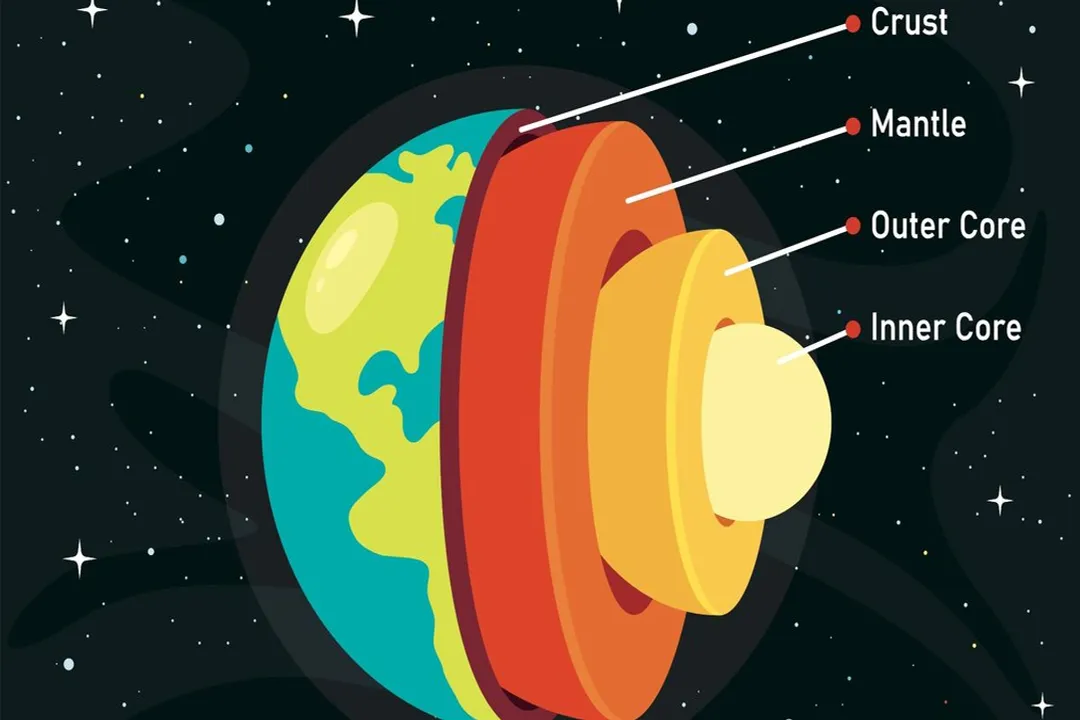
Our planet is organized into distinct, concentric layers, each with dramatically different properties based on temperature and pressure gradients. [5] From the outside in, we have the relatively thin crust, followed by the massive mantle, then the liquid outer core, and finally, the solid inner core. [5] This stratification isn't simply theoretical; it's observable because seismic waves—the vibrations generated by earthquakes—change speed and direction as they pass through materials of different densities. [5]
Studying these wave patterns is akin to echolocating a vast, opaque object. We cannot directly see the core, but we can infer its nature with remarkable precision. The outer core, for instance, is known to be liquid because S-waves (shear waves) cannot travel through it, while P-waves (compressional waves) slow down significantly. [5] The inner core, however, is solid, despite being hotter than the surface of the Sun, due to the immense pressure bearing down upon it. [5] The transition between the liquid outer core and the solid inner core is a critical boundary, but even the inner core itself is not perfectly uniform. Recent evidence suggests the structure of the inner core might be more complex, potentially exhibiting areas where the iron crystals have different orientations or even a slightly "mushy" texture near the boundary. [1] The idea that a solid center could possess such variation under unimaginable pressure forces a reconsideration of what we define as "solid" in extreme settings. [1]
If we consider the sheer scale, the core—both outer and inner—makes up nearly half the planet's radius, meaning that over half of Earth’s volume is comprised of these iron-nickel structures, a hidden material world entirely inaccessible to direct sampling. [5] Thinking about how we interpret these findings highlights an interesting point: because our only tools are indirect waves, precise mapping relies on minuscule differences in wave travel time, much like trying to determine the exact shape of a large submerged structure by listening to echoes bounced off its surface in a vast, dark ocean. [5]
# Theia Remains
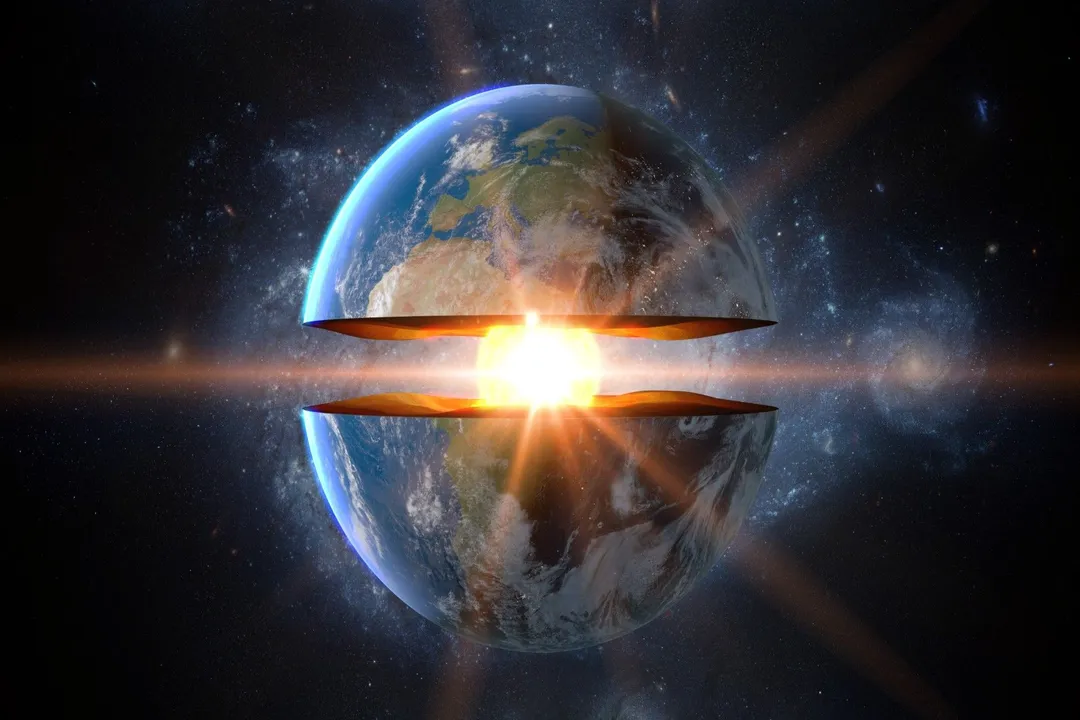
Perhaps the most scientifically compelling "hidden world" inside the Earth isn't a cavern, but a colossal deposit of ancient, exotic material. Geological evidence strongly suggests that about 4.5 billion years ago, a Mars-sized protoplanet named Theia slammed into the early Earth. [4][9] This impact is the accepted mechanism for the creation of our Moon. [9] However, the story doesn't end with the collision. Much of Theia’s mass didn't simply vaporize and reform the Moon; a significant portion sank, settling deep within the Earth’s interior. [4][9]
These ancient, distinct reservoirs of material are believed to reside beneath the mantle, possibly bordering the core boundary. [4] Scientists hypothesize that these massive piles of debris, remnants of Theia, are chemically different from the surrounding terrestrial material. [4] They are so large that they are considered structures within the mantle itself, sometimes referred to as Large Low Shear-Velocity Provinces (LLSVPs). [4] These features are so vast they span thousands of kilometers. [4] While they reside within the mantle rather than the core itself, they represent an enormous, chemically distinct, and fundamentally alien world embedded within our own planet, a direct record of the solar system’s violent birth. [4] Comparing the potential scale of these structures to something tangible, if the material from Theia coalesced separately, it would be comparable in mass to a significant terrestrial body, yet it now sits permanently locked away beneath our feet, influencing mantle flow and volcanism. [4]
# Deep Biosphere
Moving away from the planet's physical center, another type of hidden world exists: a biosphere hidden within the crust and mantle that challenges our understanding of where life can thrive. While the core itself is too hot and pressurized for known life, the deep subsurface harbors vast microbial ecosystems. [8] These communities exist independent of sunlight, deriving energy from chemical reactions within the rock and water deep underground. [8]
This deep realm is characterized by unique forms of chemosynthesis, utilizing minerals and gases trapped within the rock matrix. [8] The extent of this subsurface living space is still being quantified, but it suggests that Earth's habitable zone extends miles below the surface, creating a vast, dark realm populated by organisms adapted to conditions that would instantly kill surface life. [8] This offers a different kind of internal secret—a living, dynamic environment rather than a static, dense material one.

# Core Dynamics
The very nature of the solid inner core continues to be a subject of intense scrutiny. Scientists have analyzed seismic data, particularly waves traveling through the inner core, to understand its orientation and composition. [1] One compelling discovery suggests that the inner core may not be a perfectly uniform sphere of pure iron crystals. Some research indicates that the innermost part of the core might have a structure that is fundamentally different from the layer just outside it. [1] Specifically, some models suggest a solid inner-inner core that is compositionally or structurally distinct. [1]
This differentiation implies a complex evolutionary history for the core, perhaps marking a phase change or solidification event billions of years ago. [1] Analyzing the seismic data from waves that travel across the planet provides the necessary expertise to infer these structures, treating the wave distortion as the primary evidence. [5] The high pressure and temperature environment means that the movement and alignment of iron atoms within this solid sphere are governed by forces we cannot replicate in a laboratory setting, making every new finding a significant piece of geological discovery. [1]
# Reconciling Reality and Imagination
The allure of a fully formed, habitable world inside Earth persists because the reality of the deep interior—the immense pressure, the alien material from Theia, and the existence of the deep biosphere—is inherently difficult to grasp. [3][5] While we definitively know there are no great subterranean oceans or hidden suns accessible via polar openings, we do have evidence of incredible, hidden material worlds within: the chemically distinct mass of an ancient impactor, and a vast, sunless ecosystem supporting life. [3][4][8] The difference lies in scale and composition. The internal secret is not one of geography, but of geochemistry and physics operating under unimaginable duress. [5] To truly understand our planet, we must shift our focus from seeking fictional portals to refining the seismic measurements that reveal the billion-year-old remnants of planetary formation and the present-day limits of life itself. [4]
#Videos
There Is Life Hiding Inside Earth - YouTube
The Remains of an Ancient Planet Lie Deep Within Earth - YouTube
Related Questions
#Citations
'New hidden world' discovered in Earth's inner core | Live Science
There's a secret realm hidden at Earth's core – and scientists are ...
Hollow Earth - Wikipedia
The Remains of an Ancient Planet Lie Deep Within Earth - Caltech
There Is Life Hiding Inside Earth - YouTube
Massive hidden structures deep inside Earth may explain how life ...
Scientists discover 'sunken worlds' hidden deep within Earth's ...
Chunks of an Alien World Could Be Hidden Deep Within Our Planet