Does Earth have a hidden ocean?
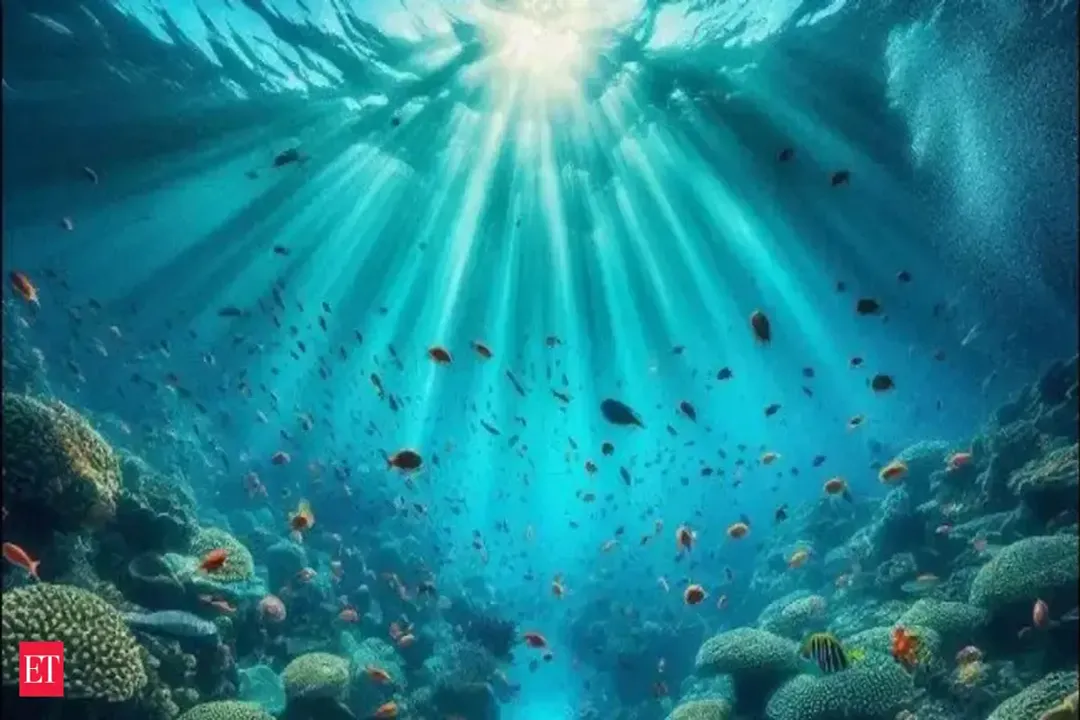
The idea that oceans exist only where the sky meets the land is a simplification that planet science is busy overturning. Deep beneath the familiar crust, beneath the mountains and the abyssal plains, rests a volume of water so immense it challenges our understanding of the planet's very composition. It isn't a vast, sloshing sea of liquid water like the Atlantic or Pacific, which might lead to misleading imagery of flooded underground caverns. Instead, this water is hidden in a state far stranger to us, locked away in the rocky structure of the Earth's interior.
# Mantle Layers
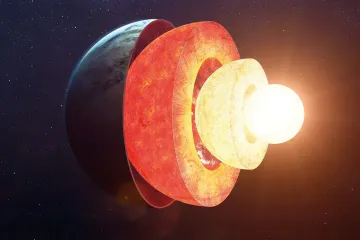
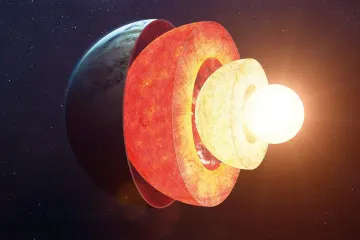
To appreciate this hidden reservoir, one must look past the familiar surface crust, which averages about 30 miles thick. Below this lies the mantle, a layer making up approximately 84 percent of the planet’s total volume, stretching for about 1,800 miles. The mantle is not uniform; it is commonly divided into three sections: the upper mantle, the transition zone, and the lower mantle. Scientists have long theorized that water cycling into the planet gets stuck somewhere in these layers, but definitive proof remained elusive until researchers focused their attention on a specific depth range.
# Transition Zone
The key location for this discovery centers on the mantle's transition zone, which sits roughly between 250 miles and 410 miles beneath the surface. Early speculation placed potential water reservoirs here, and subsequent research confirmed this area may be saturated with . This region, which has been observed extensively beneath the United States, appears to be as wet as the rocks can physically hold under the immense pressure and heat found there. This contrasts sharply with the upper and lower mantles, which are generally considered to be "bone-dry". The sheer volume being discussed suggests that the total amount of water held in this zone could be equivalent to nearly three times the amount of water found in all our surface oceans combined.
# Ringwoodite Mineral
The substance holding this massive quantity of water is a rare mineral called ringwoodite. This mineral only forms under the extreme temperature and pressure conditions present deep within the mantle. The water is not present as liquid, ice, or vapor; rather, it is chemically integrated into the mineral’s crystal structure, existing as a form of water of hydration. Researchers found that ringwoodite acts much like a sponge, possessing a unique structure that attracts and traps hydrogen, allowing it to hold a significant amount of . One specific, rare sample of ringwoodite, recovered from a diamond brought up by volcanic forces from a depth of about 400 miles in Mato Grosso, Brazil, demonstrated that it was comprised of about 1.5 percent water by weight. Experiments synthesizing ringwoodite in laboratories have shown it can contain more than one percent of its weight as .
# Seismic Tracing
Discovering something miles underground without drilling requires indirect methods, and in this case, geophysicists relied on the planet’s own rumblings: earthquakes. Researchers, including geophysicist Steven Jacobsen and seismologist Brandon Schmandt, used seismic wave data gathered from extensive networks, like the USArray of over 2,000 seismometers across the United States. When seismic waves generated by earthquakes pass through an area saturated with water-bearing ringwoodite, their speed slows down. This sluggishness provided the team with clear evidence of water-rich rock existing at these depths, particularly across the interior of the US. The initial research, published in the journal Science in 2014, combined this observational seismic data with laboratory simulations conducted under high-pressure diamond-anvil cells to confirm the wave-slowing effect was consistent with the presence of melted rock caused by water release.

# Water Origin
This discovery feeds into a long-standing geological debate: where did Earth’s surface water originate? For a long time, the prevailing theory suggested that Earth was largely dry upon formation and received its oceans through impacts from icy comets and asteroids. However, the existence of such a vast reservoir within the mantle lends considerable support to the theory that a significant, if not primary, source of our water came from outgassing from within the planet itself. This internal reservoir may explain why the planet has maintained such a stable supply of surface water over geological timescales.
# Dehydration Melting
The trapped water doesn't stay bound forever; it is an active participant in the planet's ongoing processes. This is where the concept of dehydration melting comes into play, tying the deep water to surface phenomena like volcanism. As the rock mass containing water-heavy ringwoodite is drawn deeper into the mantle, it eventually reaches conditions where it begins to transform into a different, higher-pressure mineral called silicate perovskite. Silicate perovskite cannot hold the water within its structure the way ringwoodite can. This forces the to be squeezed out of the descending rock—"almost as if they're sweating"—which triggers partial melting of the rock at the boundary between the transition zone and the lower mantle.
This process, where water is effectively "sweated out" of the rock, generates small pockets of magma, which is exactly what the seismic wave analysis detected beneath North America. The water that is released may then become trapped again in the transition zone, suggesting a whole-Earth water cycle is in effect, cycling materials between the surface and the deep interior via subduction.
# Volume Context
To truly grasp the scale of the discovery, it helps to place the percentage of water content into context. The transition zone rock, if just one percent of its weight is , contains a volume that rivals our surface oceans. Consider that a typical, non-porous rock like granite might only contain trace amounts of bound water, perhaps well under 0.5% by weight. Even oceanic crust, when saturated near hydrothermal vents, holds far less accessible water than what is being theorized across the entire transition zone volume. If we take the estimated water content found in the Brazilian ringwoodite sample, and apply that across the estimated volume of the transition zone, the resulting quantity is staggering. If the surface oceans hold an estimated $1.35$ billion cubic kilometers of water, a reservoir three times that size would equate to roughly 4 billion cubic kilometers of held as a structural component of rock—a truly mind-boggling quantity of material that is effectively the largest water reservoir on the planet.
# Deep Implications
The significance of this deep water reservoir extends beyond just adding to the planet’s total budget; it influences planetary dynamics. The movement of this water—subducting, being trapped, and then being released via dehydration melting—is likely a fundamental driver of geological activity. For example, the presence of water significantly lowers the melting point of rock. Therefore, the dehydration melting occurring at the boundary of the transition zone and the lower mantle directly influences the formation of magma. This provides a critical link between the seemingly static deep interior and the dynamic surface processes we observe, such as volcanism and plate tectonics. If this mechanism is globally active, it has profound consequences for how we model mantle convection, which in turn dictates how continents form and shift over eons. Understanding this deep cycle gives scientists a more accurate composition model for Earth, potentially improving predictions about the planet's long-term habitability and even offering a template for assessing water content on other rocky worlds. While we won't be piping this water up for drinking, realizing how much water is structurally integrated into the planet's deep architecture forces us to view Earth as a system where water is constantly being recycled through the deep rock, rather than just moving between the sea, sky, and ground we walk on.
Related Questions
#Citations
Is there An Ocean Below Your Feet?
A Gigantic Ocean Discovered 700km Beneath The Earth's ...
New Evidence for Oceans of Water Deep in the Earth
Scientists found a massive underground ocean hidden ...
There's an Ocean Beneath Your Feet!
There May Be a Massive Ocean Beneath the Earth's Surface