How hot are the cores of stars?
The center of a star is the universe’s most extreme furnace, a place where matter is pressed and heated to conditions that redefine our understanding of energy and stability. This region, the stellar core, is where the engine of a star resides, responsible for producing the light and heat that sustains life, like ours, across unimaginable distances. Asking how hot these cores are is like asking about the world’s highest mountain—the answer depends entirely on which mountain you are looking at, or in this case, which star. The temperature is not a single number; it is a sliding scale dictated by the star's mass, its chemical composition, and its current stage of life.
For any celestial body to officially be called a star, its core must reach the critical threshold necessary to initiate sustained thermonuclear fusion. This process releases enormous energy, creating an outward pressure that perfectly balances the crushing force of the star’s own gravity, holding the massive object in hydrostatic equilibrium.
# Fusion Ignition
The fundamental requirement for a star to shine through fusion is temperature. To force hydrogen nuclei—simple protons—to overcome their natural electrical repulsion and fuse into helium, the core must reach at least $10^7$ Kelvin (). This temperature ensures the particles are moving fast enough to tunnel through the Coulomb barrier, the repulsive electrostatic force between their positive charges. If a gas cloud collapses and never achieves this heat, it doesn't become a star; it becomes a failed star, known as a brown dwarf.
The process that initiates this searing heat is gravity itself. A star begins as a vast, diffuse cloud of gas. Gravity draws this material inward, causing the cloud to contract. As the radius shrinks, the gravitational potential energy of the infalling material is converted into the kinetic energy of the particles, which then "thermalizes" through collisions. This internal motion is what we experience as rising temperature and pressure. The entire system works as a self-governing feedback loop: collapse increases temperature, which increases pressure, which slows the collapse. This continues until the critical fusion temperature is met, at which point the new outward pressure from fusion stops any further gravitational contraction.
# Sun Core
Our own Sun, a stable, main-sequence star, offers the most familiar benchmark. Its core operates at a staggering degrees Celsius, which is comparable to $15$ million . At this temperature, the primary energy generation mechanism is the proton-proton () chain reaction, where four hydrogen nuclei combine to form one helium atom. In the Sun's specific mass range, this process provides nearly all of its power, with the cycle contributing only about $1.5%$ of the net energy.
The stability of the Sun’s core, fueled by hydrogen conversion into helium, is expected to last for about ten billion years. It took roughly $100$ million () years for the Sun’s core region to reach this thermal equilibrium after it first formed. The density at this center is extreme, exceeding ().
The core temperature is intrinsically linked to the star's mass, even among main sequence stars. For a very low-mass star, like a red dwarf, the core temperature is less intense, around (5 million ) when it has $0.1$ times the mass of the Sun. This temperature continues to decrease as the mass drops further.

# Giant Heating
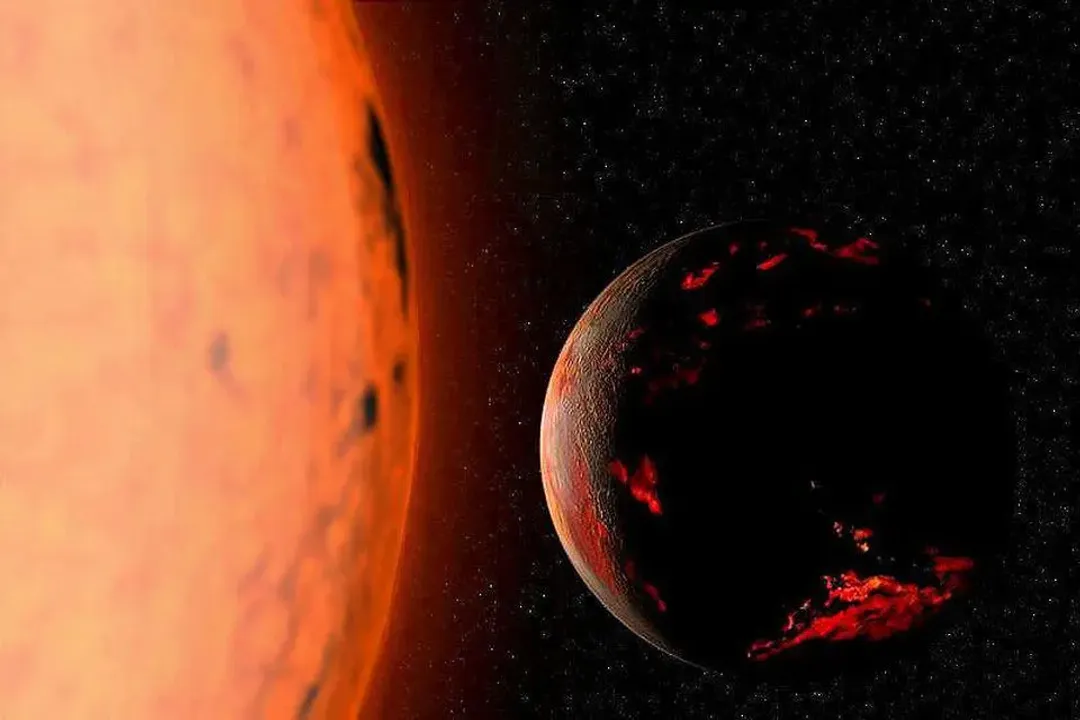
As a star ages and consumes the hydrogen fuel in its very center, the core begins to change dramatically. With fusion ceasing in the center, gravity takes over, causing the inert helium core to contract and heat up intensely. This heating ignites hydrogen fusion in a shell surrounding the contracting core, marking the subgiant phase.
For solar-mass stars, this contraction continues until the core becomes hot and dense enough to ignite helium fusion, transforming the star into a red giant. Helium atoms begin fusing into carbon atoms via the triple-alpha process. This ignition requires the core temperature to climb significantly higher—around (one billion ), or $1$ billion degrees Celsius. At this density, around , the helium core undergoes an explosive event called the helium flash before settling into a stable fusion rate.
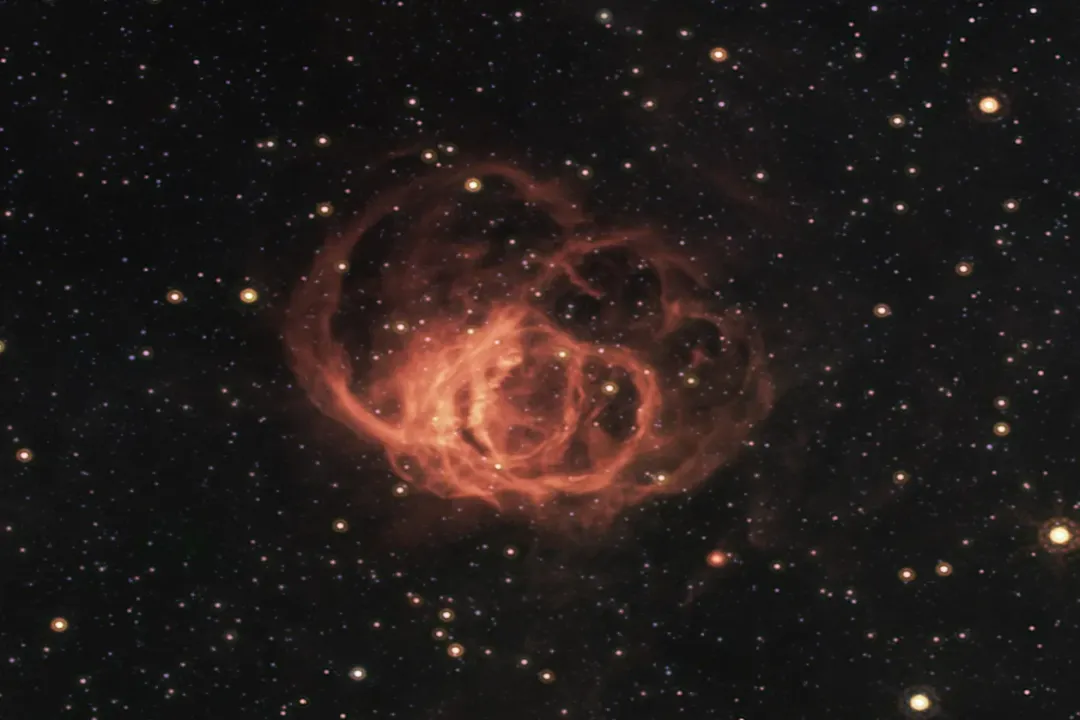
In significantly more massive stars—those $1.5$ times the mass of the Sun or greater—the energy production shifts while on the main sequence. The cycle, which uses carbon, nitrogen, and oxygen as catalysts, becomes increasingly dominant because its reaction rate is much more sensitive to temperature than the chain. When the core temperature hits in a star, the energy output splits evenly between the two processes. When these giants advance past helium, the core contracts again, eventually reaching temperatures high enough to fuse carbon into heavier elements like oxygen and nitrogen, which requires the core to hit . This complex layering of burning shells—hydrogen burning in an outer layer and helium/carbon burning deeper inside—is entirely mapped out by the temperature structure established deep within the core.
Here is a simple way to place these thermal milestones in context, noting that at these extreme levels, the difference between and is negligible:
| Star State/Type | Core Fusion Element | Approximate Core Temperature |
|---|---|---|
| Very Low-Mass Star () | Hydrogen | Million |
| Sun-like Star (Main Sequence) | Hydrogen ( Chain) | Million |
| Solar-Mass Red Giant | Helium into Carbon | Billion |
| Massive Star (Carbon Burning Phase) | Carbon into Oxygen/Neon | Million |
| Hottest True Star Core (WR 102) | Carbon/Neon/Oxygen | Billion |
# Wolf Rayet
When considering the absolute hottest cores, we must look past the long-lived main sequence stars and toward the most massive, evolved stars that are nearing collapse. The hottest surface temperatures observed on what are classified as "true stars" (those undergoing standard stellar fusion) belong to Wolf-Rayet () stars. These stars have already blown off their outer hydrogen layers through ferocious stellar winds. The hottest known of these, , has a surface temperature around .
However, surface temperature is a poor guide for core heat. The massive nature of stars means their cores are undergoing the fusion of heavier elements, driving temperatures far higher than the surface can reveal. Theoretical models for a star like suggest its core is currently hot enough () to burn carbon or neon. The very leading edge of stellar evolution—a phase that might last only a few years or even days—could see that core temperature climb to times higher still, potentially reaching billion as it burns oxygen or silicon right before an inevitable core collapse. The core temperature in these extreme cases defines the star's imminent, violent end.
# Neutron Core
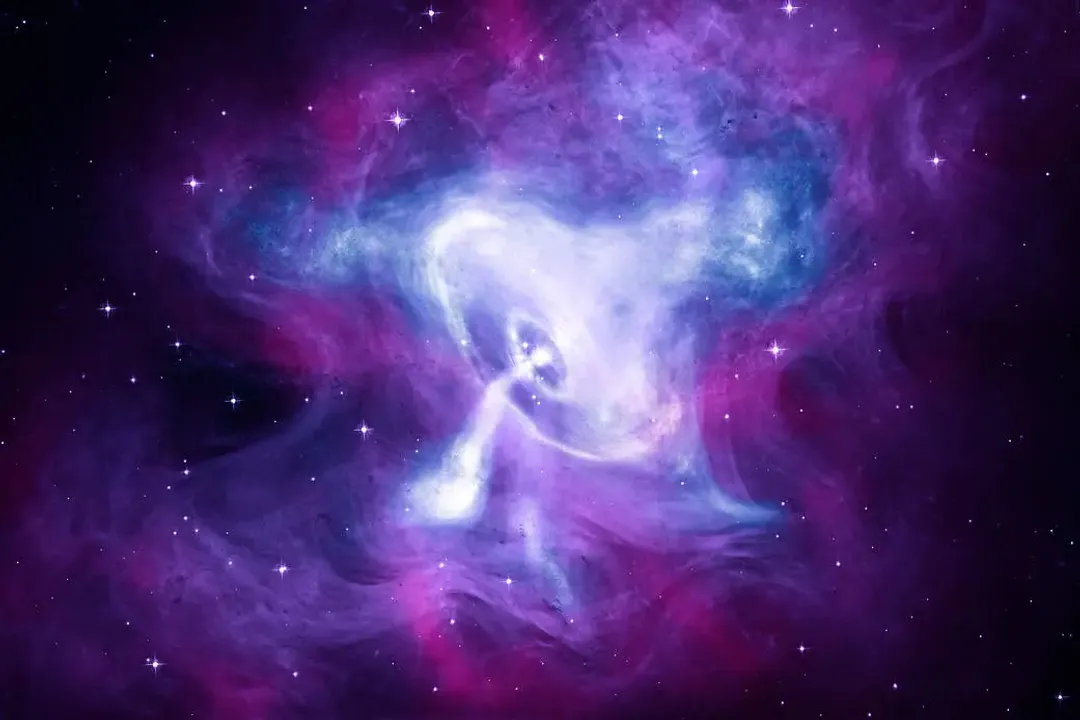
The most phenomenal heat is found not in a living star, but in its corpse: the neutron star. These are the ultra-compressed remnants of supernovae involving massive progenitor stars ( to ). The collapse is so complete that the star’s core shrinks to a sphere only about to miles across.
This catastrophic compression converts vast amounts of gravitational energy directly into thermal energy, making the newly formed core spectacularly hot. Calculations suggest the interior of a newborn neutron star reaches temperatures between billion and trillion ( to ). To put this into perspective, the Sun’s core is a mere $15$ million . The core temperature of a young neutron star is billions of times hotter than the surface of our star.
The confusion regarding the heat of neutron stars often comes from misinterpreting the Kelvin scale. is an absolute scale where is the coldest possible temperature (absolute zero), equivalent to . Therefore, is profoundly hot, not cold. These objects cool quickly for their age because they radiate energy so efficiently, primarily through neutrinos in the first hundreds of thousands of years. After this rapid initial cooling, the core temperature settles to perhaps $10^8$ to . Even after millions of years, a cooling neutron star core might still register around . While is far cooler than its birth temperature, it is still vastly hotter than the surface of the Sun ().
The physics inside a neutron star core is complex because the extreme density means thermal energy exists alongside quantum effects. The neutrons form a degenerate Fermi fluid, supported by degeneracy pressure, not thermal pressure, against gravity. In this state, neutrons can even enter specialized states like superfluidity at these "cool" residual temperatures (relative to the Fermi energy), which further complicates how they lose heat over cosmic timescales.
# Core Determinism
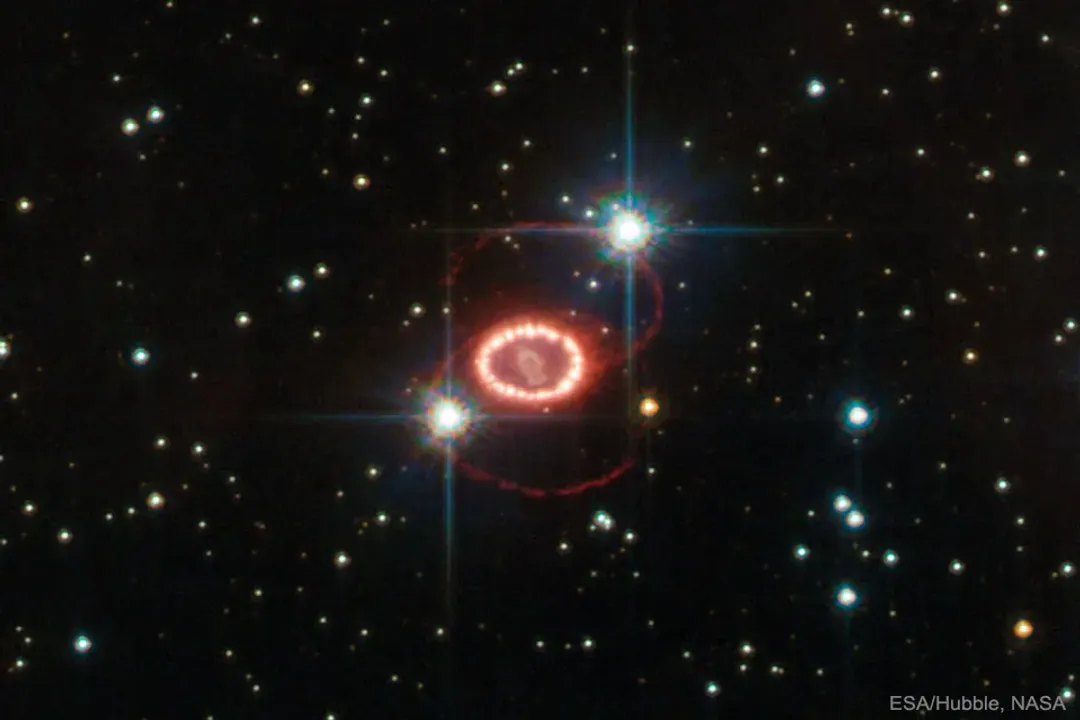
The temperature within a star's core is more than just an indicator of how hot it is; it is the fundamental control mechanism dictating the star's entire existence and subsequent fate. The central temperature determines which nuclear fuel can be accessed next. A star hot enough for hydrogen fusion will only begin fusing helium once the core contracts and heats up enough to hit the billion mark. If the star cannot reach that second threshold, it dies as a white dwarf after exhausting its hydrogen. For the most massive stars, the temperature continues to escalate through carbon, neon, oxygen, and silicon burning, with each step requiring a higher core temperature to overcome the ever-increasing repulsion of heavier nuclei. The instant the core produces iron, fusion stops because fusing iron absorbs energy rather than releasing it. This temperature-defined boundary marks the definitive end of a massive star's life, triggering the gravitational collapse that leads to a supernova and the creation of even hotter neutron stars or black holes. The core temperature, therefore, serves as a cosmic clock, setting the pace for stellar evolution across the entire spectrum of stellar masses.
Related Questions
#Citations
Stellar core - Wikipedia
The Core of a Star Reaches 16 Million Degree Celsius. A Grain of ...
Stars - StarChild - NASA
Is the temperature of the hottest star's core known?
Are neutron star cores cold or hot because somethings say ... - Quora
Lecture 8: How Hot is a Star?
How hot are the hottest stars in the Universe? - Big Think