How do catalysts lower activation energy?
Chemical reactions are the engine of everything, from the fizz in a soda can to the complex manufacturing processes that create modern materials. Yet, many thermodynamically favorable reactions—reactions that should happen based on the energy difference between starting materials and products—occur agonizingly slowly, if at all, under standard conditions. [8] The speed of a chemical transformation is often governed by a bottleneck, an initial energy investment required to kickstart the process. This initial hurdle is precisely what chemists call the activation energy (). [10] To speed things up, chemists turn to catalysts, substances that possess the remarkable ability to lower this energy barrier without being chemically altered themselves by the end of the reaction. [3][5][9]
# Defining Energy
Activation energy is best understood as the minimum energy required for reactants to successfully collide and form products. [10] Think of it as the height of a hill that reactants must climb to get to the transition state, which is the most unstable point along the reaction pathway. [4][6] Only molecules possessing kinetic energy equal to or greater than this threshold can successfully react. [8] If the activation energy is very high, only a minuscule fraction of molecules will have enough energy at any given moment, leading to an extremely slow reaction rate. [5] Conversely, if the energy barrier is low, many more molecules can overcome it, and the reaction proceeds quickly. [4]
# Catalyst Function
A catalyst is defined by its effect: it increases the rate of a chemical reaction without being consumed in the net process. [3][7][9] This is a critical distinction; a catalyst might react temporarily during the process, but it is regenerated by the end, allowing it to participate in subsequent reaction cycles. [5][10] The presence of a catalyst does not change the inherent thermodynamics of the reaction; the energy difference between the reactants and the products, known as the overall enthalpy change (), remains exactly the same whether the reaction is catalyzed or not. [1][4][5][10] The catalyst only changes how the reaction gets from A to B. [4]
# Alternative Route
The fundamental way a catalyst achieves this rate enhancement is by offering an alternative reaction mechanism. [1][4][5] Imagine a mountain pass versus a tunnel: both lead to the same destination (products), but the tunnel requires much less effort (energy) to traverse than climbing over the mountain. [6] The catalyzed reaction pathway has a lower energy profile than the uncatalyzed reaction pathway. [4][10] This new route often involves a series of steps with lower energy barriers than the single, high-energy barrier of the uncatalyzed path. [5]
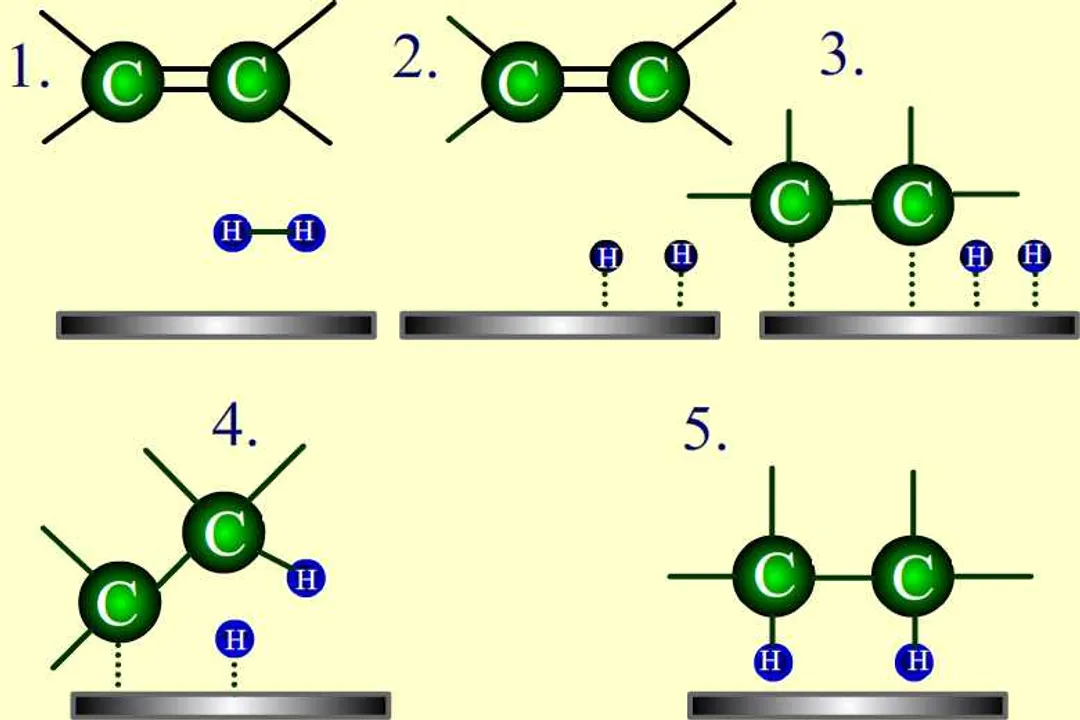
In many heterogeneous catalysis examples, such as industrial processes, the physical interaction at the catalyst surface is key. Reactants adsorb onto the catalyst surface, which effectively concentrates them in close proximity and often weakens the bonds within the reactant molecules themselves, making them more receptive to reaction. [4] This localized interaction changes the electronic structure temporarily. A helpful way to visualize this is to consider the catalyst acting like a temporary molecular scaffold; it holds the reactive parts of the molecules together in the perfect orientation and geometry needed for bond breaking and forming, reducing the entropic penalty and the specific energy required for that alignment, which is a significant part of the activation energy barrier. [4]
# Energy Profiles
Chemists represent this change using energy profile diagrams, which plot the potential energy of the system against the reaction coordinate (the progress of the reaction). [4][6]
When comparing the two pathways on such a diagram, we observe:
- Uncatalyzed Reaction: Shows a single, tall peak representing the high activation energy ( uncatalyzed). [4]
- Catalyzed Reaction: Shows a lower overall energy profile path, often featuring multiple, smaller peaks corresponding to the intermediate steps in the new mechanism. The highest peak in the catalyzed pathway is significantly lower than the peak of the uncatalyzed reaction ( catalyzed uncatalyzed). [4][10]
Crucially, the starting energy level (Reactants) and the final energy level (Products) are the same for both curves. [1][5] This visual representation makes it clear that the catalyst is not storing or releasing energy; it is simply providing a "shortcut" that requires less initial energy input. [10]
# Rate Comparison
The reduction in activation energy directly translates into a faster reaction rate because a larger fraction of the reactant molecules possess the necessary energy to react at any given temperature. [8] If we consider the Arrhenius equation, which links the rate constant () to the activation energy () and temperature ():
Where is the pre-exponential factor and is the gas constant. [4] Because appears in the negative exponent, a decrease in results in an exponential increase in the rate constant . [4] This is why even a small decrease in the activation barrier can lead to a massive acceleration of the reaction speed. [4]
An illustrative scenario highlights this mathematical reality: If a catalyst reduces the activation energy by just at room temperature (), the reaction rate will increase by a factor of approximately ten. If the reduction is , the rate can increase by a factor of about one hundred. This compounding effect explains why certain industrial processes rely on highly specific catalysts to achieve commercially viable production speeds, turning what would take centuries into mere hours.
# Catalyst Types
Catalysts are broadly categorized based on the phase (state of matter) of the catalyst relative to the reactants. [7]
# Homogeneous Catalysis
In homogeneous catalysis, the catalyst exists in the same phase as the reactants, usually as a liquid or gas. [3][7] For example, enzymes in biological systems (biological catalysts) operate within the aqueous medium of the cell. [7] The advantage here is often high selectivity and uniform interaction, but separation of the catalyst from the final product can sometimes be difficult. [3]
# Heterogeneous Catalysis
Heterogeneous catalysis involves the catalyst being in a different phase than the reactants, most commonly a solid catalyst acting on liquid or gaseous reactants. [7] A classic example is the catalytic converter in a car, which uses solid metal surfaces (like platinum or palladium) to convert harmful gases into less harmful ones. [7] The mechanism here relies heavily on surface area, as the reaction occurs only where the phases meet. [4]
# What Catalysts Do Not Change
It is important to dispel a few common misconceptions about what these chemical accelerators achieve. [5]
- Equilibrium Position: Catalysts do not shift the position of a chemical equilibrium. [1][3] They speed up both the forward and the reverse reactions equally by lowering the activation energy for both directions. [10] Thus, the system reaches equilibrium faster, but the final ratio of products to reactants at equilibrium remains governed by the (Gibbs Free Energy change) of the reaction, which the catalyst does not influence. [3]
- Reaction Stoichiometry: Catalysts do not appear in the net chemical equation because they are not consumed overall. [3]
# Practical Application
The application of catalysis is vast and touches nearly every facet of modern chemistry and industry. [2][7] The development of efficient catalysts is central to reducing energy costs and minimizing waste in manufacturing. [7] For instance, in the Haber-Bosch process for making ammonia, iron-based catalysts dramatically lower the necessary pressure and temperature required for nitrogen and hydrogen to combine, which is otherwise incredibly slow. [2] Similarly, the chemical transformations that occur in your own body—like digesting food or synthesizing proteins—are entirely dependent on specialized biological catalysts called enzymes. [7] Enzymes achieve incredible rates and selectivity under mild conditions (near neutral pH and body temperature) because their active sites are perfectly evolved to lower the activation energy for very specific transformations. [7] Understanding the principles of activation energy reduction allows chemists to design better, greener, and more specific chemical transformations for the future. [2][7]
#Videos
Activation Energy and Catalysts - YouTube
Related Questions
#Citations
How does a catalyst affect activation energy? : r/askscience - Reddit
Catalysts & Activation Energy | ChemTalk
The Effect of a Catalyst on Rate of Reaction - Chemistry LibreTexts
Effect of catalysts - Chemistry 302
How does a catalyst actually lower the activation energy of a reaction?
Activation Energy and Catalysts - YouTube
DOE Explains...Catalysts - Department of Energy
7.4 Mechanism of reaction and catalysis | Rate and extent ... - Siyavula
Activation Energy and Catalysts | Definition, Relation & Examples
How Catalysts Affect Activation Energy | RevisionDojo