
catalyst articles

What is the primary role of enzymes in biological reactions?

What is the primary role of enzymes in biological reactions?

What characteristic ensures metabolic pathways function without chaotic crosstalk?

What characteristic ensures metabolic pathways function without chaotic crosstalk?

How is the three-dimensional structure of the active site formed?

How is the three-dimensional structure of the active site formed?

What distinguishes the induced-fit model from the lock-and-key model?

What distinguishes the induced-fit model from the lock-and-key model?

Which noncovalent force is specifically mentioned as involving electrostatic attractions between charged groups on the enzyme and substrate?

Which noncovalent force is specifically mentioned as involving electrostatic attractions between charged groups on the enzyme and substrate?

What type of specificity describes an enzyme that acts only on molecules sharing a specific functional group, regardless of the overall structure?

What type of specificity describes an enzyme that acts only on molecules sharing a specific functional group, regardless of the overall structure?

Why does trypsin cleave peptide bonds after lysine or arginine, while chymotrypsin cleaves after large hydrophobic residues?

Why does trypsin cleave peptide bonds after lysine or arginine, while chymotrypsin cleaves after large hydrophobic residues?

How do severe deviations in pH affect enzyme function?

How do severe deviations in pH affect enzyme function?

What mechanism involves a regulator binding to a site *separate* from the active site to modulate function?

What mechanism involves a regulator binding to a site *separate* from the active site to modulate function?

In kinetic analysis, what does a lower Michaelis constant ($	ext{K}_	ext{m}$) indicate about an enzyme?

In kinetic analysis, what does a lower Michaelis constant ($ ext{K}_ ext{m}$) indicate about an enzyme?
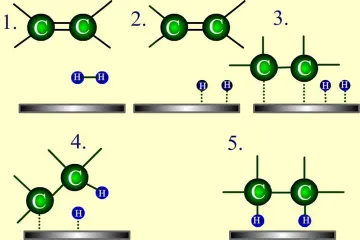
What does activation energy ($E_a$) represent in a chemical reaction?

What does activation energy ($E_a$) represent in a chemical reaction?

What is the primary way a catalyst accelerates a chemical reaction?

What is the primary way a catalyst accelerates a chemical reaction?

Does the presence of a catalyst change the inherent thermodynamics ($\Delta H$) of a reaction?

Does the presence of a catalyst change the inherent thermodynamics ($\Delta H$) of a reaction?

On an energy profile diagram, what is true regarding the reactant and product energy levels for both catalyzed and uncatalyzed reactions?

On an energy profile diagram, what is true regarding the reactant and product energy levels for both catalyzed and uncatalyzed reactions?

According to the Arrhenius equation structure ($k = A \cdot e^{-E_a / RT}$), what effect does a decrease in $E_a$ have on the rate constant ($k$)?

According to the Arrhenius equation structure ($k = A \cdot e^{-E_a / RT}$), what effect does a decrease in $E_a$ have on the rate constant ($k$)?

What must be true about the phase of the catalyst relative to the reactants in heterogeneous catalysis?

What must be true about the phase of the catalyst relative to the reactants in heterogeneous catalysis?

How does a catalyst affect the position of a chemical equilibrium?

How does a catalyst affect the position of a chemical equilibrium?

What critical condition must be met for a substance to be classified as a catalyst?

What critical condition must be met for a substance to be classified as a catalyst?

What is the key advantage provided by using catalysts like iron in the Haber-Bosch process?

What is the key advantage provided by using catalysts like iron in the Haber-Bosch process?

What term describes specialized biological catalysts that function effectively under mild conditions like body temperature and neutral pH?

What term describes specialized biological catalysts that function effectively under mild conditions like body temperature and neutral pH?