How does energy flow through food webs?
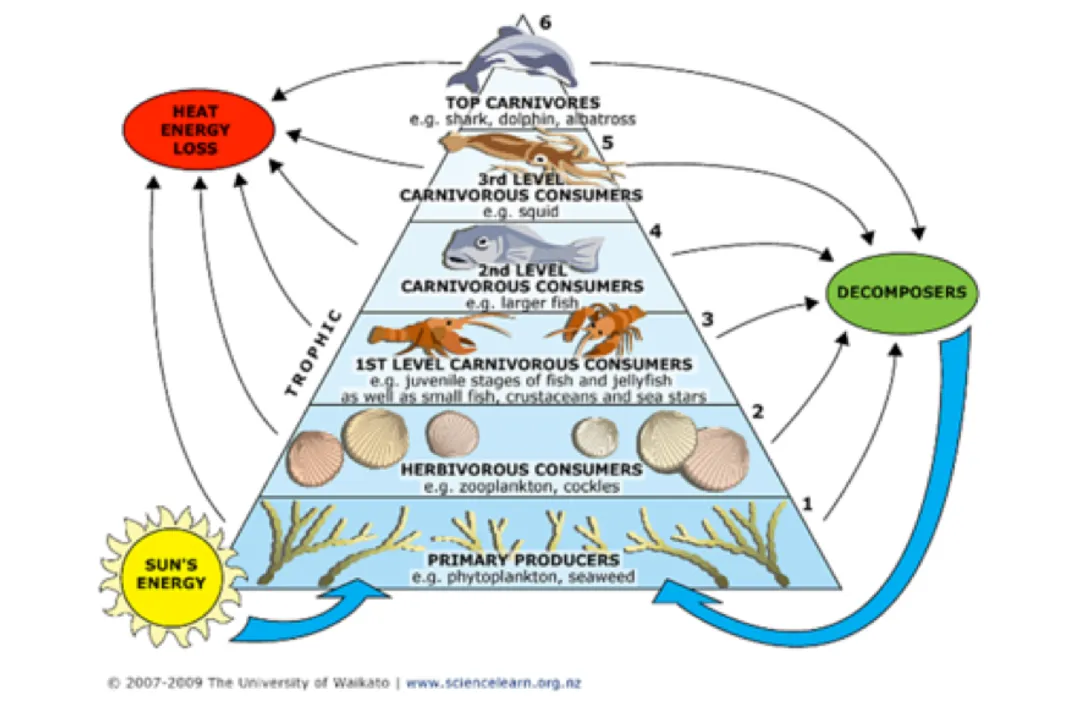
The passage of energy through the living components of an environment is a fundamental concept in ecology, dictating the structure and sustainability of every community on Earth. [5][9] This flow is directional, moving in one way from its origin through various organisms before it is eventually lost from the system, primarily as heat. [1][5] Unlike matter, which is cycled endlessly through the soil, water, and air, energy is constantly being used up, requiring a continuous input, usually from the sun, to keep the entire biological machine running. [5][9]
# Energy Origin

The vast majority of energy entering an ecosystem originates from the sun. [1][4][5] Specialized organisms, known as producers or autotrophs, capture this radiant energy. [1][5] Through the remarkable process of photosynthesis, these organisms—like plants, algae, and some bacteria—convert light energy into stored chemical energy in the form of organic compounds, such as sugars. [1][9] This stored chemical energy forms the absolute base of the entire food web. [5][9] The total amount of energy captured by these producers through photosynthesis is referred to as Gross Primary Production (GPP). [5] However, producers themselves need energy to live, grow, and reproduce, so the energy actually available to the next level is the Net Primary Production (NPP), which is the GPP minus the energy the producers burned for their own life processes. [5]
# Feeding Hierarchy
Once energy is stored in the producers, it begins to move along what is often simplified as a food chain. [2] A food chain illustrates a straightforward, linear sequence of who eats whom. [2] The organisms occupying the first position in this sequence are the producers. [1][9] The next step involves primary consumers—organisms that feed directly on producers, making them herbivores. [1][9] Following them are the secondary consumers, which prey on the primary consumers. [1] If a secondary consumer is eaten by another organism, that organism occupies the fourth spot, becoming a tertiary consumer. [1] Organisms that sit at the top of these chains, eating other consumers but rarely being eaten themselves, are sometimes called apex predators. [1]
For example, in a simple grassland scenario, grass (producer) is eaten by a grasshopper (primary consumer), which is then eaten by a frog (secondary consumer), which finally becomes a meal for a snake (tertiary consumer). [1] Every time energy moves between these designated trophic levels, a transformation occurs. [4]
# Web Complexity

While food chains offer a simple model for tracking energy, they rarely reflect reality. [2][3] In almost all natural settings, organisms consume, and are consumed by, more than one species. [2] For instance, that frog in the grassland might also eat small beetles or small spiders, and the snake might be prey for a hawk or coyote. [3] When these interconnected feeding relationships are mapped out, we create a food web. [2][3] Food webs provide a much more accurate depiction of energy flow because they show the numerous pathways energy can take through an ecosystem. [2] This interconnectedness is vital; if one food source disappears, an animal relying on it can often switch to another food source within the web, providing a degree of stability that a simple chain lacks. [3]
Consider a marine environment where phytoplankton (producer) are eaten by zooplankton. The zooplankton are eaten by small fish, but those small fish might also eat small crustaceans, while those same crustaceans might also graze on bottom algae. A change in the crustacean population, therefore, ripples through multiple feeding paths simultaneously, which is what a food web captures. [3]
# Transfer Efficiency

Perhaps the most crucial concept governing the shape and function of any food web is the inefficiency of energy transfer between trophic levels. [1][4][5] When an organism consumes another, it does not acquire all the energy stored in its meal. [1][5] A significant portion—often the vast majority—is lost to the environment. [4] This loss occurs because a large amount of the consumed energy is used by the organism for its own life functions: moving, finding food, growing, repairing tissues, and maintaining a constant body temperature (metabolism). [1][5] The energy used for these activities is ultimately dissipated as heat and cannot be captured or used by the next trophic level. [1][4]
Ecologists generally apply the Rule of Ten. [1][4] This principle suggests that only about 10% of the energy from one trophic level is successfully incorporated into the biomass of the organisms at the next level. [1][5][9]
To visualize this constraint, imagine a pond ecosystem where the producers (phytoplankton) capture 10,000 kilocalories (kcal) of solar energy as chemical energy:
| Trophic Level | Organism Type | Available Energy (Approx.) |
|---|---|---|
| Level 1 | Producers (Phytoplankton) | 10,000 kcal |
| Level 2 | Primary Consumers (Zooplankton) | 1,000 kcal (10% of 10,000) |
| Level 3 | Secondary Consumers (Small Fish) | 100 kcal (10% of 1,000) |
| Level 4 | Tertiary Consumers (Large Fish/Birds) | 10 kcal (10% of 100) |
| Level 5 | Apex Predators (Eagles/Sharks) | 1 kcal (10% of 10) |
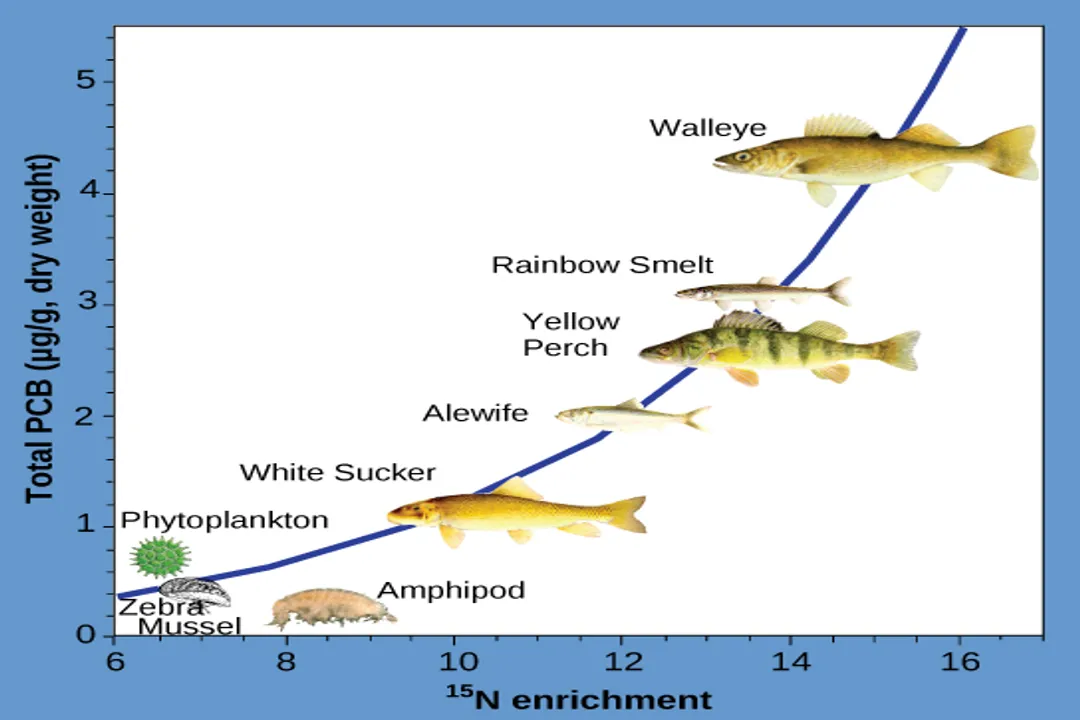
This rapid decline in available energy explains why food webs rarely have more than four or five trophic levels. [1] The biomass pyramid reflects this loss, being widest at the bottom (producers) and tapering sharply toward the top. [1][5] The sheer scale of primary production needed to support a few top predators is immense. To support a single 150-pound predator at Level 4, the system must have invested energy equivalent to approximately 150,000 pounds of initial plant matter, assuming steady 10% transfers across the preceding three steps. This highlights the enormous energetic dependence the top of the web has on the base.
# Decomposer Role
Energy flow is characterized by being one-way, but matter is cycled. [5] This recycling is the function of decomposers and detritivores, such as bacteria, fungi, and earthworms. [1][5] These organisms break down dead organic material from all trophic levels—fallen leaves, animal waste, and carcasses. [5] In the process of decomposition, decomposers consume energy themselves, but their major ecological contribution is releasing the inorganic nutrients (like nitrogen, phosphorus, and carbon) locked within that dead matter back into the soil or water. [1][5] These released nutrients then become available again for the producers to absorb and use in photosynthesis, thus closing the nutrient cycle. [5][9] While energy is perpetually lost as heat, the essential building blocks of life are constantly reused within the ecosystem boundary. [5]
# Ecosystem Structure
The mechanisms of capture, consumption, and loss ultimately define the overall structure of an ecosystem. [1] The energy loss dictates that the greatest biomass and the greatest diversity of life will always be found at the lowest trophic levels—the producers. [1][5] Any significant disturbance that reduces the producer base, such as widespread pollution or habitat destruction affecting plant life, sends drastic, unsustainable consequences upward through every subsequent trophic level. [3] Because the higher levels hold so little residual energy compared to the base, they are far more vulnerable to such disturbances. [1] Understanding this flow is not just an academic exercise; it is essential for managing fisheries, predicting the effects of invasive species, or assessing the long-term viability of any natural habitat. [3] The continuous need for new energy input, coupled with the inescapable exit of energy as heat, ensures that ecosystems are dynamic systems always processing, never recycling, the power that sustains them. [5]
Related Questions
#Citations
Energy Transfer in Ecosystems - National Geographic Education
Food chains & food webs (article) | Ecology - Khan Academy
Food Web: Concept and Applications | Learn Science at Scitable
[PDF] Energy Flow in Ecosystems - Lesson Overview
3.1 Energy Flow through Ecosystems – Introduction to ...
What is a food web and how does it illustrate energy flow? - Facebook
Energy and Food Webs - Ocean Tracks
How does energy flow in a food web? - Quora
26.2: Energy Flow through Ecosystems - Biology LibreTexts
Food web | Research Starters - EBSCO