What negative consequence results from the ocean absorbing excess atmospheric $ ext{CO}_2$?
Answer
Ocean acidification
The dissolving of $ ext{CO}_2$ creates carbonic acid in the seawater, which reduces the availability of carbonate ions needed by marine organisms to construct their calcium carbonate shells.
Related Questions
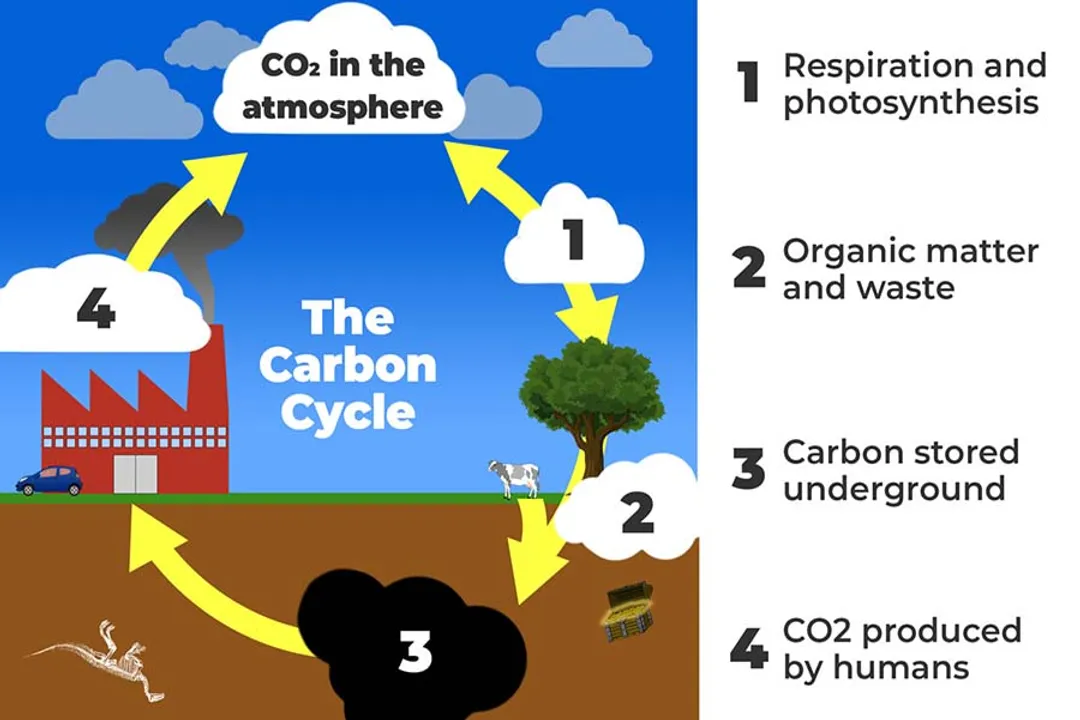
Which reservoir holds the largest approximate amount of carbon according to the provided estimates?What is the primary natural mechanism in the slow carbon cycle that removes atmospheric $ ext{CO}_2$?What negative consequence results from the ocean absorbing excess atmospheric $ ext{CO}_2$?What process is central to the fast carbon cycle, involving the absorption of atmospheric $ ext{CO}_2$ to create sugars?What is the only major natural pathway for deep, geological carbon stored in rocks to return to the atmosphere?How does the annual carbon flow rate of the fast biological cycle compare to that of the slow geological cycle?What is the consequence of thawing permafrost in the far north regarding greenhouse gas emissions?Approximately how long does it take to lock down carbon absorbed via fast cycles into stable, long-term chemical forms?Which process, sometimes called carbon fertilization, is leading to enhanced terrestrial uptake of atmospheric $ ext{CO}_2$?What was the approximate atmospheric $ ext{CO}_2$ concentration before the Industrial Revolution?