What drives the global carbon cycle?
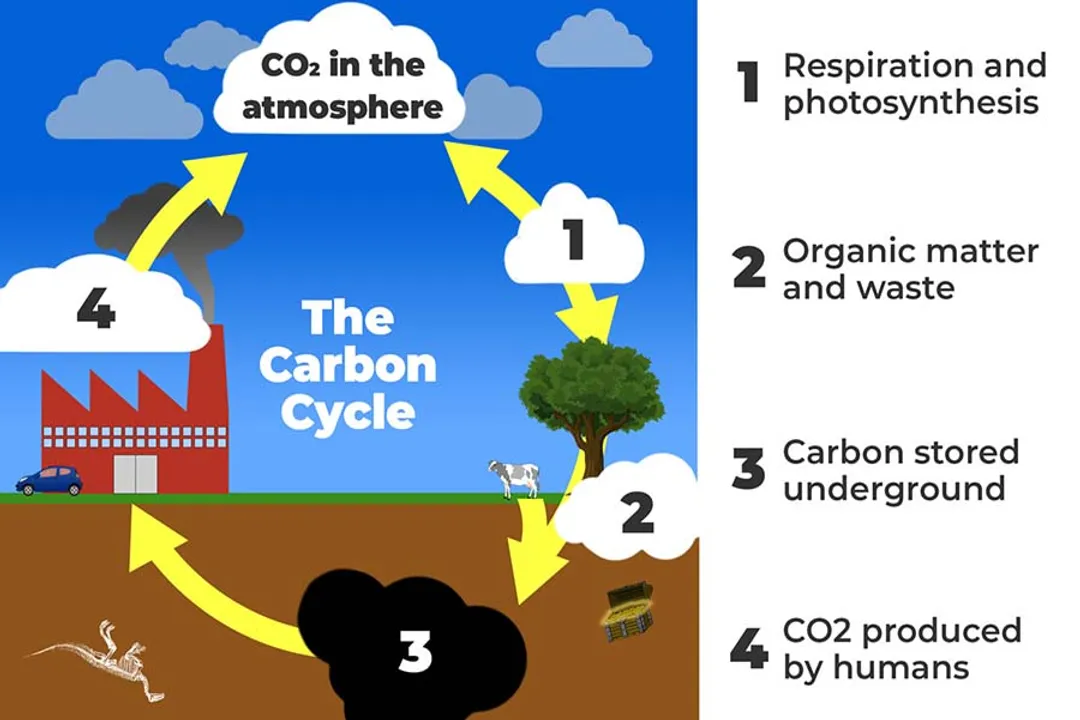
The global carbon cycle is the intricate, planet-spanning process by which carbon atoms move continually between the Earth's major reservoirs: the atmosphere, the oceans, the land (biosphere and soils), and the geosphere (rocks and sediments). It is the elemental mechanism that sustains all known life, as carbon forms the chemical backbone of DNA, proteins, sugars, and fats. Beyond biology, carbon, primarily in the form of carbon dioxide (), functions as a key heat-trapping gas, regulating the Earth's temperature and ensuring the planet remains warm enough for habitability. Without this cycle, the Earth might otherwise be a frozen world, with an average temperature around instead of the current livable average of .
Because the Earth is a closed system, the total amount of carbon here remains constant; the cycle is about movement rather than creation or destruction. The drivers of this cycle are a combination of extremely rapid biological exchanges and immensely slow geological processes, all working to keep the concentration of atmospheric in a relative, long-term balance.
# Carbon Pools
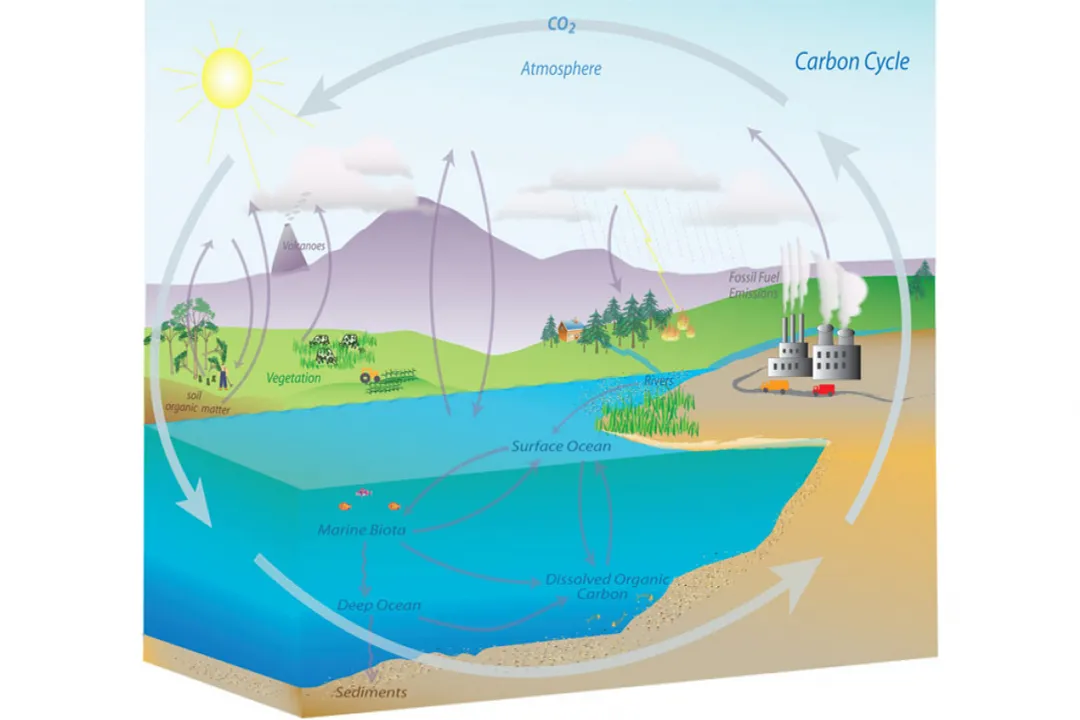
Carbon exists on Earth in solid, dissolved, and gaseous states, residing in various places known as reservoirs or sinks—any place that, over time, absorbs more carbon than it releases.
The distribution across these reservoirs highlights the relative importance of each component on human timescales. While carbon is the foundation of life, the vast majority of it is held away from immediate atmospheric interaction.
| Reservoir | Approximate Storage (Billion Metric Tons of Carbon) | Notes |
|---|---|---|
| Sedimentary Rocks (Geosphere) | (or GtC) | The largest, most static reservoir. |
| Ocean | (Deep Ocean) | Holds about $85%$ of the active carbon pool. |
| Soil | Contains accumulated organic carbon. | |
| Atmosphere | A relatively small, but highly influential pool. | |
| Land Biota | Living matter, including plants and trees. | |
| Fossil Fuels | (part of geologic deposits) | Carbon stored over millions of years. |
The largest pool, found in rocks and sediments, is largely inert on the timescales relevant to human society, taking millions of years to cycle out. The ocean holds the largest portion of the active carbon, with its surface waters exchanging with the atmosphere on relatively short timescales.
# Cycle Speeds
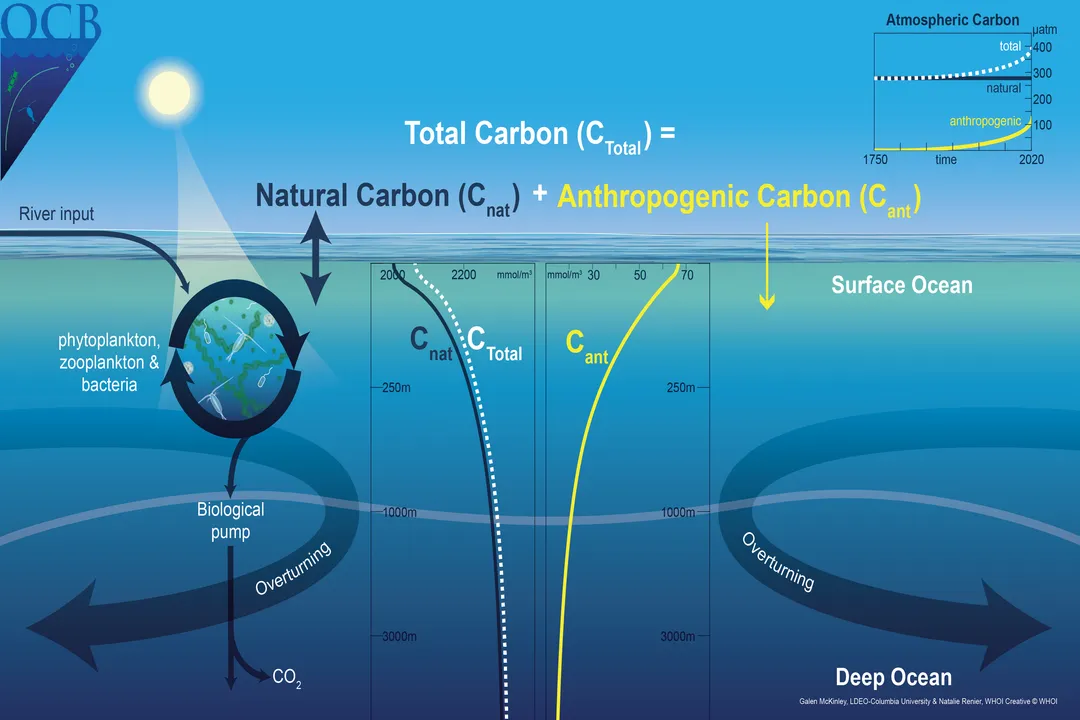
To understand what drives the cycle, one must separate its motion into two main categories based on speed: the fast carbon cycle and the slow carbon cycle. The difference in the movement rate between these two is profound.
# Fast Motion
The fast carbon cycle involves transfers happening over a lifespan or less, largely concerning the biosphere. The central reaction is the basis of life:
When proceeding to the right, plants and phytoplankton absorb atmospheric and sunlight to create sugars () for structure and energy—this is photosynthesis, the critical fixation of atmospheric carbon.
When this process reverses, carbon is returned to the atmosphere as through several mechanisms, all involving respiration or combustion:
- Respiration: Animals, plants, and microbes break down organic matter to release energy.
- Decomposition: When organisms die, microbes return the carbon to the soil or atmosphere.
- Combustion: Natural wildfires burn biomass, releasing stored carbon.
This entire biological loop is highly visible in global measurements; for instance, in the Northern Hemisphere, atmospheric dips in spring/summer when plants are growing rapidly and rises during fall/winter when decomposition dominates.
# Slow Dynamics
On timescales measured in hundreds of thousands to millions of years, the slow carbon cycle links the atmosphere, ocean, and the lithosphere (rocks). This slow system acts like a global thermostat, preventing extreme conditions seen on other planets.
The primary mechanism removing atmospheric in this slow cycle is chemical weathering.
- Atmospheric dissolves in rainwater, forming weak carbonic acid ().
- This acid dissolves minerals in rocks, releasing ions that are carried by rivers to the ocean.
- In the ocean, these ions react to form calcium carbonate (), the building block for shells created by marine organisms like plankton and corals.
- When these organisms die, their shells sink, accumulating on the seafloor over geological time to form sedimentary rock, such as limestone, effectively locking carbon away in stone.
The only major natural pathway for this deep, geological carbon to return to the atmosphere is through volcanism, where tectonic plate movement subjects carbon-bearing rocks to enough heat and pressure to melt them, releasing during eruptions. Currently, volcanic emissions are estimated to be about $130$ to $380$ million metric tons of per year.
It is a critical point that the rate of these slow processes dictates stability: if rises (e.g., from volcanoes), warming leads to more rain, increasing weathering, which draws back down over hundreds of thousands of years to rebalance the system.
If we compare the magnitude of these flows, the difference is stark: the slow cycle moves about to grams of carbon annually, while the fast biological cycle moves to grams per year. Human emissions, in contrast, are on the order of grams per year. This confirms that human activity is forcing carbon from the slow, long-term reservoir into the fast, active atmosphere-ocean system, overwhelming the natural regulatory capacity.
To put the relative speeds into perspective, imagine the slow geological cycle as a massive, slowly rotating flywheel, capable of regulating the Earth's temperature over eons. Human activity, however, is like instantly connecting a powerful motor to that flywheel—the initial push (emissions) is significant relative to the flywheel's inertia, causing immediate, noticeable spinning (climate change), even if the flywheel itself won't fully stop or reverse course for millennia.
# Anthropogenic Drivers
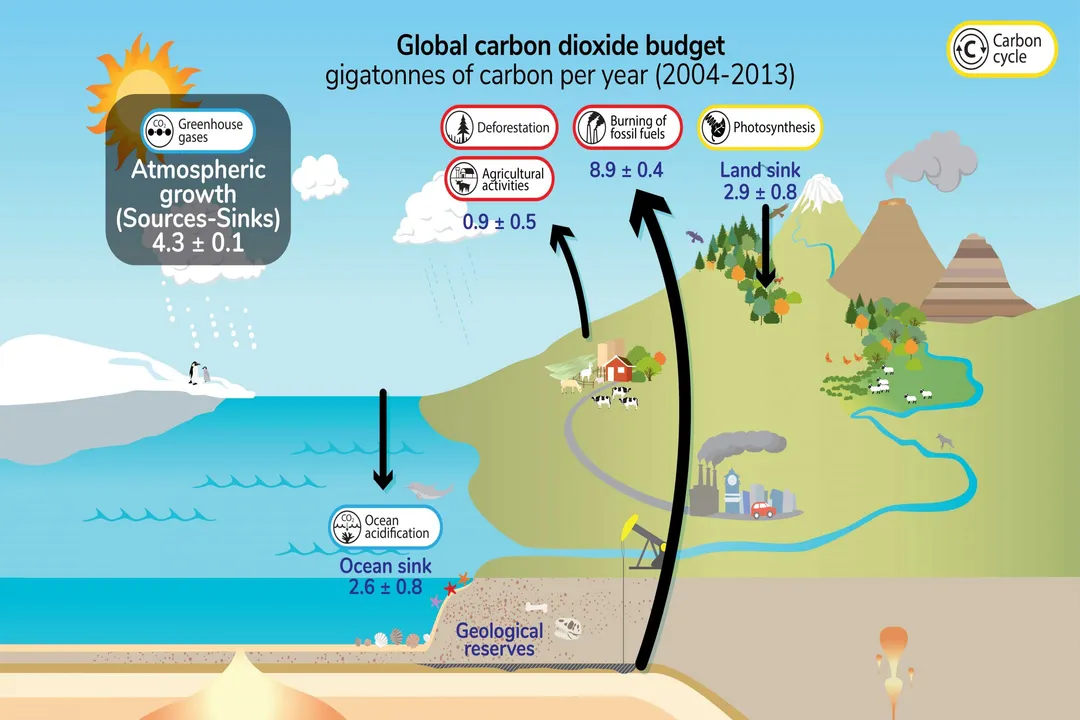
The natural cycle is being driven out of balance by human activities that move stored carbon into the active atmospheric reservoir at rates vastly exceeding natural geological inputs.
# Fossil Fuels
The single most dominant driver is the combustion of fossil fuels—coal, oil, and natural gas—for energy needs across transportation, industry, and electricity generation. Fossil fuels are essentially deposits of organic carbon that took millions of years to be buried and sequestered from the atmosphere. Burning them effectively takes carbon from the slow cycle and dumps it into the fast cycle almost instantaneously.
For example, in the 1990s, human fossil fuel use emitted about $6.4$ Petagrams of carbon per year (), which increased significantly to about between $2014$ and $2023$. This continuous release means that atmospheric concentrations have risen from about $280$ parts per million () before the Industrial Revolution to levels now exceeding , a concentration unseen in at least the last two million years.
# Land Changes
The second major human contribution comes from altering land use.
- Deforestation: Clearing forests, often through fire, removes biomass that was actively storing carbon through photosynthesis and releases that stored carbon back into the atmosphere. In the tropics, deforestation remains a primary source, accounting for about $12%$ of human emissions as of $2008$.
- Agriculture: Farming practices contribute by releasing from the energy used to power equipment, but they also release other potent greenhouse gases like methane () from livestock digestion and rice fields. Additionally, the clearing of land exposes soil, which can accelerate the decomposition of organic matter, venting stored carbon.
Another important, though smaller, source is the manufacture of cement, which involves chemical processes that release .
# Sinks and Imbalance

When this surge of anthropogenic carbon enters the atmosphere, the natural carbon sinks react, attempting to absorb the excess.
# Ocean Absorption
The ocean is a vital sink, exchanging with the atmosphere via physical, chemical, and biological processes. Cold seawater can hold more than warm water, leading to uptake in cooler regions. Because atmospheric has risen, the ocean currently takes in more carbon than it releases. Cumulatively, the ocean has mitigated about $38%$ of fossil fuel emissions since $1850$.
However, this absorption comes with a significant cost: the dissolving creates carbonic acid, causing ocean acidification. This process reduces the availability of carbonate ions, which are necessary for marine organisms like corals and shellfish to build their calcium carbonate shells, leading to thinner and more fragile structures.
# Terrestrial Uptake
Land plants have also been absorbing a significant portion of human emissions—around $25%$ in recent decades. This enhanced uptake, sometimes called carbon fertilization, is driven by several factors:
- The direct availability of more atmospheric for photosynthesis.
- Warming temperatures extending the growing season, particularly in high latitudes.
- Increased availability of nitrogen due to human activity accelerating nitrogen cycling.
It's important to note that this land uptake is variable and can be limited. For example, studies suggest that even with abundant , plant growth can be capped by shortages of water or nutrients like nitrogen. Furthermore, the warming that stimulates growth in some regions can stress plants in others, leading to reduced growth or increased fire risk, which returns the stored carbon to the atmosphere.
# The Storage Dilemma
When considering the recent human input of carbon ( from $2014-2023$), natural systems are demonstrably damping the atmospheric increase. The ocean absorbed about $27%$, and the land biosphere absorbed $30%$, meaning roughly $48%$ remained in the atmosphere to drive warming.
This partitioning leads to an important consideration regarding the longevity of human impact. While the fast cycle (photosynthesis/air-sea exchange) can draw down atmospheric within years, actually locking that carbon into stable, long-term chemical forms, safe from quick recycling, requires to years. Therefore, the carbon we release by burning ancient fuels now will dictate atmospheric composition and warming for geological timescales, even if sinks manage to remove some of the immediate spike.
My second original observation relates to the concept of the "atmospheric budget." While we often focus on the total amount of carbon in the atmosphere, it is the residence time combined with the rate of input that defines the current warming pressure. The atmosphere is the primary thermostat setter because stays in a gaseous state across a wider temperature range than water vapor—the atmosphere's largest greenhouse component. Even if forests and oceans were to continue absorbing $55%$ of our emissions, the remaining $45%$ forces a temperature increase, and because the ocean takes so long to absorb that remaining atmospheric fraction, we have already locked in future warming equivalent to at least another based on current atmospheric concentrations alone. This means the consequences of past actions are unavoidable and will manifest even if all emissions ceased today.
# Climate Feedbacks
The carbon cycle does not simply react to climate change; it also amplifies it through feedback mechanisms.
One area of great scientific focus is the thawing of permafrost, especially in the far north. Permafrost contains ancient, slow-decaying organic matter. As rising temperatures thaw this ground, microbial activity increases, releasing significant amounts of both and methane ()—a powerful greenhouse gas—into the atmosphere. Current estimates suggest the Northern Hemisphere permafrost holds over $1,670$ billion tons of organic carbon. If even $10%$ of this thaws, it could add enough extra carbon to raise global temperatures by an additional by $2100$. This feedback loop—warming causes thaw, thaw releases gases, gases cause more warming—is a prime example of the cycle accelerating its own disruption.
In the tropics, the dynamic is often reversed, leading to a potential positive feedback loop where warming leads to drying, which stresses trees, slows growth, and increases the risk of fire, causing ecosystem carbon stores to be released rather than sequestered.
The overall drive of the system is toward a new state where the natural buffering capacity may become overwhelmed or altered. For instance, while warmer, wetter conditions in mid-latitudes might increase carbon storage, the projected larger effect of drier, warmer tropics leading to carbon release suggests an overall net release of ecosystem carbon as the climate warms. Understanding these rates—how fast carbon moves out of storage versus how fast it moves in—is central to predicting the severity and longevity of future climate change.
# Monitoring Change
To track what drives the cycle, scientists employ modern techniques that integrate data across different scales. Satellite instruments like MODIS monitor net primary productivity—how much carbon plants and phytoplankton convert into matter—helping quantify the biological sink activity. Other satellites track changes in land cover, like deforestation or forest regrowth, which directly impacts the land flux.
Furthermore, direct atmospheric monitoring, such as the measurements started at Mauna Loa, Hawaii, reveals the steady upward trend of even when accounting for the seasonal breathing of the planet. This long-term data, combined with paleoclimate records from ice cores stretching back $800,000$ years, allows researchers to place the current human-driven rise in context, confirming that the current atmospheric concentration change rate is exceptionally fast compared to natural shifts.
Ultimately, the drivers of the global carbon cycle are nature's foundational processes—photosynthesis, respiration, weathering, and volcanism—which, when left to their own timescales, maintain Earth's habitability. However, the overwhelming driver of change in the modern cycle is the rapid introduction of geologically stored carbon through the burning of fossil fuels, effectively accelerating the cycle to a pace the planet's slower chemical and biological systems cannot absorb, leading to a consequential atmospheric imbalance.
Related Questions
#Citations
Carbon cycle | National Oceanic and Atmospheric Administration
The Carbon Cycle - NASA Science
DOE Explains...the Carbon Cycle - Department of Energy
Carbon and Climate - McKinley Ocean Carbon Group
Carbon cycle dynamics - How are major carbon sinks and sources ...
Climate and the Carbon Cycle: Unit Overview
Carbon cycle - Understanding Global Change
What is the Carbon Cycle & Why is it So Important? - Crown Oil
Module 5: Global Carbon Cycle | EARTH 103 - Dutton Institute