Did Fred Hoyle discover anything?
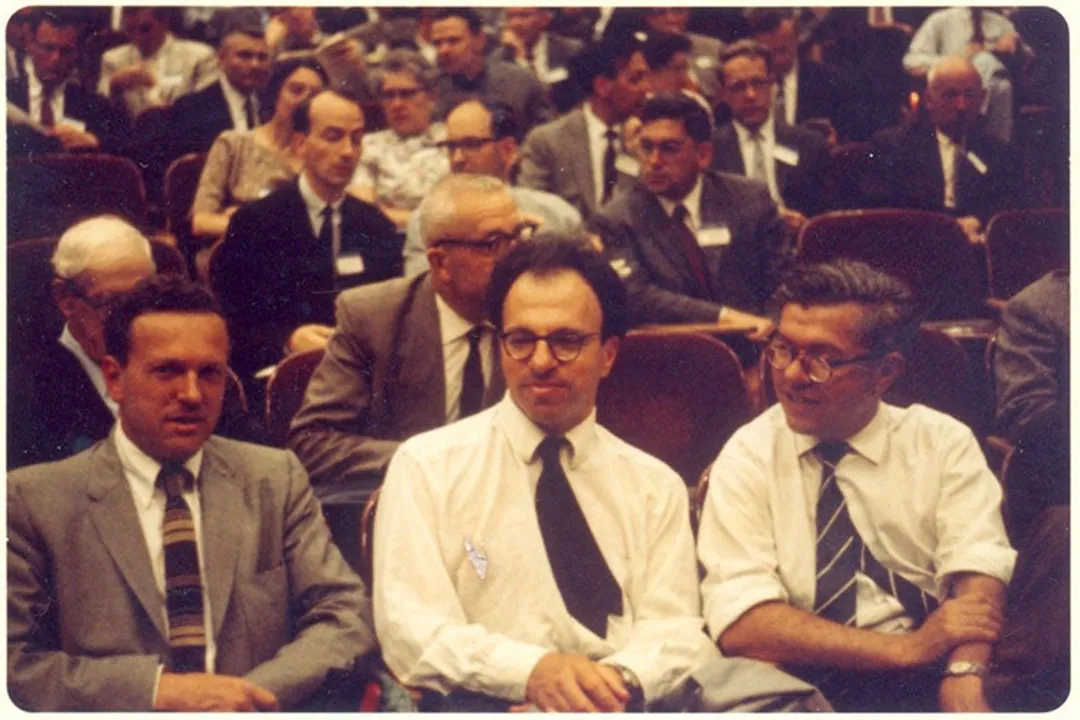
The name Fred Hoyle echoes through the history of 20th-century astronomy, attached both to fundamental breakthroughs in understanding the cosmos and to one of science's most persistent—and perhaps self-inflicted—controversies. He was a prominent British astronomer and cosmologist whose career spanned decades of revolutionary discovery in astrophysics. [1][2][5] Born in Bingley, Yorkshire, Hoyle made indelible contributions to our understanding of stellar processes, yet his name is perhaps most often recalled by the public for the very term he used to mock the prevailing theory of cosmic origins. [1][6]
# Star Forging
Hoyle's work on stellar nucleosynthesis stands as one of his most concrete and celebrated achievements, a finding that fundamentally explained the cosmic origins of matter as we know it. [2][9] Before this development, the prevailing view struggled to explain how elements heavier than hydrogen and helium could have been created in significant quantities within the universe. [9] Hoyle, alongside Geoffrey Burbidge, William Fowler, and Margaret Burbidge—often known collectively by their initials, HB2FM—developed the detailed theory describing this process. [2][9]
This theory posits that the essential building blocks of life and matter—the carbon in our bodies, the oxygen we breathe, the iron in our blood—are forged deep inside stars through nuclear fusion reactions that occur at various stages of stellar evolution. [9] His rigorous work cemented the understanding that stars are not just passive lights in the sky, but rather cosmic element factories, responsible for the chemical enrichment of the galaxy. [5][9] This area of expertise placed him squarely at the forefront of nuclear astrophysics. [9] A practical way to view this is to consider the stellar lifecycle: the very lightest elements are formed during the Big Bang (the cosmic soup), but anything heavier requires the incredible pressure and heat only found within stellar cores or during supernova explosions, a mechanism Hoyle helped map out. [1][9]
# Cosmological Stance
While his contributions to stellar chemistry were highly successful, Hoyle became equally famous for his commitment to an alternative model for the universe's large-scale structure: the Steady State theory. [1][7] Developed with Hermann Bondi and Thomas Gold, the Steady State model proposed a universe that was eternal, requiring no beginning and no end. [1][2] Its central tenet was that while the universe was expanding, the density of matter remained constant because new matter was continuously created in the space vacated by the expansion, leading to a universe that looked statistically the same at any point in time—the "perfect cosmological principle". [1][2]
This view stood in direct opposition to the Big Bang theory, which requires a singular beginning from an extremely hot, dense state. [7] It is a fascinating irony of scientific history that Hoyle himself is credited with popularizing the term "Big Bang". [2][5] He did not intend it as a compliment; rather, he used the phrase dismissively during a BBC radio broadcast in 1949 to describe the opposing theory, implying it was less scientifically sound than his own Steady State model. [2][6][7] This memorable, albeit derogatory, label stuck and ultimately became the name of the theory that would eventually prevail over his own. [6][7] The ultimate downfall of the Steady State model arrived with the discovery of the Cosmic Microwave Background (CMB) radiation in the mid-1960s, an observational prediction of the Big Bang model that the Steady State theory could not easily account for. [2][5][6]

# Naming Quasars
Beyond the grand scale of cosmology, Hoyle also engaged in cataloging and naming astronomical phenomena, demonstrating a flair for language that could capture the strangeness of the new discoveries being made. [1] He is credited with coining the term quasar, short for quasi-stellar radio source. [1][5] These incredibly bright, distant objects posed a major puzzle to astronomers in the early 1960s because their measured distances implied luminosities far exceeding those of normal galaxies. [5] By giving them a distinct, descriptive name, Hoyle helped categorize a new class of extreme celestial objects observed through radio telescopes. [1]
# Academic Leadership
Hoyle’s professional home for much of his career was the University of Cambridge, where he held the esteemed position of Lucasian Professor of Mathematics from 1958 to 1972. [1][2][5] This is a title famously held by Sir Isaac Newton centuries earlier, underscoring the intellectual weight of the appointment. [5] During his tenure, Hoyle was instrumental in advancing the field of astronomy at Cambridge, going beyond theoretical work to build infrastructure. [5] A significant mark of his organizational ability was his role in founding the Institute of Astronomy at Cambridge. [5] This creation institutionalized the study of astronomy in a new setting, providing a dedicated center for research and collaboration that continues to operate today. [5]
His academic influence was clearly established; he was a highly visible and prolific figure in the British scientific community. [1] However, it is worth noting the contrast in impact between his conceptual work and his institutional role. His advocacy for the Steady State model, while deeply reasoned, placed him in opposition to the emerging consensus, yet his role in establishing the Institute of Astronomy represents a lasting, tangible improvement to the scientific landscape, independent of any specific cosmological theory. [5]

# Honors and Snubs
Despite the Nobel Prize being awarded for the discovery of the CMB—the key evidence against his Steady State model—Hoyle himself never received the award. [3] He was nominated numerous times for his work, particularly in nucleosynthesis, yet the Nobel Committee often honored discoveries made after the initial groundwork, sometimes overlooking the theorists who laid the foundation. [3] The 1978 prize for the CMB went to Arno Penzias and Robert Wilson. [3]
This omission, while perhaps disappointing for Hoyle, highlights a common tension in scientific recognition: the difference between establishing a theory and providing the definitive observational proof. [3] Hoyle's commitment to his beliefs, even when the evidence seemed overwhelming, meant he remained a highly polarizing figure in cosmology until his death in 2001. [2][8] Nevertheless, his impact was broad, extending beyond academic journals; he was also known for writing accessible popular science books, translating complex ideas for a wider audience. [1]
| Contribution Area | Key Achievement | Status/Recognition |
|---|---|---|
| Stellar Nucleosynthesis | Detailed model of heavy element formation in stars [9] | Highly successful, foundational work [2] |
| Cosmology | Championed the Steady State Theory [1] | Overturned by observational evidence (CMB) [5] |
| Nomenclature | Coined the term "Big Bang" (derisively) [6] | Ironically became the dominant term [2] |
| Nomenclature | Coined the term "quasar" [1] | Standard astronomical classification [5] |
| Institutional | Founded the Institute of Astronomy, Cambridge [5] | Lasting physical legacy [5] |
The longevity of Hoyle's ideas in areas like nucleosynthesis shows that solid theoretical work, even when disconnected from a scientist’s main cosmological preoccupation, can secure a permanent place in scientific literature. [9] The fact that his name is synonymous with the very idea he opposed—the Big Bang—serves as a remarkable lesson in how public discourse can sometimes overshadow nuanced scientific debate, turning a piece of casual commentary into a historical anchor. [6][7] Fred Hoyle’s legacy is therefore twofold: a set of undeniable discoveries about the guts of stars and a historical marker representing the battle between competing visions of cosmic history. [2][5]
#Citations
Fred Hoyle
Sir Fred Hoyle | Biography, Discoveries, Books, & Facts
Fred Hoyle: the scientist whose rudeness cost him a Nobel ...
Fred Hoyle: Father of Nucleosynthesis
Scientist of the Day - Fred Hoyle, British cosmologist
Remembering Big Bang Basher Fred Hoyle
Fred Hoyle – The Visionary of Stellar Nucleosynthesis
Obituary: Sir Fred Hoyle (1915-2001)
Fred Hoyle: pioneer in nuclear astrophysics