Can life exist inside stars?
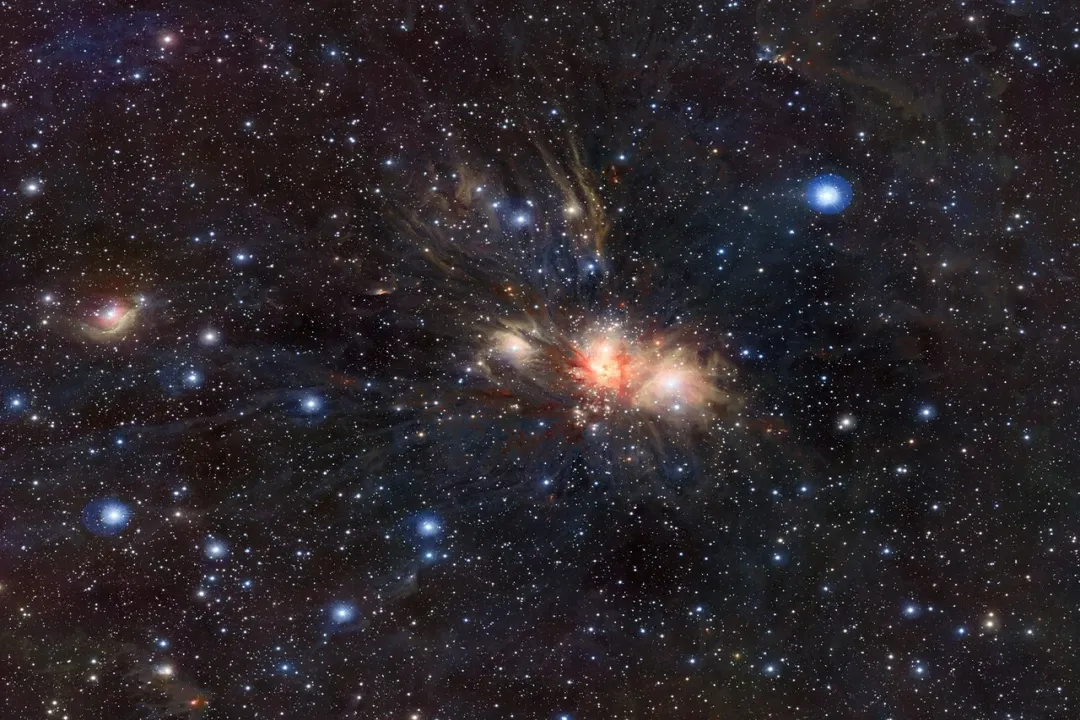
The idea of organisms thriving within the thermonuclear furnace of a star, rather than orbiting one, immediately clashes with everything we understand about biology and chemistry. Stars, whether main-sequence giants like our Sun or smaller dwarfs, represent environments of extreme heat and pressure, conditions that would instantly vaporize or crush any carbon-based structure known to us. [4][9] The sheer energy flux within these celestial bodies, where fusion reigns supreme, seems fundamentally incompatible with the delicate processes that sustain life, such as self-replication, metabolism, and structural integrity. [4]
# Physical Barriers
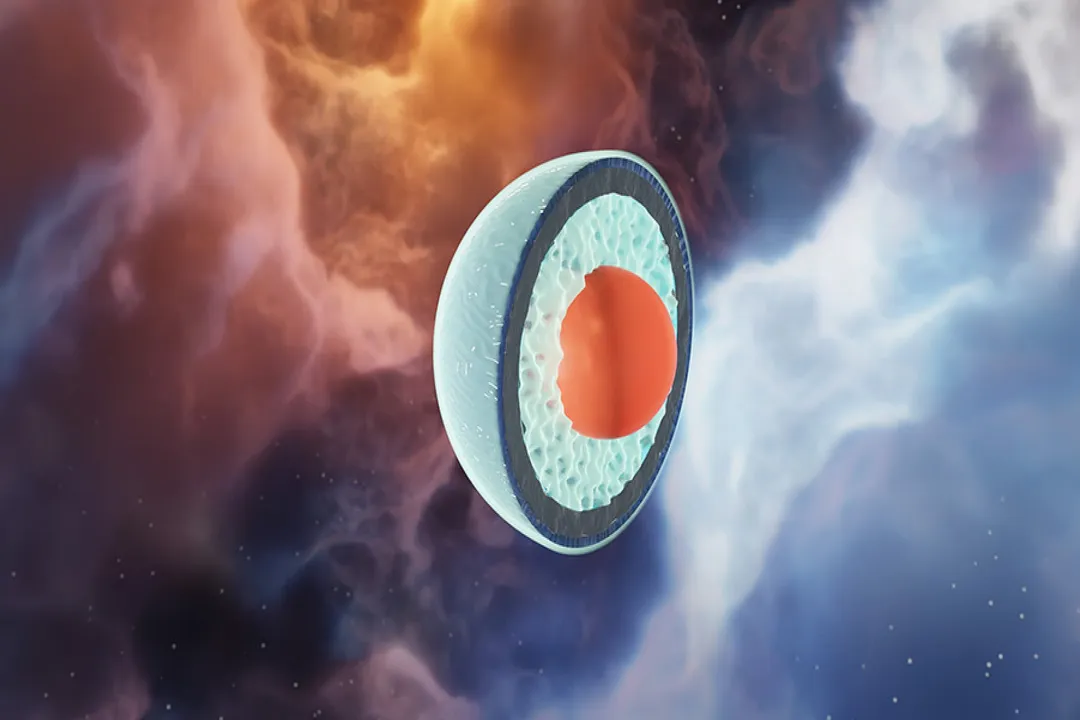
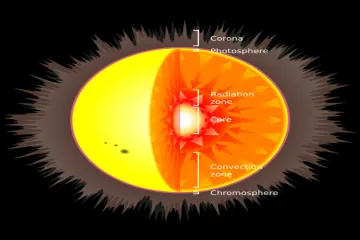
The core barrier to life inside a star is temperature. In the Sun, for example, the photosphere alone is around 5,500 degrees Celsius, and the interior skyrockets into the millions of degrees. [1] Life on Earth depends on liquid water, a universal solvent that allows complex molecules to interact chemically while maintaining stable structures like proteins and DNA. Inside a star, there is no liquid phase; matter exists as a superheated, ionized gas known as plasma. [4] In this state, electrons are stripped from atoms, creating a high-energy soup where chemical bonds, as we define them, cannot persist long enough to build or maintain organized systems. [4]
If we consider the density, the conditions are equally hostile. While the very outer layers of a star might seem less intense, they are still far too energetic for life as we picture it. Even if a hypothetical organism could somehow exist in the plasma, the constant, violent collisions and the extremely high electrical conductivity would prevent the localized, stable organization necessary for biological information processing. [4] It is the stability of arrangement over time, not just the presence of energy, that life requires. [4]
It is interesting to consider the density gradient. A red dwarf might offer lower average temperatures than a massive star, but its internal structure remains a continuous, high-energy plasma transitioning rapidly between states of extreme compression and heat. [1] The conditions are not a gentle gradient leading to a habitable zone, but rather a continuous slide into thermodynamic chaos relative to biological requirements. [4]
To put the energy scale into perspective, consider the sheer difference between a biological reaction and a stellar one. A typical chemical reaction on Earth releases perhaps a few electron volts of energy per event. In the core of a star, nuclear fusion releases millions of electron volts per reaction, an energy level that would instantly destroy any molecular structure trying to capture it for slow, controlled work. [4]
# Exotic Chemistry
The very premise of life existing inside a star usually forces us to abandon carbon and water as fundamental building blocks. If life were to exist in such a realm, it would need an entirely different, perhaps purely energetic or structural basis. [9] Some discussions suggest considering life that doesn't rely on molecular chemistry at all. If life were a pattern or a self-sustaining structure within the plasma itself, perhaps utilizing the electromagnetic fields or density fluctuations, it might evade the immediate destruction caused by heat. [4] However, the challenge then becomes how that structure would encode information and replicate that information across generations—the defining characteristic of life. [4]
One area where speculation moves away from traditional chemistry involves hypothetical concepts like cosmic strings. [3] These are not physical objects made of ordinary matter but rather immense, one-dimensional topological defects in the structure of spacetime that might have formed in the very early universe. [3] Physicists have suggested that if life could somehow be based on these structures, it might be possible for them to exist within the high-energy environment of a star. [3] This concept moves the argument entirely out of the realm of biochemistry and into the domain of pure spacetime dynamics. The idea is that the life form wouldn't be made of stellar material but would use the star's environment as a medium or energy source, perhaps existing on or within the string itself. [3]
It is worth noting a key difference between terrestrial biochemistry and these speculative forms: terrestrial life requires order maintained against entropy through energy input, but it still relies on predictable, relatively low-energy chemical interactions. [4] Life based on something like a cosmic string would need to organize spacetime itself, a process vastly different from organizing atoms and molecules. [3]
# String Hypothesis
The speculation surrounding cosmic strings offers a potential pathway for star-based existence, but it requires accepting physics far outside the Standard Model of particle physics. [3] A cosmic string, if it exists, would have immense density and gravitational influence, potentially spanning vast distances. [3] Life associated with such a structure would not be "swimming" in plasma; it would be fundamentally interwoven with a warp in spacetime.
If we look at this through the lens of what we know, the probability remains vanishingly small. The very existence of stable cosmic strings is highly debated, and hypothesizing life on them is several levels removed from established science. However, proponents of this extreme form of life suggest that the energy density within a star might be precisely what is needed to maintain the extreme tension or structure of the string upon which this exotic life would reside. [3]
When comparing this to the challenges faced by hypothetical plasma-based organisms, the string concept is arguably more self-consistent, even if wildly speculative. Plasma life struggles with information storage in a chaotic medium, [4] whereas life on a string might use the string's inherent topological properties for stable information recording, akin to an incredibly durable, one-dimensional magnetic tape resisting the chaos around it. [3]
# Condition Contrast
The fundamental requirements for life—solvents, structural integrity, and controlled energy transfer—are directly contradicted by stellar interiors. We can create a useful, though stark, comparison table to highlight this incompatibility:
| Requirement | Terrestrial Life (Carbon/Water) | Hypothetical Star Life (General) |
|---|---|---|
| Solvent | Liquid Water () | Plasma (Ionized Gas) or Spacetime Defect |
| Energy Scale | Low eV (Molecular bonds) | High MeV (Nuclear Fusion) |
| Structure | Macromolecules (DNA, Proteins) | Unknown; possibly purely energetic or topological |
| Stability | Requires relatively low turbulence/heat | Must resist millions of degrees and crushing pressure |
The need for a liquid solvent is often cited as a critical requirement for complex chemistry because it provides a medium for molecules to move, interact, and form transient structures, yet separate to allow for error correction during replication. [4] The plasma state inside a star, being highly conductive and turbulent, does the opposite: it instantly breaks down any complex structure faster than it can self-repair or replicate. [4]
One interesting consideration, beyond the simple fact of heat, is the rate of interaction. Biological processes happen on the millisecond to second timescale. Stellar processes are orders of magnitude faster, meaning that any information-bearing pattern trying to form would be violently erased and reorganized on timescales far too short for biological maintenance. To survive this, a hypothetical life form would need a replication and reaction cycle that is either instantaneous or somehow buffered from the surrounding plasma's dynamics. [4] This leads to an internal thought: for life to exist in a star, the physics of its organization would likely have to involve the star's energy so completely that the 'life' is not in the star, but rather a persistent, self-correcting feature of the star's ongoing thermonuclear process, a standing wave of organization in the chaos.
# Informational Entropy
A significant challenge not fully captured by just temperature and pressure is the concept of informational entropy. Life, at its heart, is the struggle against increasing disorder (entropy); it stores low-entropy information (like a genome) and uses energy to maintain that low-entropy state against the universe's tendency toward disorder. [4] Inside a star, the environment is one of maximum energy dispersal and high entropy. Maintaining a complex, information-dense structure—whether it's DNA or a cosmic string nexus—in such an environment requires an impossible energy budget or a physical structure that fundamentally bypasses standard thermodynamics.
If we imagine a self-replicating structure, every time it copies itself, it must expend energy and shed entropy, but the surrounding stellar environment is already so high in entropy that the local work required for replication might be orders of magnitude higher than the total energy available to the structure before it gets subsumed by fusion products. The informational "noise" from the surrounding plasma—the background radiation, magnetic field fluctuations, and particle impacts—is so overwhelming that maintaining a clear, readable set of instructions for survival and replication seems unattainable for any known mechanism of information storage. [4]
# Possibilities Outside
While the interior is hostile, the edges of possibility often lead to discussions about objects near stars or those that barely qualify as stars. Brown dwarfs, often called "failed stars," are cooler and less massive than true stars. [1] While still very hot compared to Earth, their interiors are not undergoing sustained hydrogen fusion in the same way, offering a slightly less extreme environment, though still far from liquid water. [1] Furthermore, systems without visible stars, such as those revolving around black holes or composed entirely of stellar remnants like white dwarfs, present different physics challenges, but they are not life inside a burning star. [5] Even in the vast emptiness of intergalactic space, life forms have been hypothesized, relying on dark matter or extremely low-energy processes, demonstrating that life concepts can push boundaries, but the stellar core remains the ultimate environmental extreme. [7]
In summary, the scientific consensus is that the environment inside any star, by virtue of its extreme heat, density, and plasma state, prohibits the existence of life as we understand it or can reasonably extrapolate it based on known physics. [1][4][9] While speculative physics involving cosmic strings offers a highly theoretical, non-chemical alternative, the challenge of maintaining complex, ordered information against the universe's most powerful engine of disorder remains the most fundamental obstacle. [3][4] For now, the star's interior remains the undisputed realm of thermonuclear physics, not biology.
#Videos
Could Life Evolve Inside Stars? - YouTube
#Citations
Could there be a form of life inside stars? - Phys.org
Could life develop on a star? : r/AskScienceDiscussion - Reddit
A Strange Form of Life Could Flourish Deep Inside of Stars ...
2020 | For Intelligent Life Beyond Earth, Look to the Stars, Lehman ...
Can a star system with no visible stars contain life? - Quora
The Possibility of Life inside Stars - Weird Universe
Could Life Evolve Inside Stars? - YouTube
Can life exist in intergalactic space? [closed] - Physics Stack Exchange
Could There Be a Form of Life Inside Stars? - Universe Today