Are supergiants bigger than giants?
The distinction between a giant star and a supergiant star is one of the most striking comparisons one can make in stellar astronomy, and the simple answer to whether supergiants are bigger than giants is a resounding yes, though the context of which giant we are discussing matters greatly. Both classes represent a star's post-main-sequence adulthood or old age, but supergiants occupy the extreme upper echelons of size and luminosity. A star’s eventual fate, whether it swells into a regular giant or explodes as a true behemoth, is entirely determined by its initial mass when it was burning hydrogen in its core.
# Stellar Progression
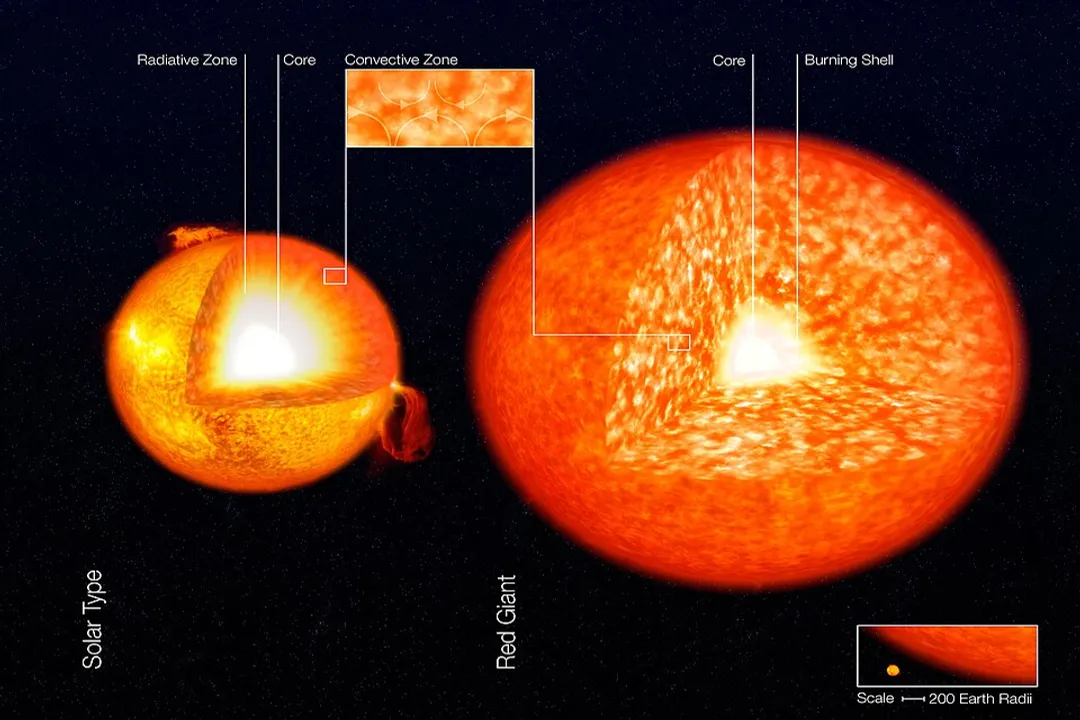
To understand the size difference, we must first look at how a star evolves away from the main sequence, the long, stable phase where it fuses hydrogen in its core. When a star like our Sun exhausts this core fuel, the core contracts and heats up, initiating hydrogen fusion in a shell surrounding the core. This energy increase causes the outer layers to puff up and cool, leading the star to become a red giant. For a star similar to the Sun, this expansion can result in a radius between $200$ to $800$ times that of the Sun. As our Sun approaches this state in about $5$ billion years, its radius is predicted to swell past Earth's orbit, effectively consuming the inner planets.
Stars that were significantly more massive than the Sun—those generally exceeding about $12$ solar masses—take a different, much faster route. When they exhaust their core hydrogen, they also expand, but because their core temperatures reach much higher levels, they can ignite fusion of heavier elements than just helium. These stars skip past the typical giant phase seen in Sun-like stars and become supergiants. While a Sun-like star spends roughly $10%$ of its life as a red giant, these massive stars burn through their fuel far more quickly and live shorter lives overall.
# Size Distinction
On the Hertzsprung-Russell (H-R) diagram, which maps stellar temperature against luminosity (brightness), giants and supergiants occupy distinct regions above the main sequence. A giant star is defined as having a substantially larger radius and luminosity than a main-sequence star of the same surface temperature.
However, the next step up the scale is reserved for the supergiants. Stars that are more luminous than ordinary giants are specifically termed supergiants. When we look at the specific dimensional measurements, the size gap becomes apparent:
- Giants (like Red Giants): Radii can reach up to a few hundred times the radius of the Sun. Arcturus, a well-known giant, is nearly twenty times the size of the Sun.
- Supergiants (like Red Supergiants): These stars routinely expand to sizes near $1500$ times the radius of the Sun. The supergiant Antares, for instance, is cited as being over $300$ times larger than the Sun, large enough to swallow the Earth and extend past the orbit of Mars. Even more extreme examples exist, with some supergiants expanding wide enough to encompass the orbit of Neptune.
This suggests a clear hierarchy where supergiants represent the larger, more luminous evolutionary outcome, often engulfing solar system bodies that their giant counterparts might only threaten. For instance, if the Sun swells to $800$ solar radii as a Red Giant, it consumes Earth at . A supergiant like Betelgeuse, said to be large enough to swallow Jupiter (at about ), implies a radius potentially in the range of thousands of solar radii, putting it significantly larger than the upper estimates for a typical Red Giant. When we compare the relative volumes this suggests, a star expanding to $1500$ solar radii instead of $800$ means its volume is increasing by a factor of , which is nearly eight times the volume of the smaller giant, despite the fuel exhaustion process being slightly different.
# Luminosity Classes
The official classification system further reinforces this separation through luminosity classes. Giants fall into Class III (giants) and Class II (bright giants). Bright giants are particularly interesting as they sit on the border, straddling the line between ordinary giants and supergiants based on their spectral appearance. Supergiants, on the other hand, occupy the highest classes, I, Ia, and Ib. This positional difference on the H-R diagram visually confirms that a supergiant is fundamentally a more luminous object than a star designated as a mere giant.
Stars categorized as O class on the main sequence are already extremely luminous. For these high-mass stars, the "giant" phase can be a very brief period of slightly increased size before they transition rapidly into the supergiant class, meaning the division can be narrow for the hottest, most massive stars. This overlapping evolutionary track is why some stars in the AGB (Asymptotic Giant Branch) phase—the late-life stage for Sun-like stars—might be large and luminous enough to be classified as supergiants, even if they followed the evolution path of a lower-mass star. This ambiguity means that classification can sometimes depend on which criteria—absolute luminosity or evolutionary stage—an astronomer is prioritizing at that moment.
# Density Implications
The sheer difference in size leads to a dramatic difference in density, despite the fact that their masses are sometimes comparable within a factor of ten. A star becomes a giant or supergiant by expanding its outer layers dramatically while its core is shrinking and heating up. This means that while supergiants occupy vastly larger volumes than main-sequence stars, their mass is not proportionally increased.
A red giant, for example, can have a density millions of times less than that of the Sun, making the material in its outer layers an incredibly thin vacuum. Supergiants, being even larger and often still supporting immense mass by fusing heavy elements, possess even lower average densities in their expanded envelopes. This explains why a Red Supergiant star, despite being orders of magnitude larger in diameter than a Red Giant, might not always possess proportionally more mass; the difference is primarily in expansion due to different internal energy sources and greater initial gravitational pressure.
# Color and Temperature Notes
While size is the primary discriminator between the two classes, color provides a clue to their evolutionary state. Both Red Giants and Red Supergiants cool down on the surface, often to around $3500$ Kelvin, because their energy output is spread over such a massive area. Cooler stars appear red.
However, supergiants are not exclusively red. Blue Supergiants exist as very hot and bright objects, representing stars that are still fusing hydrogen in their cores but are so massive they are already on the path to becoming supergiants. Blue giants transition into blue supergiants before expanding further into the cooler red supergiant phase, showing that not all massive stars pass through the same color sequence as they expand off the main sequence.
# Hypergiants Beyond
The terminology doesn't even stop at supergiant. There is a class of stars even more luminous and enormous than the standard supergiants: hypergiants. These represent the most massive and luminous stars known, sitting at the very top of the HR diagram, sometimes blurring the line with the largest supergiants. The presence of the hypergiant class confirms that supergiant is not the ultimate size ceiling; it is simply the category above 'giant' and below 'hypergiant' in the stellar size rankings.
In summary, while a regular giant star marks the beginning of a star's post-main-sequence swelling after leaving its stable life, a supergiant is a much more extreme version, reserved for stars that were initially very massive. Supergiants are indeed bigger, far more luminous, and destined for more spectacular ends—usually a supernova—than the giants that will gently puff away their outer layers to become white dwarfs.
#Citations
Giant star - Wikipedia
How big would a red giant or supergiant star appear in the sky from ...
Giants and Supergiants
Stars
G. C. Sloan: Main Sequence Stars, Giants, and Supergiants
What are the distinguishing features between red giants and ... - CK-12
Supergiant Facts for Kids