Why is there so much iron on Mars?
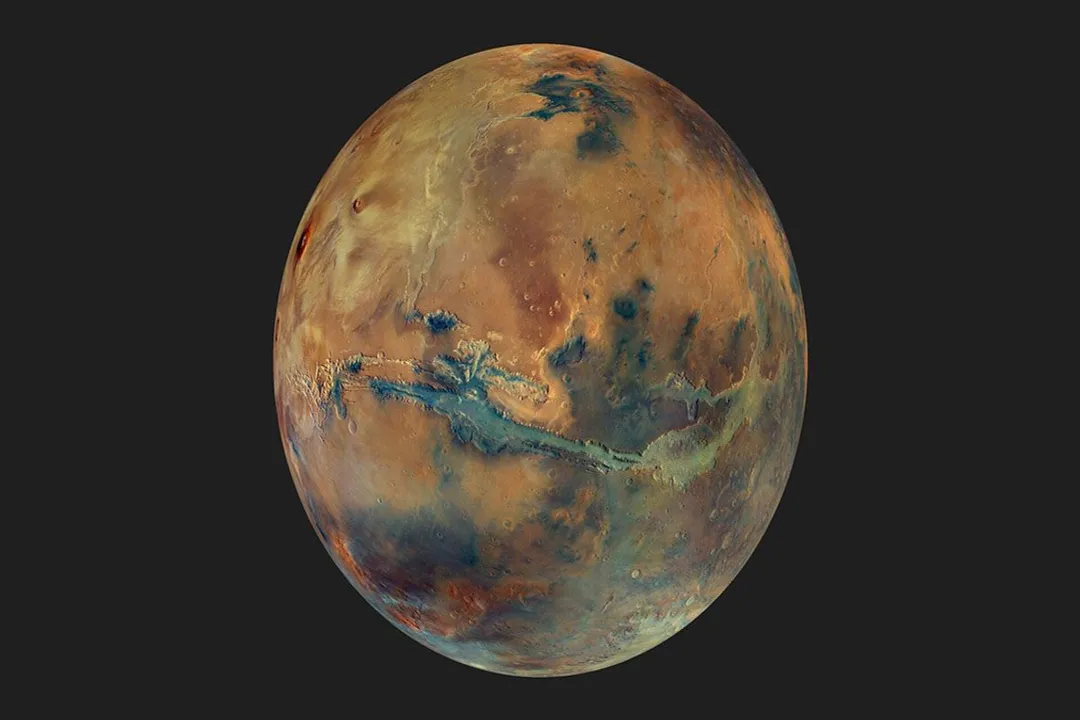
The familiar, arresting color of Mars—that pervasive reddish-ochre hue—is perhaps the planet's most defining characteristic, instantly recognizable even to a casual stargazer. This color isn't merely surface dust catching the sunlight; it's a direct chemical signature indicating a massive amount of iron on the Martian surface, locked up in compounds we commonly call rust. [2][6][9] The question isn't just why the surface is red, but rather, where did this iron originate, and how did it become so oxidized across an entire planet? The sheer quantity of iron exposed on Mars presents a fascinating geological puzzle when compared to our own world, suggesting vastly different evolutionary paths for these neighboring planets. [3]
# Red Planet Hue
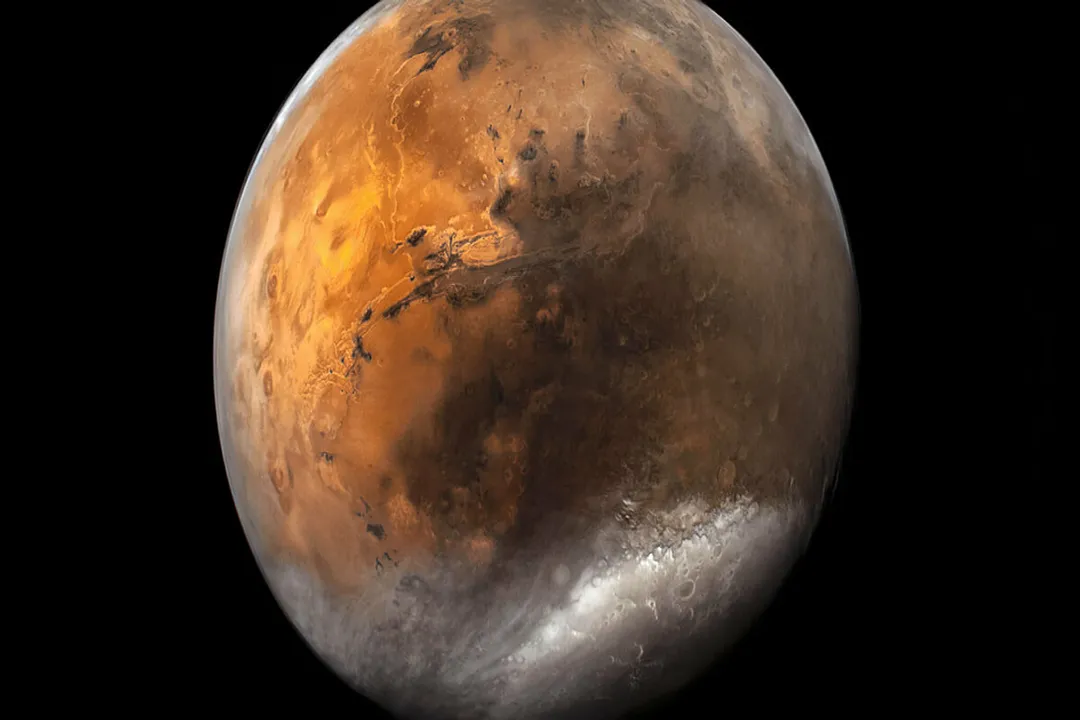
The deep crimson color of Mars is attributed almost entirely to iron oxide, the same chemical compound that gives Earth's rust its familiar look. [2][6] Specifically, the Martian dust is rich in iron-bearing minerals that have undergone oxidation. [9] This pervasive reddish dust covers much of the planet, sometimes blanketing vast plains and occasionally being swept up into planet-encompassing dust storms. [6]
While the iron is oxidized, the specific chemical form matters. Scientists have determined that a significant portion of this oxidized iron exists as ferrihydrite on Mars. [8] Ferrihydrite is an iron oxide mineral often associated with environments where iron reacts with water, which presents a seeming contradiction given Mars's current arid state. [8] However, the oxidation didn't necessarily require oceans of liquid water in the way we experience it today. [5] The key takeaway is that wherever you look on Mars, you are seeing the signature of iron that has reacted with an oxidizing agent, most likely oxygen or other compounds, over eons. [9]
# Iron Abundance
A natural point of comparison arises when considering Earth. Does Mars possess more iron overall than Earth? The answer, perhaps counterintuitively, is likely no, at least in terms of total planetary mass. [3] Earth is believed to have a much larger, denser iron core, a result of planetary differentiation where heavy elements sank to the center early in its formation. [3] Mars, being significantly smaller, also underwent differentiation, but its smaller mass meant that a larger proportion of its iron remained closer to or within the crust and mantle, rather than sinking entirely into a massive central core as happened on Earth. [3]
This difference in internal structure explains the visual contrast: On Earth, we see iron mostly in the deep subsurface or occasionally brought up through volcanic activity, but not spread across the continents as a surface coating. [3] Mars, however, seems to have experienced a global event that brought iron-rich materials to the surface and chemically altered them. [5] If we consider only the mass distributed in the crust and surface regions, Mars has a greater concentration of accessible iron than Earth does, even if Earth's total iron budget is larger due to its massive core. [3]
This disparity between the two planets’ iron distribution is stark. Imagine Earth’s surface covered in a layer of iron oxide kilometers thick—that is conceptually what we are observing on Mars, even if the actual layer isn't uniformly that deep. [1] The iron present in the Martian crust is estimated to be roughly equivalent to an oxidized layer about 30 to 40 kilometers thick if that iron were uniformly distributed across the planet's surface. [1] That is a tremendous amount of material chemically altered across an entire world.
# Core Differentiation
The initial presence of iron on Mars stems from the very processes that formed the planet. Like Earth, Mars accreted from the solar nebula, and once it grew large enough, internal heating caused partial or complete melting, leading to differentiation. [7] This is the process where denser materials, primarily iron and nickel, sank inward to form the planet's core, while lighter silicate materials floated upward to form the mantle and crust. [7]
For the surface to be so rich in iron oxide, that iron must have been somehow brought back up from the mantle or retained in the crust before the main differentiation event was complete, or it must have been delivered later. [3][5] The prevailing theory suggests that the early Martian crust retained a significant amount of iron-bearing minerals during or immediately following this planetary segregation. [1] Unlike Earth, where the mantle has remained mostly iron-poor since the core formed, Mars appears to have retained a more iron-rich primitive crust, perhaps due to a less intense or incomplete differentiation process. [3]
Another contributing factor often discussed is the role of giant impacts early in the planet's history. Major collisions could have excavated material from deeper layers, churning the crust and exposing fresh, unoxidized iron silicates to the atmosphere. [9] This excavated material would then be susceptible to the oxidizing conditions present at the surface.
# Oxidation Mystery
The critical question that follows the presence of abundant iron is how it turned to rust () when the current Martian atmosphere is extremely thin (less than 1% of Earth's surface pressure) and lacks significant free oxygen (). [5] Rust, as we commonly understand it on Earth, is the product of iron reacting with both oxygen and liquid water: . [5]
The existence of widespread ferrihydrite, a hydrated iron oxide, strongly suggests that liquid water was present in abundance on early Mars, allowing for the slow chemical weathering of iron-rich rocks. [8] Even if surface oceans disappeared billions of years ago, that ancient wet environment would have initiated the process of creating the oxidized dust that now covers the planet. [5] Furthermore, evidence suggests that the atmosphere was denser and contained more oxidizing agents in the distant past. [9]
One proposed mechanism to explain the current state, especially in the absence of active large bodies of liquid water, involves atmospheric chemistry. Water vapor, even in trace amounts in the thin modern atmosphere, can react with solar ultraviolet radiation in the upper atmosphere, splitting water molecules into hydrogen and oxygen radicals. [9] The lighter hydrogen escapes into space, while the heavier oxygen remains, slowly building up oxidizing compounds over geological timescales. [9] While the rate of this process might be slow today, it could have been far more effective when Mars had a thicker atmosphere billions of years ago. [5] This ongoing, low-level atmospheric loss and reaction helps maintain the oxidized state of the surface dust.
A helpful way to frame this is to consider the environment of deposition versus the environment of weathering. The iron-rich crust formed when Mars was hot and differentiated. [7] The rusting occurred primarily when Mars was wet and warm, or perhaps intermittently wet, which may have happened across vast stretches of time rather than in one single, continuous era. [5] The current thin atmosphere is simply not responsible for creating the rust, but for maintaining the conditions that keep the existing rust from being chemically reduced back into its metallic form.
Here is a breakdown comparing the main iron compounds identified on Mars:
| Compound | Chemical Formula (General) | Significance | Citation |
|---|---|---|---|
| Iron Silicates | (Olivine) | Common in the mantle/unaltered crust | [1][3] |
| Hematite | Gives the deep red color, stable form | [6][9] | |
| Ferrihydrite | Hydrated iron oxide, suggests past water | [8] |

# Surface Distribution
The distribution of this iron oxide isn't perfectly uniform. Certain regions, particularly the low-lying northern plains, are thought to be younger and perhaps retain more basaltic, less oxidized material compared to the ancient, heavily cratered southern highlands. [1] The highlands, being older, have had much longer exposure to the elements and the oxidizing chemistry of the early Martian environment, leading to a thicker accumulation of the red dust. [1]
This distribution has practical implications for future exploration. For robotic and eventual human missions, understanding the crustal composition—where the iron is concentrated and where less-oxidized, iron-silicate bedrock might be found—is key for resource utilization. [4] Future missions will need to carefully map these variations, as unoxidized iron-bearing rock might be a better source material for extracting oxygen or structural metals than the already highly oxidized surface dust, which is already bonded with oxygen. [4] The sheer volume of surface iron presents a massive, albeit highly oxidized, resource pool for in-situ resource utilization (ISRU) technology, should we ever establish a permanent presence. [4]
If we look at the data gathered from orbiters, the surface iron content is a major indicator of geological history. Regions like Syrtis Major Planum, which shows evidence of ancient volcanic activity, present a different surface chemistry signature than the vast dust sheets seen elsewhere, suggesting that how the iron was brought to the surface (volcanism versus ancient weathering) dictates the final mineralogy we observe today. [7] The fact that we can use simple color differences—a very broad measurement—to infer complex geological epochs speaks volumes about the success of remote sensing in planetary science.
# Conclusion
Mars is red because it is saturated with iron oxide, a geological phenomenon stemming from a history fundamentally different from Earth's. While Earth sequestered most of its iron deep within its core, Mars retained a large fraction in its crust, which was subsequently exposed to oxidizing agents, likely a combination of early liquid water and ongoing atmospheric chemistry. [3][5][9] The abundance of iron, whether as hematite or ferrihydrite, defines the planet's appearance and dictates much of its geological narrative, painting a picture of a warmer, wetter world that slowly transitioned into the cold desert we see today. [6][8] Analyzing this pervasive red dust is essentially reading the planet's autobiography, written in the language of oxidized metals. [2]
#Videos
New study explains why Mars is RED - YouTube
#Citations
How Mars got its rust : Nature News
Mars is red because of the iron oxide present in its soil ... - Reddit
Does Mars contain more iron than the Earth?
Mars: Facts - NASA Science
Where did all the rust (iron oxide) come from on Mars since ... - Quora
Why is Mars red? A new clue to the history of habitability in Martian…
New study explains why Mars is RED - YouTube
New theory as to why Mars is red | BBC Sky at Night Magazine
Is Mars red because of iron corrosion? If so, what process caused it ...