Which planet does iron come from?
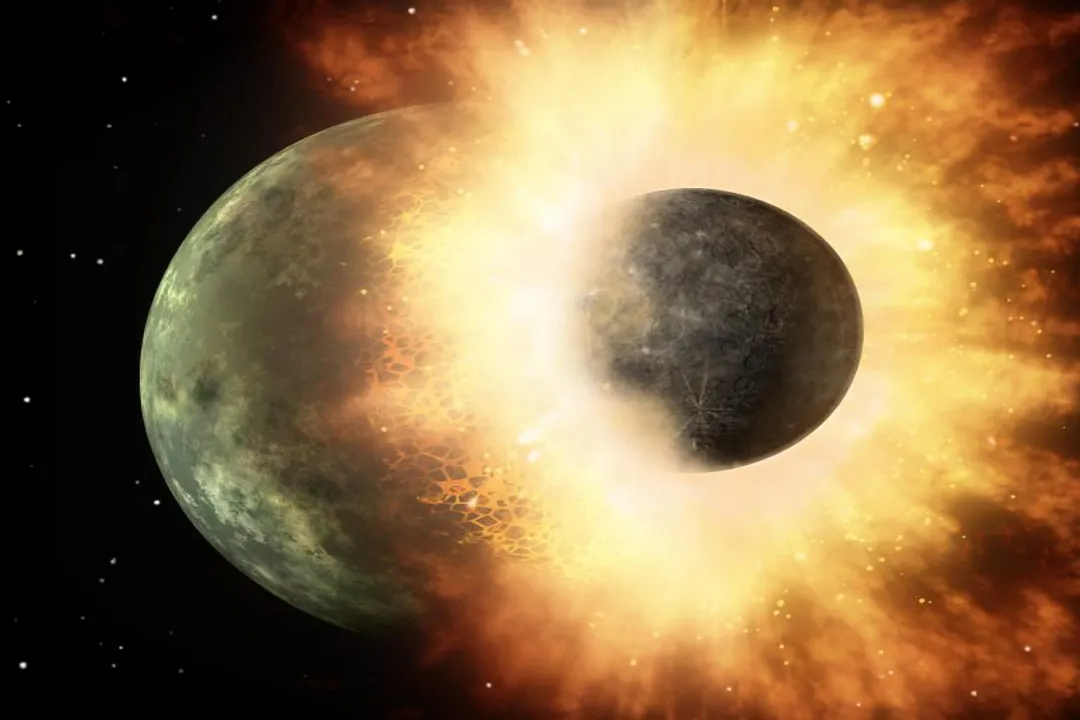
The existence of the element iron is a fundamental marker in the history of the universe, originating not from any single planet, but from the cataclysmic deaths of massive stars. This element, essential for life as we know it—found in our blood and heavily concentrated in the Earth’s interior—has a journey that spans billions of years, from nuclear fusion deep within ancient stellar cores to its present location in the crusts and hearts of worlds across the solar system. [4][9] When considering which planet iron "comes from," the answer shifts: it comes from the raw materials of the solar nebula, but where it settles defines a planet’s character.
# Cosmic Birth
The creation of iron atoms is a spectacular, high-energy process. Lighter elements fuse together over eons inside stars, but this fusion process stalls when the core begins producing iron. [4] Iron has the most stable atomic nucleus of all elements up to bismuth, meaning fusing it consumes energy rather than releasing it. Once a massive star builds up an iron core, it can no longer support itself against its own gravity, leading to a catastrophic gravitational collapse and a resulting supernova explosion. [4] It is in this immense burst of energy—the supernova—that elements heavier than iron, as well as the newly forged iron itself, are scattered across the interstellar medium. [4][9]
These newly enriched clouds of gas and dust, containing the elemental building blocks like iron, eventually collapse under gravity to form new solar systems, including our own. [9] Therefore, every planet, including Earth and Mars, inherited its iron supply from this common, violent stellar origin story that occurred before the solar system even coalesced. [9]
# Planetary Accretion
As the Sun formed, the surrounding disk of material—the protoplanetary disk—began clumping together. Iron, being a relatively dense element, played a major role in this accretion process. [9] In the early, molten stages of planetary formation, gravity drove the process of differentiation. This is a natural sorting mechanism based on density, where the heaviest materials sink toward the center, and lighter materials float toward the surface. [3][7]
For terrestrial planets like Earth, this meant that the vast majority of its available iron—which accounts for a significant fraction of the planet's total mass—migrated inward to form the planet's core. [9] If we look at the overall structure of Earth, the core is composed primarily of iron and nickel. [9] This separation is not unique to Earth; it is a defining characteristic of rocky worlds that have gone through sufficient heating and differentiation to allow dense metals to sink. [7]
# Earth's Internal Reservoir
The concentration of iron deep within Earth presents a fascinating scientific puzzle regarding its exact path to the core. One prevailing idea is that the iron was largely incorporated into the planet during the initial accretion of planetesimals. [3] However, another line of thinking suggests that a significant amount of iron might have been stored in the planet's mantle and later sank during differentiation as the core formed. [3] The theory that the iron was sourced predominantly from the mantle after the main body of Earth had formed is supported by some modern analyses, suggesting a more localized source within the planet itself rather than solely from later, massive external impacts. [3] Regardless of the precise mechanism of sinking, the result is clear: the largest, most inaccessible reservoir of iron on our world is locked away, inaccessible to us on the surface. [9]
# Contrasting Iron on Mars
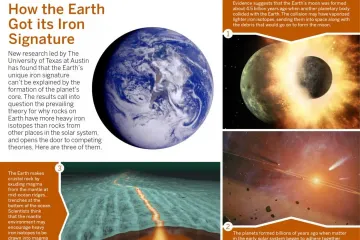
While Earth entombed its iron core deep beneath miles of rock, Mars presents a starkly different surface manifestation of the same element. Mars is famously known as the Red Planet. [5] This distinctive color comes directly from the iron minerals present in its dust and soil. [2]
On Mars, iron is oxidized—it has combined with oxygen—forming iron oxides, which are essentially rust. [5] This ubiquitous presence on the Martian surface is visible evidence of iron that did not sink entirely into a core or was somehow brought back to the surface over geologic time, perhaps through volcanic activity or impacts. [5]
We can contrast the two planets by looking at their fundamental composition differences driven by these initial differentiation stages:
| Feature | Earth | Mars |
|---|---|---|
| Dominant Iron Location | Massive central core (largely metallic iron/nickel) [9] | Surface dust and soil (as iron oxides/rust) [2][5] |
| Surface Appearance | Blue/White/Green (Water/Silicates/Life) | Red (Iron oxides) [2][5] |
| Accessibility | Extremely difficult to access (deep mantle/core) [9] | Relatively accessible in surface regolith |
This difference in distribution, where one planet's iron is its structural heart and the other's is its colorful skin, highlights how planetary evolution—the degree and speed of internal melting and density sorting—dictates the accessible chemistry of a world. [3][7] Earth underwent a complete, deep-seated differentiation, whereas Mars, being smaller, may have cooled faster, or its initial accretion history resulted in a comparatively smaller, or perhaps less dense, core relative to its mantle, leaving more oxidized iron near the surface. [3]
# Accessible Metal
The iron we interact with daily—the steel in our buildings, cars, and tools—is, of course, sourced from terrestrial deposits, mined from what the Earth did allow to remain near the crust. The transition to using this accessible, high-strength metal fundamentally changed human civilization, marking the start of the Iron Age. [8] Historically, the discovery of how to extract and refine iron ore marks a technological leap, moving from meteoritic iron (which is extraterrestrial but rare) to abundant terrestrial sources. [8] Even meteorites, which strike Earth, are often fragments of iron cores from planetesimals that were shattered early in solar system history. [4]
It is interesting to note that while the element iron is created in the most energetic events known, our modern technological reliance is entirely on the comparatively tiny fraction that escaped gravitational sequestration into our planet’s core. [9] The vast majority of the iron that formed with Earth remains deep below, fundamentally shaping its magnetic field by driving convection in the liquid outer core, a feature vital for protecting life on the surface. [7] Without that massive, deep core, the iron would simply be spread throughout the mantle, yielding a planet with a very different chemical makeup and, critically, no strong global magnetic field.
In summary, the element iron originates from stellar nucleosynthesis, scattered by supernovae. [4] It arrived on Earth via cosmic accretion. [9] Which planet it "comes from" in terms of its current state depends entirely on that planet's internal history: on Earth, it primarily comes from the core that formed via density sorting, [3][7] while on Mars, the visible iron has become an oxidized component of the surface crust. [2][5]
#Citations
Other than Earth, how common is iron on terrestrial planets? - Reddit
Mars: Facts - NASA Science
Finding the Origin of Earth's Iron | Jackson School of Geosciences
Where did iron come from on Earth? - Quora
You've heard that it's called the Red Planet (because of the iron ...
Iron From Space - YouTube
Which theory is stronger, that iron came from outside or was formed ...
The 'Iron Age' | Anglo American
Where does iron come from? - C.A. Lawton