Why are the early telescopes not ideal?
The history of astronomy is often told as a story of ever-increasing clarity, a steady march toward perfect vision. Yet, the instruments that launched this revolution—the early telescopes—were profoundly flawed, their grand discoveries made in spite of, rather than because of, their optical quality. To look through a device built in the early 17th century was to peer through glass that fought against the image at every turn, besieged by distortion, blurriness, and a bewildering array of colors.
# Galileo's Compromise
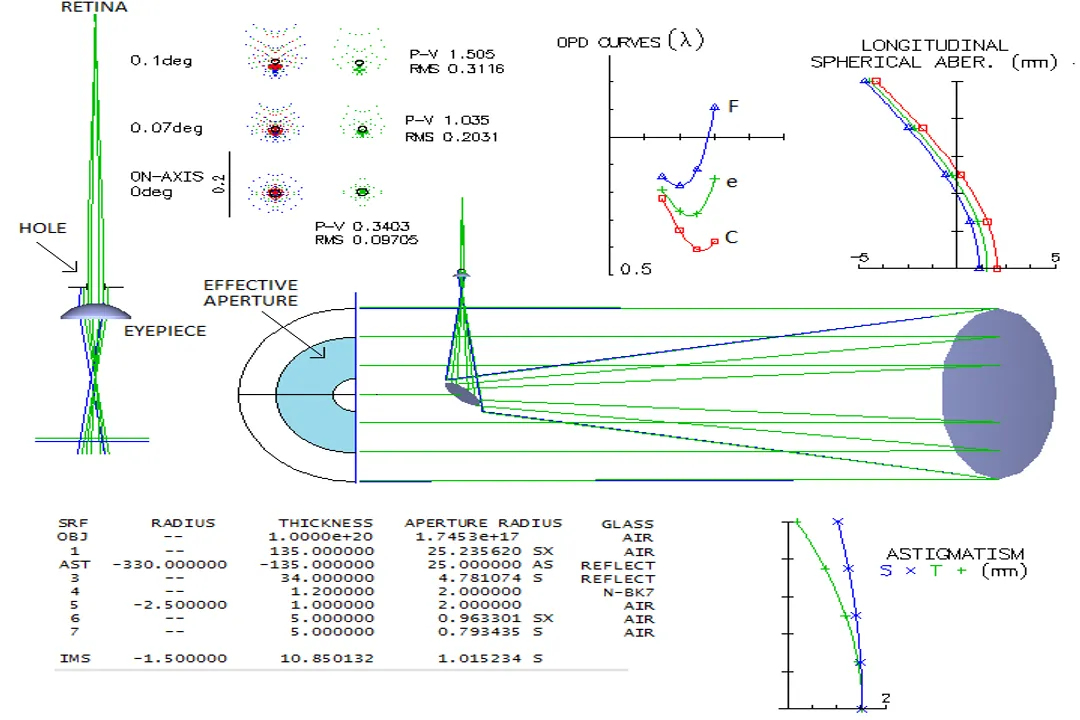
The initial leap from a simple spyglass to an astronomical tool was made by Galileo Galilei around 1609. His design, the refractor, was built using two lenses: a convex objective lens facing the object and a concave eyepiece lens placed near the eye. Galileo derived the basic magnification formula, finding that a 20x instrument was achievable by late 1609. He managed to revolutionize science, showing the phases of Venus and discovering the moons orbiting Jupiter, thus challenging the long-held geocentric view of the universe.
However, the means to these ends were inherently poor by modern standards. Galileo’s lenses were simple, single elements—what optical engineers now call singlets. The main optical affliction of these simple, curved lenses was longitudinal chromatism, or "primary spectrum". When white light passes through a single convex lens, it acts like a prism, separating the light into its constituent colors. Each color focuses at a slightly different point along the optical axis, resulting in the distracting, colorful fringes surrounding every object seen through the telescope. For Galileo’s original objective lens (around 51mm diameter with a 1330mm focal length), the wavefront error due to chromatism alone was severe, leading to a resolution limit of about 14 arc seconds based on color error alone.
To mitigate this chromatic smear, Galileo often resorted to a pragmatic but limiting technique: stopping down the objective lens. By placing cardboard around the edges, he let light enter only the central, flatter portion of the lens, where distortions caused by curvature were less pronounced. One of his smaller, surviving scopes had its objective physically restricted from its full diameter down to just 15mm. While this halved the chromatism, it drastically reduced the light-gathering power and field of view.
The second major restriction in the Galilean design was the trade-off between image size and visual area. As Galileo pushed for larger magnification, his field of view shrank drastically. He found a practical ceiling around 20 or 30 times magnification; anything more made the image too small to be useful. He could see no more than about a quarter of the Moon’s face without repositioning the instrument.
A modern beginner's telescope, even a cheap one costing under 50, possesses vastly superior optics. For instance, a modern cheap refractor uses achromatic lenses—two different types of glass cemented together—to bring most colors to a common focus, nearly eliminating the color fringes that plagued Galileo. Galileo could not resolve Saturn's rings, seeing them as mere "ear-like globs," whereas a modern, small-aperture refractor can resolve them clearly. This highlights that while Galileo's contribution was monumental in applying the device to the sky, the quality of his glass and lens design was rudimentary.
# The Length Epidemic
The limitations of the Galilean system led directly to the next evolutionary step, one pioneered by Johannes Kepler. Kepler replaced the concave eyepiece with a convex lens. This created the Keplerian or astronomical refractor.
The Keplerian design had significant advantages over the Galilean system. It offered a much greater field of view, immediately lifting the magnification ceiling Galileo had encountered. However, this improvement came with a significant drawback for terrestrial observers: the image was inverted (upside down). For astronomy, this was inconsequential, but for general use, it was undesirable.
The optical trade-off for achieving better color correction in a refractor was always length. The less curved a lens is, the less it acts like a prism, thus reducing chromatic aberration. To reduce the objective lens's curvature while maintaining the necessary magnification, the telescope’s focal length—and thus its physical length—had to increase.
This realization triggered an optical arms race in focal length that verged on the absurd:
- By 1645, good astronomical refractors were around 6 to 8 feet long.
- By 1650, they stretched to 10 to 15 feet.
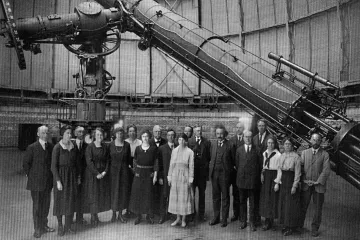
- By 1673, Polish astronomer Johannes Hevelius constructed a spectacular refractor measuring 150 feet (approximately 45 meters) long.
Hevelius’s massive objective lens, about 8 inches in diameter, was still a single plano-convex element. While its extreme length helped manage aberrations compared to a shorter, faster lens, ray tracing analysis suggests that even this giant still exhibited primary spectrum issues comparable to a modern 100mm f/4 achromat.
These aerial telescopes required colossal, awkward mounting systems and were incredibly cumbersome to maneuver. If an astronomer wanted to observe a patch of sky far from the zenith, the entire massive structure had to be physically reoriented, a process that was unstable and slow. The utility peaked where the inconvenience became unmanageable. One astronomer even dreamed of 1,000-foot focus instruments to see details on the Moon, a goal entirely impractical due to the engineering nightmare they presented. The sheer difficulty of maintaining alignment across a 150-foot tube, ensuring the single objective lens was perfectly figured, and avoiding the crippling effects of atmospheric turbulence over that distance, meant that the theoretical optical potential was almost certainly never realized in practice.
# Mirror's Arrival
The extreme lengths required to control chromatic aberration in refractors eventually led scientists to seek an alternative to the lens entirely. The problem stemmed from the fact that all glass refracts color differently.
The solution arrived with Sir Isaac Newton, who demonstrated in 1672 that by using mirrors instead of lenses for the primary light collector, the problem of chromatic aberration could be circumvented, as reflection does not separate colors in the same manner.
Newton’s first successful reflecting telescope used a primary concave mirror that reflected light to a smaller, secondary flat mirror placed at a 45-degree angle, which then bounced the light out the side of the tube to an eyepiece lens. This design effectively eliminated primary chromatism because the eyepiece was a simple lens, but the primary focusing element was a mirror.
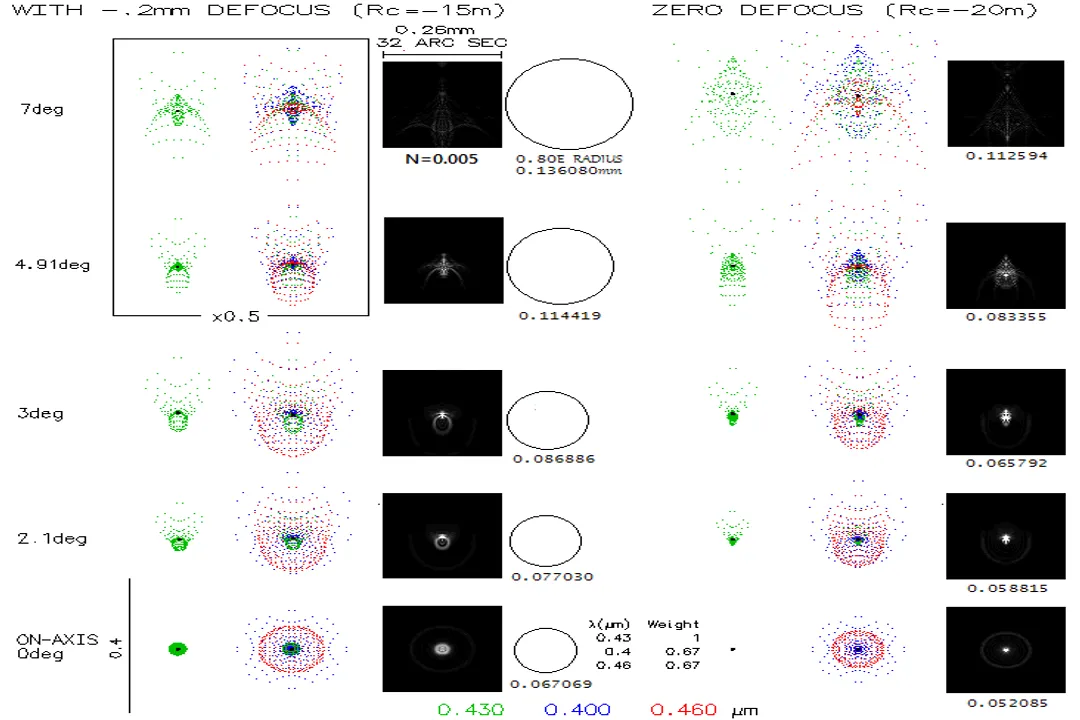
While Newton solved the color problem, his design introduced a new, major set of defects tied to the mirror's shape. To keep the design manageable, Newton used a spherical mirror. Spherical mirrors, like spherical lenses, focus light rays hitting the edge differently than rays hitting the center, leading to spherical aberration. Newton’s specific two-inch mirror suffered from about 1.5 waves P-V of this error, which was reduced by stopping down the aperture to 1.3 inches.
The early reflectors, including Newton's own, were also hampered by the material itself. The polished metal mirrors, often made of speculum, had low reflectivity. Newton's instrument transmitted only about a dozen times more light than the naked eye, a significant reduction from the nominal gathering power due to these reflective losses. Furthermore, other designers struggled to grind mirrors with the regular curvature needed, meaning reflectors remained largely novelties until better polishing techniques emerged later in the 18th century.
# Giant Flaws
The quest for light-gathering power, which was directly proportional to aperture, forced astronomers like Hevelius and later William Herschel to build truly immense instruments, embracing the associated image defects.
Hevelius’s 45-meter refractor was an attempt to get greater light grasp without sacrificing the perceived purity of color rendition (though chromatism was still present). The sheer scale of his scope made its use incredibly slow and difficult.
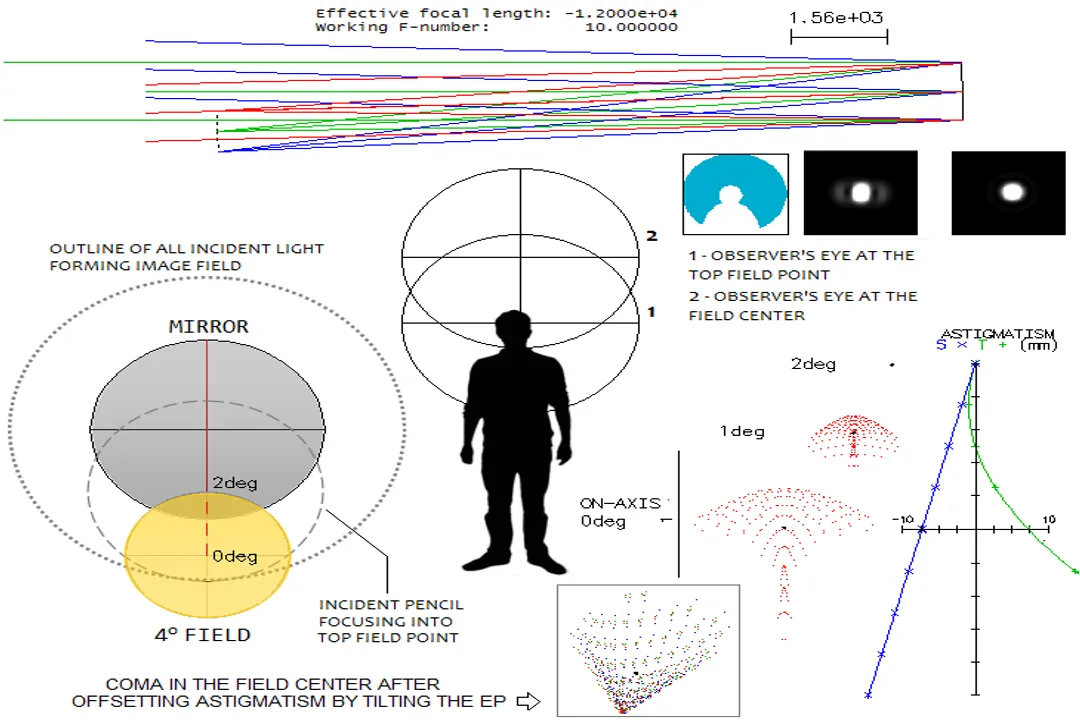
Herschel’s 40-foot reflector (built in the late 1780s) used a massive 48-inch (1.2m) primary mirror. To avoid placing the eyepiece directly in the path of the incoming light—which would obscure a large portion of the aperture—Herschel tilted the primary mirror slightly and observed the image off to the side.
This decision was catastrophic for image quality. Tilting the mirror by just 2 degrees introduced horrific off-axis aberrations, primarily astigmatism and coma, amounting to 36 waves P-V at the intended focus point. For comparison, a perfect optical system would measure in fractions of a wave. This massive aberration resulted in a blur spot about 17 arc seconds in angular size.
To regain a usable image, Herschel had to radically change his viewing position, effectively moving his head and torso into the path of the incoming light beam to find a zone where the aberrations diminished slightly.
Here is a comparison illustrating the technical gulf between these giants and what we consider "poor" today:
| Feature | Galileo's Best Scope (~1610) | Herschel's 40-foot Reflector (~1780s) | Modern Cheap Binoculars (Example) |
|---|---|---|---|
| Design Type | Refractor (Galilean) | Reflector (Front-End View) | Refractor (Modern Achromatic) |
| Magnification | High (e.g., with eyepiece) | ||
| Primary Defect | Longitudinal Chromatism | Astigmatism/Coma (from mirror tilt) | Negligible (due to doublets) |
| Light Gathering | Low (limited by small aperture) | High (limited by mirror reflectivity ) | Moderate (limited by aperture) |
| Resolution Capability | Could not resolve Saturn's rings | Severely hampered by tilt aberrations | Easily resolves Saturn's rings |
This brings us to a fascinating point about practical application. Herschel, faced with a telescope that was optically ruined by tilting the mirror to keep his head out of the light, seemingly prioritized aperture and light gathering over perfect image shape at high power. If he moved his head into the light path to achieve the best possible correction, the resulting blur was still larger than what the seeing conditions (atmospheric turbulence) would often produce anyway. This reveals the intense, real-world engineering choice: sacrificing geometric perfection (by blocking light with his body) to achieve an image just good enough to be limited by nature (seeing) rather than by the instrument’s own design flaws.
# Later Progress Imperfect
Even as glass technology and understanding of aberrations advanced into the 19th and early 20th centuries, the instruments, though far superior to Galileo’s tube, still harbored significant limitations when pushed to extremes of field or speed.
The Cooke Triplet design, invented by Dennis H. Taylor in the late 1890s, became famous for photographic objectives—systems designed to capture a wide, flat field of view. The Pluto-discovery telescope, an astrograph from the late 1920s, used a triplet lens configuration. While it was a major advance, capable of yielding a nearly flat field, its primary flaw was still excessive longitudinal chromatism. Its image quality, even in optimized wavelengths, was limited, requiring astronomers to use specific color filters to cut out light outside the range where the lens performed best. The residual errors meant that even for the discovery of Pluto, the image quality was quite poor by today’s professional imaging standards.
Similarly, earlier attempts to solve the refractor's problems involved the Dollond Triplet in the 1760s, used by Peter Dollond. These instruments successfully corrected spherical aberration by splitting a positive lens element, but they still suffered from noticeable coma unless run at a very slow focal ratio (e.g., f/30 for a 10-foot model). Coma, an aberration causing points of light to stretch into comet-like shapes away from the center, is often more noticeable than residual spherical aberration in these systems.
The takeaway across two centuries of optical development is that every solution introduced a new problem or forced an extreme compromise in physical dimensions or operational procedure. Eliminating color led to massive size or severe off-axis distortion; reducing distortion led to overwhelming color or requiring slow focal ratios. The early telescope was not ideal because the mathematical and physical tools to correct all aberrations simultaneously simply did not exist until the advent of specialized glass types and computational design methods in the modern era. The genius of figures like Galileo and Newton was not in achieving optical perfection, but in extracting profound physical truth from instruments that were, by objective measures, quite severely handicapped.
Related Questions
#Citations
How good were the optics in Galileo's telescope compared ... - Reddit
Early telescopes
NOVA | Galileo's Battle for the Heavens | Two Types of Telescopes