Why are stars gas?

The simplest answer to why stars are comprised primarily of gas is that they form from the vast, diffuse clouds of matter scattered throughout space, which happen to be overwhelmingly composed of the lightest elements. While we often call them massive, burning balls of gas, the material inside a star is far more extreme than any gas we experience on Earth. They are essentially gigantic factories built from the universe's most basic ingredients, held together by gravity until the pressure forces those ingredients into a superheated, energetic state. [1][3]
# Plasma State

When discussing the composition of a star, the term gas is technically a simplification. The conditions within a star—immense heat and pressure—fundamentally alter the state of the matter present. [2] The material inside a star is not the neutral gas we might find in a balloon; instead, it exists as plasma, which is often described as the fourth state of matter. [2][3]
Plasma occurs when the energy of the heat is so intense that atoms are stripped of their electrons. [2] In this ionized state, the gas is a soup of free-floating atomic nuclei and electrons moving independently. [2] This extreme pressure and temperature are what allow nuclear reactions to occur in the star's core. [3] So, while the raw material starts as a gas cloud, the functioning star is an object made of plasma, behaving under the colossal force of its own gravity. [1][8]
# Elemental Origins

The specific chemical recipe for nearly every star is strikingly consistent, dominated by just two elements: hydrogen and helium. [3][6] Hydrogen, the simplest element, makes up about 75% of the star's mass, and helium accounts for nearly all of the remaining 24%. [3] The tiny fraction left over is made up of heavier elements, often referred to by astronomers as "metals". [3][6]
This overwhelming dominance of hydrogen and helium is not accidental; it reflects the history of the universe itself. [4] These light elements were the first substances forged in the initial moments after the Big Bang. [4][6] Everything else—the carbon, oxygen, iron, and silicon that make up planets, rocks, and life—was created much later, either inside the cores of earlier generations of massive stars through nucleosynthesis or scattered outward when those stars died. [4][6] Because stars are essentially recycling vast amounts of raw, primordial material, they overwhelmingly contain what was most abundant at the beginning of time. [6]
To put the stellar composition into context, one can compare the Sun’s makeup to that of our own home world. While the Sun is mostly light gas, Earth is predominantly composed of heavier, condensed material.
| Element | Sun (Approximate Mass Percentage) | Earth’s Crust (Approximate Mass Percentage) |
|---|---|---|
| Hydrogen | ~74% | < 0.001% |
| Helium | ~24% | Trace |
| Oxygen | ~0.8% | ~47% |
| Iron | ~0.1% | ~5% |
| Silicon | Trace | ~28% |
This stark difference arises because the planet-forming disk surrounding a newborn star often allows the heavy elements to condense into rocky cores while the light, voluminous hydrogen and helium are either blown away by the young star’s radiation or remain in a gaseous envelope far from the star's center. [6]
# Gravity's Role
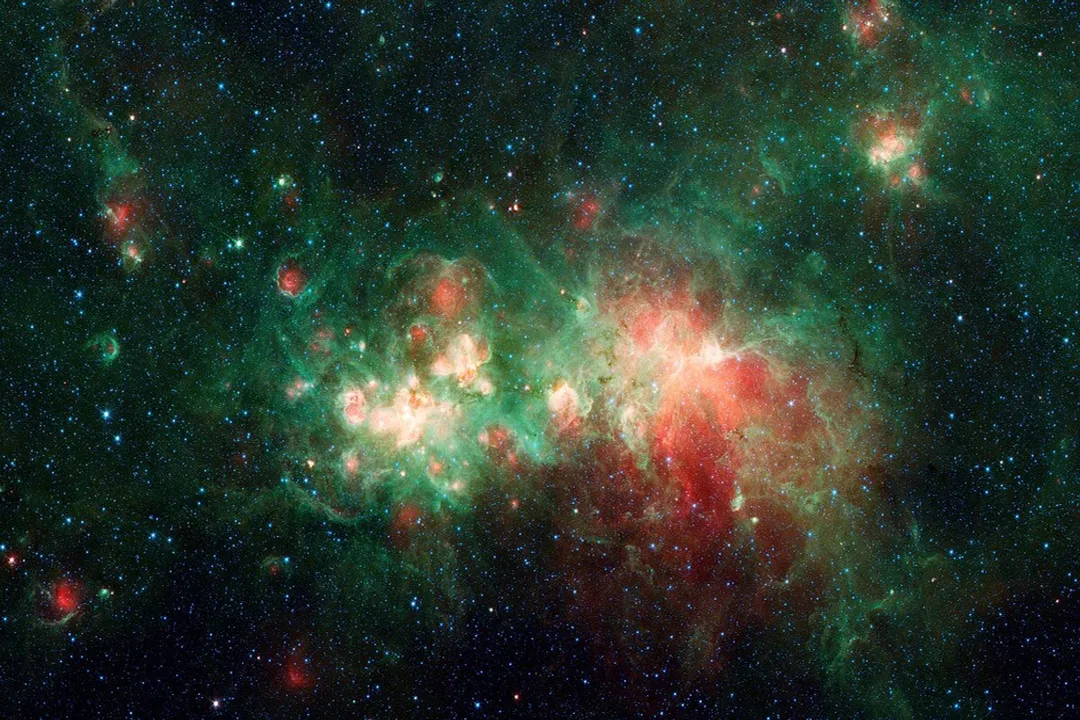
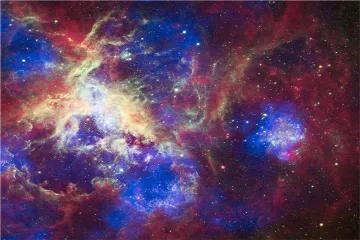
Stars exist because gravity manages to compress massive amounts of this diffuse gas into a small volume. [7][8] Star formation begins within colossal, cold, dark regions of space known as nebulae, which are clouds composed of gas (mostly H and He) and dust. [7][8]
For a star to ignite, a portion of this cloud must begin to collapse under its own self-attraction. [7] If a region within the nebula is dense enough, gravity starts pulling the surrounding gas and dust inward. [7] As this material falls toward the center, the gravitational potential energy is converted into thermal energy, causing the core of the collapsing clump to heat up dramatically. [7] This process continues for millions of years as the cloud shrinks, its central temperature rising steadily due to the relentless crush of infalling mass. [7] A star, therefore, is defined by having enough mass to create this incredible gravitational pressure.
# Stellar Engines
The key transition from a large, hot ball of gas to a true, self-sustaining star happens when the core temperature and pressure finally become sufficient to initiate nuclear fusion. [7] For a star like our Sun, the core must reach approximately 15 million degrees Celsius. [7] At this point, the core generates enough energy to counteract the inward pull of gravity, establishing a state of hydrostatic equilibrium that keeps the star stable for billions of years. [1][8]
Hydrogen nuclei begin fusing together to form helium nuclei, releasing enormous amounts of energy in the process. [3][8] This outward pressure balances the inward force of gravity, making the star luminous. [1] If a collapsing cloud does not accumulate enough mass—roughly 80 times the mass of Jupiter—it will never reach the temperature required to start this fusion engine, resulting in a brown dwarf rather than a true star. [1] The reason the star burns is directly tied to the sheer volume of hydrogen fuel it possesses, which is dictated by the initial gas cloud it formed from. [4]
# Mass Differentiation
The initial amount of gas pulled together fundamentally dictates the star's entire life story, including its color, temperature, and lifespan. [1] More massive clumps of gas lead to hotter, brighter, and shorter-lived stars, while less massive stars burn cooler and live far longer. [1]
When looking at the very smallest objects that form from these clouds, we see a gradient of success. A collapsing object must overcome a minimum mass threshold to become a hydrogen-fusing star. If it falls short of that threshold but still manages to fuse deuterium (a heavier isotope of hydrogen) for a brief period, it becomes a brown dwarf, sometimes called a "failed star". [1] This shows that the initial supply of gas, and the ensuing gravitational collapse, is the sole determinant of whether a celestial body achieves the sustained energy output we associate with a true star. The raw material is gas; the outcome—be it a dim brown dwarf or a brilliant blue giant—is entirely dependent on the initial quantity of that gas collected by gravity. [7]
It is fascinating to consider the initial density variations within a nebula. Even in a region that seems uniformly spread out, microscopic quantum fluctuations present immediately after the Big Bang provided the initial slight density variations in the primordial hydrogen and helium gas. Gravity acts upon these infinitesimal differences, amplifying them over billions of years until a macroscopic clump achieves the critical mass necessary to overcome the thermal pressure resisting collapse. [7] This highlights that the entire structure of the cosmos, from gas clouds to glowing suns, rests upon the behavior of matter at the very smallest scales during the universe's infancy.
Related Questions
#Citations
Star Basics - NASA Science
ELI5- if stars are big burning balls of gas what keeps them ... - Reddit
What are stars made of?
Why are stars made from hydrogen and helium and not other ...
What Are Stars Made Of? - Layers of the Sun and More at Little ...
Why are stars mostly hydrogen and helium but orbiting planets metal ...
Star formation - Wikipedia
stars | AMNH