When was it proven that the Earth rotates around the Sun?
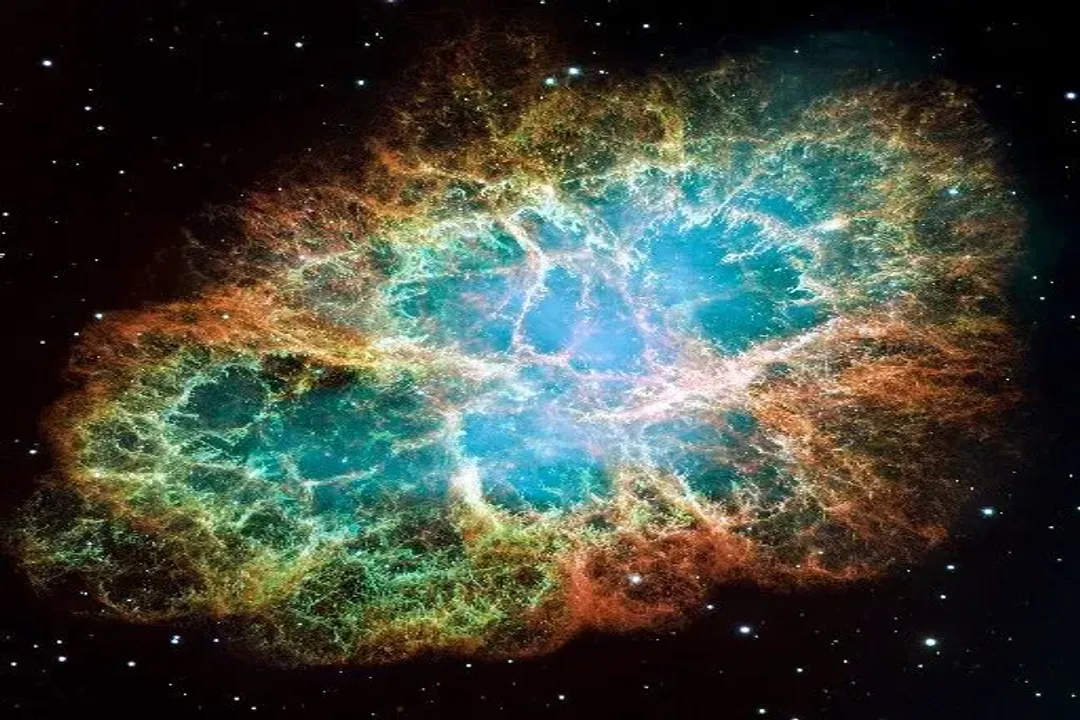
The realization that Earth is not the static center of creation but a planet orbiting a star, the Sun, was not a sudden flash of insight but a slow, grinding victory of mathematics and observation over millennia of deeply held belief. For most of human history, the heavens appeared perfect, immutable, and centered entirely around us, a conviction so pervasive that challenging it felt less like science and more like heresy. [9] The path to proving heliocentrism involved a handful of brilliant minds whose work gradually dismantled the ancient geocentric worldview, piece by piece, sometimes centuries apart.
# Ancient Ideas
The concept that the Earth moved—specifically revolved around the Sun—was proposed long before it gained traction. Perhaps the earliest known proponent of a sun-centered system was the ancient Greek astronomer Aristarchus of Samos in the 3rd century BCE. [5] He theorized that the Earth orbited the Sun, and that the Earth also rotated on its own axis. [5] However, this idea did not replace the reigning model championed by Ptolemy and Aristotle, which placed the Earth firmly at the center of the universe. [9]
The primary reason Aristarchus’s model failed to take hold was the lack of compelling observational evidence that could outweigh the common-sense appearance of the cosmos and the philosophical weight of the geocentric view. [9] If the Earth were moving, shouldn't we feel it? Shouldn't the stars appear to shift their positions relative to one another throughout the year? Since no such shifts—no measurable stellar parallax—could be detected with the technology of the time, the geocentric model remained dominant for nearly two thousand years. [9]
# Copernican Model
The major scientific turning point arrived in the 16th century with Nicolaus Copernicus. Copernicus published his comprehensive heliocentric theory, De revolutionibus orbium coelestium, just before his death in 1543. [1][5] His system placed the Sun at the center, with the Earth moving around it, simplifying the complicated mathematics required to track the retrograde motion of the outer planets under the older Ptolemaic system. [5]
It is important to note that Copernicus's work was initially a sophisticated mathematical argument more than an empirically proven physical reality. While it offered a more elegant description of planetary motions, it lacked the definitive observational proof needed to overturn established doctrine. [1] For a time, the model was used as if the Sun were the center, purely for calculation ease, without necessarily convincing many astronomers that it was physically true. [1]

# Observational Evidence
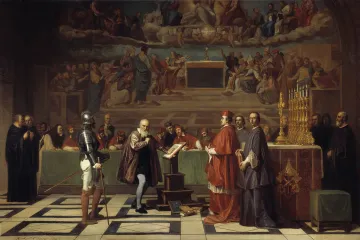
The transition from a mathematically convenient hypothesis to a physical certainty required telescopic observation. The work of Galileo Galilei in the early 17th century provided some of the most powerful, direct blows against the Earth-centered model. [1]
Galileo observed four moons orbiting Jupiter, clearly demonstrating that not everything in the heavens revolved around the Earth. [1] This observation showed that the Earth was not the sole center of orbital motion in the universe. Additionally, his observation of the phases of Venus was critical. [1] Just as the Moon goes through phases depending on its position relative to the Sun and Earth, Venus exhibited a full set of phases. In a strictly Ptolemaic system, Venus could only ever appear as a crescent or be entirely hidden from view because it would always be positioned between the Earth and the Sun. [1] Seeing Venus display a full phase proved it must orbit the Sun, placing the Earth outside the orbit of Venus, a fundamental pillar of the heliocentric structure. [1]
While these findings strongly suggested the Sun was central, the physical mechanism remained elusive. It's fascinating to consider that even with these observations, many scientists resisted the idea simply because the Earth's required speed seemed impossible to reconcile with everyday experience. For instance, if the Earth orbits the Sun, it completes that circuit in about 365.25 days. [6] However, for practical daily life, the apparent motion we observe—the Sun rising and setting—is the Earth's rotation on its axis, a process that takes approximately 24 hours. [4] Distinguishing between these two motions observationally, especially without knowing the universal laws governing motion, required great intellectual separation between daily perception and cosmic reality.
# Explaining the Motion
The acceptance of the Sun as the center required not just what was happening, but why. This "why" arrived through the laws developed by Johannes Kepler and Isaac Newton.
Kepler, building upon the meticulous observations compiled by Tycho Brahe, mathematically refined the orbits in the early 17th century. Kepler showed that the planets, including Earth, move not in perfect circles as Copernicus assumed, but in ellipses, with the Sun at one focus of the ellipse. [1] This significantly increased the predictive accuracy of the heliocentric model.
Then came Sir Isaac Newton. His formulation of the law of universal gravitation in the late 17th century provided the physical underpinning for Kepler’s observations. [1] Newton demonstrated that the Sun’s immense mass exerted a gravitational pull that dictated the paths of the planets, explaining why the planets followed elliptical orbits and why they moved faster when closer to the Sun and slower when farther away. [1] Once gravity provided the physical explanation, the heliocentric system achieved a level of descriptive and predictive power that the geocentric model could never match.
# Direct Proof
Despite the overwhelming mathematical and observational support provided by Galileo, Kepler, and Newton, the final, conclusive proof that the Earth orbited the Sun—the definitive answer to the ancient objection regarding stellar parallax—remained unproven for centuries. [1][9]
Stellar parallax is the apparent shift in the position of a nearby star against the background of more distant stars as the Earth moves from one side of its orbit to the other. [1] Because the distance to even the nearest stars is so vast, this shift is incredibly tiny. It required highly precise instruments and a deep understanding of observational error to measure reliably.
This final piece of direct, indisputable evidence arrived in 1838 when German astronomer Friedrich Bessel successfully measured the parallax of the star 61 Cygni. [1] This measurement confirmed the Earth’s orbital motion around the Sun with direct, empirical certainty, finally closing the observational gap that had lingered since the time of Aristarchus. [1]
In comparing the timelines, we see the sheer scale of resistance to changing such a fundamental concept:
| Milestone | Figure(s) | Approximate Year | Nature of Proof/Model |
|---|---|---|---|
| Initial Proposal | Aristarchus | c. 270 BCE | Theoretical (rejected) |
| Mathematical Model | Copernicus | 1543 CE | Mathematical/Geometric |
| Indirect Observation | Galileo | c. 1610 CE | Phases of Venus, Moons of Jupiter |
| Physical Laws | Kepler/Newton | 1609–1687 CE | Elliptical orbits, Gravitation (The Why) |
| Direct Observation | Bessel | 1838 CE | Stellar Parallax Measurement |
It took over two millennia from Aristarchus’s first suggestion for the required measurement technology to exist to confirm the Earth’s orbital motion directly. [1][9] The sheer difficulty of measuring that shift—a difference of less than one arc-second for the nearest stars—highlights why the ancient Greeks, operating without telescopes or precise chronometers, logically defaulted to the stationary Earth model. Their instruments simply could not resolve the tiny annual movement that Copernicus predicted.
# Modern Confirmation
While Bessel's parallax measurement provided the "proof" in the classical sense, modern science has provided an avalanche of confirmations that are now taken as baseline fact. For example, we can now track spacecraft, like the Mars rovers, which rely on precise calculations of orbital mechanics to navigate successfully across millions of miles of space. [2] Furthermore, the study of other planetary motions, as described by NASA, relies entirely on the understanding that the planets, including Earth, are in constant motion around the Sun. [2] The physics that predicts the timing of eclipses, the path of comets, and the relative positions of all solar system bodies only works if the Sun is the gravitational anchor. [1] The successful prediction of phenomena centuries in advance, based on the heliocentric model, serves as an ongoing, practical demonstration that the Earth truly does revolve around the Sun. [1] The Earth’s rotation on its axis, causing day and night, is also confirmed daily by the movement of the constellations, though this rotation is distinct from the yearly revolution around the Sun. [4]
#Videos
How We Figured Out That Earth Goes Around the Sun - YouTube
Related Questions
#Citations
When did we realize Earth orbits the Sun? - Astronomy Magazine
The History of an Idea That Launched the Scientific Revolution
Who first claimed planets go round the Sun?
Earth's rotation - Wikipedia
February 3, 1851: Léon Foucault demonstrates that Earth rotates
How did we know it takes the Earth 365 days to orbit the sun ... - Reddit
Earth Goes Around the Sun? What's Your Best Evidence?
How We Figured Out That Earth Goes Around the Sun - YouTube
When was it discovered that Earth revolves around the sun ... - Quora