What were those strings of lights in the sky tonight?
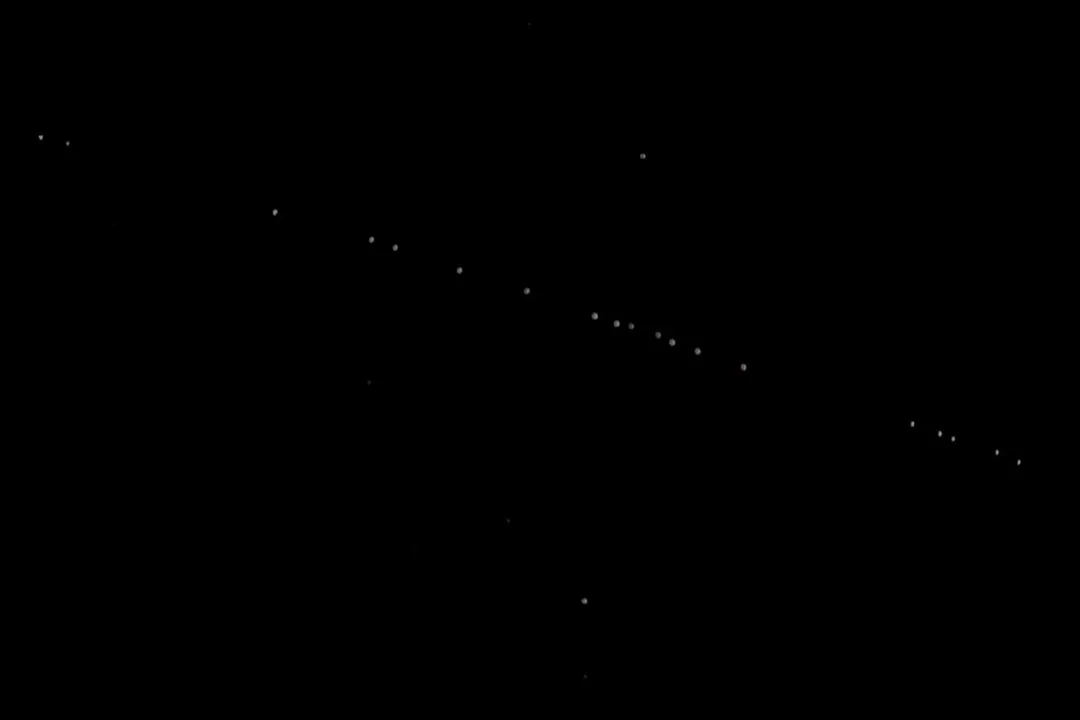
The sudden appearance of a long, neat string of lights moving silently across the dark sky has become a common occurrence, prompting thousands of people across different regions to look up in confusion or awe. Whether seen over the San Francisco Bay Area or a community like Nashville, the immediate reaction is often one of surprise, leading many to question if they are witnessing something entirely new or unidentified. For those who have seen satellites before, this formation looks dramatically different—brighter, more elongated, and with the individual points spread further apart than expected. However, for the vast majority of these recent evening sightings, the explanation is not extraterrestrial, but rather a testament to modern private space industry advancements: SpaceX Starlink satellites.
# Satellite Train
What you observed was most likely a Starlink satellite train. This phenomenon occurs shortly after a new batch of the company's satellites is deployed into Earth's orbit via a Falcon 9 rocket. Instead of spreading out immediately, the new satellites remain in a close-knit formation, appearing to sky-watchers as a single, bright line or string moving across the celestial sphere.
The Starlink project aims to create a megaconstellation to provide high-speed internet globally. As of late 2025, the sheer number of operational satellites already in orbit stood near 9,357, demonstrating the scale of this ongoing deployment. Because SpaceX conducts these launches frequently—sometimes multiple times a week—the opportunity to see these overhead processions is relatively high.
The very nature of the "train" appearance is tied to this deployment phase. Once the satellites reach their final operational altitude of about 340 miles (550 kilometers) above the Earth, they ascend further and drift apart from one another. At that point, they are much harder to distinguish as a single line and simply blend into the background of the night sky. The striking, organized string formation is therefore short-lived.
# Sunlight Reflection
A critical aspect of understanding these sightings is realizing that the satellites do not generate their own light. What observers are seeing is sunlight being reflected off the metallic surfaces of the satellites as they pass overhead. This mechanism dictates precisely when the trains are visible.
Optimal viewing times are narrow windows, typically occurring just after sunset or shortly before sunrise. During these times, the ground below is cast in darkness, but the satellites, still at high altitude, are still catching direct sunlight. This contrasting illumination makes them stand out brilliantly against the darkening or lightening atmosphere. A satellite orbiting the Earth roughly every 90 minutes might offer multiple brief viewing opportunities in a single evening, depending on the local geometry of the sun and the orbital path.
Interestingly, reports from observers noted that as the string moved across the sky, the lights would gradually dim and then disappear completely at a certain point. This fading is a direct visual confirmation of the reflection mechanism: the satellites are losing their angle of illumination from the sun, which has dropped further below the horizon from their perspective. This predictable dimming and vanishing is a key characteristic that helps differentiate them from, for example, aircraft, which maintain steady navigation lights.
# Public Confusion
The immediate impact of seeing such an unusual sight in the sky is often startling, and the reports gathered online reveal a common pattern of immediate concern followed by online searching for answers. Across multiple locations, residents have reported these streaks of light, sometimes describing them as resembling "Morse code across the sky" or simply a "wild" sight. In many cases, people who are aware of Starlink have still been momentarily thrown off by a specific sighting, particularly if the train appeared unusually bright or the spacing between the lights seemed wider than expected compared to prior observations.
While the vast majority of community discussions quickly converge on the Starlink explanation, other possible, though less likely, causes sometimes surface in the moment of confusion. For instance, some have proposed looking for patterns in aircraft landing paths, which can sometimes line up as multiple planes approach an airport. Another suggestion raised was the Leonid meteor shower, although meteors are transient streaks rather than steady, aligned points of light. The key distinguishing factors for the satellites remain their speed and their persistence—they move quickly but hold a steady position relative to one another for the duration of the sighting.
For viewers in areas with significant light pollution, like near downtown areas, the satellite reflections can be surprisingly bright—bright enough to be compared to the North Star in some observations. This brightness is a result of the satellite's position relative to the sun and the low visibility classification for that particular pass.
# Tracking and Mitigation
If you are eager to catch this spectacle again, timing and location are everything, but fortunately, there are resources available to plan your next viewing session. Because the trains are only visible shortly after a launch when they are in their lowest orbit and grouped tightly, knowing the launch schedule is the first step. Once a launch has occurred, specialized websites exist that can track the location of the Starlink satellites in real-time globally, providing specific times and directions for when the train might pass over your location. Several apps designed for general stargazing can also incorporate this tracking data, making it easier to point your phone toward the correct part of the sky.
When you look up, remember you are looking for passive reflection; if the sun is too high or too far below the horizon, the satellites will be invisible from the ground, even if they are overhead.
The visibility of these trains is actually an evolving story in the world of astronomy and space hardware. To address concerns from professional astronomers regarding light pollution impacting deep-sky observations, SpaceX has implemented mitigation efforts. One notable project mentioned is the Starlink VisorSat program, which is designed to apply a sort of shade or coating to darken the satellites. Over time, as more satellites incorporate these upgrades, the dramatic "string of lights" effect seen during initial deployment is expected to become less pronounced. This ongoing adjustment shows a technological response to public and scientific feedback regarding the impact of these large orbital deployments.
The way these satellites appear and disappear provides a unique visual marker for the intersection of commercial activity and the visible night sky. For example, the appearance of a string of lights is fundamentally different from a single satellite or a slow-moving space station; the uniform spacing and speed are the giveaways. A string of 10 to 12 objects, perhaps with one straggler, is a classic pattern reported for a freshly deployed batch. Considering that some satellites that fail to reach their intended orbit or experience damage can re-enter the atmosphere dramatically, burning up in a visible fashion, any sighting is naturally tied to the larger, complex ballet of low-Earth orbit activity.
It is worth noting that when you are scanning the sky for these formations, the experience is entirely different depending on your viewing location. Seeing these lights from a place with minimal light pollution, far from city glow, offers the purest view, allowing you to better judge the separation and brightness of each point as it marches overhead. Conversely, observers near city centers might see a slightly dimmer or less distinct line, or potentially mistake a line of descending aircraft landing for the satellite train if the lighting conditions are just right. The fact that thousands are seeing this phenomenon concurrently, often reporting the same directional movement (e.g., west to east), is what turns an individual sighting into a community event, compelling local news outlets to issue explanations for the widespread phenomenon. These shared observations, documented via video and photos across social media platforms, build a collective experience that confirms the reality of the event, even if the initial sight feels almost unbelievable.
The continued launching of these constellations means that while the satellites do change their appearance over the years—becoming less bright due to modification efforts—the appearance of new trains will continue to surprise those who look up at the right time. Every time a new cluster is deployed, the pattern resets, offering a fresh demonstration of orbital mechanics playing out silently above us, a truly visible sign of the industrialization of space happening at a pace faster than many observers are accustomed to seeing.
#Videos
String of lights in the sky seen in Bay Area - YouTube
Starlink satellites, the string of lights in the night sky. - YouTube
#Citations
String of lights in the sky seen in Bay Area - YouTube
Starlink satellite train: how to see and track it in the night sky - Space
Weird lights in the sky?! : r/nashville - Reddit