What is a slice of rock called?
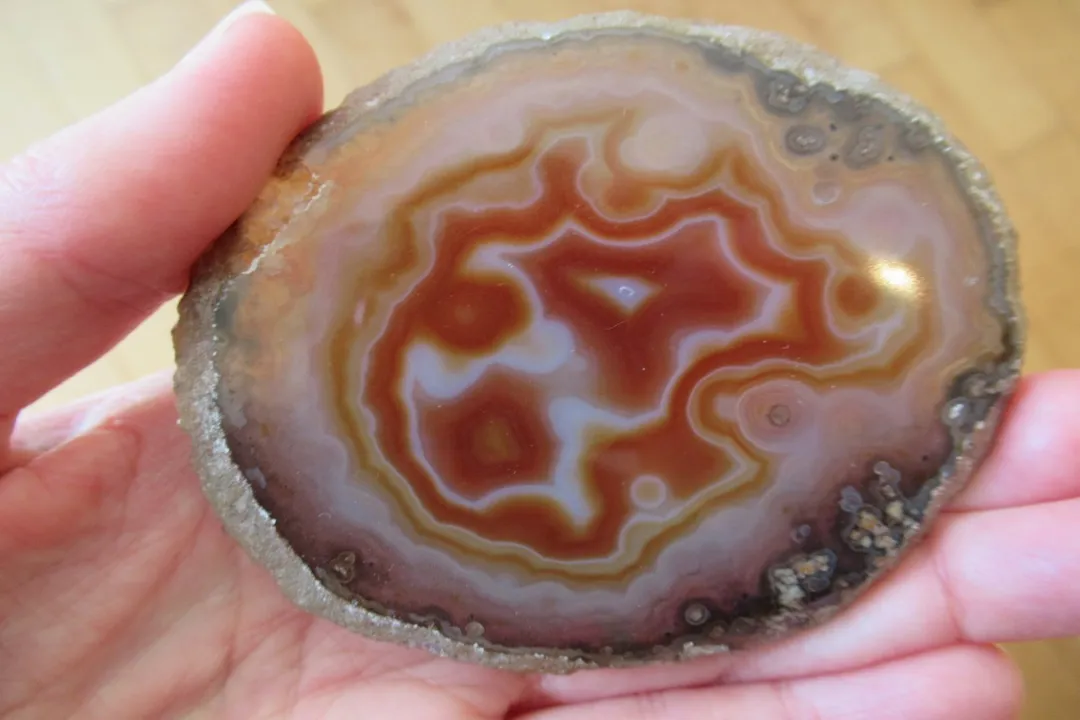
When looking at a carefully cut and polished piece of rock, whether it's for geological study or decorative display, people often wonder about the proper term for that specific cross-section. In everyday conversation, terms like "slab" or simply "slice" are commonly used when referring to gemstone or rock cuts. [1][4] For instance, a polished piece cut from a larger specimen, like a geode, might be called a "geode slice". [3] However, the world of earth sciences employs a much more specific and technical designation for the thinnest of these cuts.
# Scientific Cuts
The definitive term used by geologists when they examine a slice of rock to identify its component minerals is a thin section. [7] This isn't just any slice; it is a sample prepared with extreme precision for microscopic analysis. [2] The primary purpose of creating a thin section is to study the rock's texture, mineralogy, and structure, often by looking at how light interacts with the minerals within it. [2][5] To achieve the necessary clarity for this type of study, the rock sample must be ground down until it is nearly transparent.
# Preparation Precision
The process required to make a geological thin section is meticulous and demands specialized equipment and expertise. [2][5] The initial step involves sawing a small, representative piece from the main rock specimen. [2] This rough sample is then mounted onto a glass slide, typically using an epoxy adhesive. [2] What follows is the careful grinding and polishing stages. The rock material is ground down against successive grades of abrasive material until it reaches a precise thickness. [2]
For a standard, petrographic thin section, the target thickness is usually around 30 micrometers (). [2] To put that into perspective, a typical human hair measures somewhere between 50 and 100 micrometers in diameter. [2] This means the rock slice is often thinner than a single strand of hair, allowing light to pass through it effectively. [2] This process requires highly skilled technicians who manage the grinding to ensure the mineral grains are visible without being distorted or broken apart. [5] Some geological surveys maintain extensive collections of these thin sections, representing the bedrock and subsurface geology of a region for long-term reference and study. [5]
# Decorative Slabs
While the thin section is defined by its microscopic transparency and scientific purpose, other rock slices serve entirely different roles, often focusing on aesthetics or structural insight at a macroscopic level. [1][3] These are generally much thicker than their microscopic counterparts.
# Geode Slices
A particularly striking example of a decorative rock slice comes from geodes. [8] A geode is essentially a rock formation, often rounded, that contains a hollow cavity lined with inward-pointing crystals or mineral matter. [8] When a geode is sliced in half, or cut into slabs, the result reveals the internal crystal structure, often displaying quartz or amethyst against the outer matrix rock. [3] These slices are typically polished to enhance the color and luster of the internal crystals for display purposes. [3] The intent here is appreciation of natural beauty and structure, not transmission of light through an ultra-thin layer.
# Slabs Versus Sections
It is useful to draw a clear distinction between the common usage of "slab" and the scientific use of "thin section," as the context dictates the required preparation and what information can be gleaned.
| Feature | Thin Section (Scientific) | Slab (Decorative/General) |
|---|---|---|
| Primary Goal | Mineral identification, texture analysis | Aesthetics, structural view, lapidary art |
| Typical Thickness | ~30 micrometers () | Millimeters to centimeters |
| Light Requirement | Light must transmit through the sample | Light reflects off the surface |
| Mounting | Permanently mounted on a glass slide [2] | Usually mounted on a base or displayed freely |
Thinking about the effort involved, the preparation of a decorative slab, while requiring skill to cut without fracturing a potentially hollow geode, is focused on maximizing surface appearance. [3] In contrast, preparing a thin section prioritizes uniformity and near-invisibility of thickness over the visual appeal of the surface texture. [2][5] A hobbyist might spend hours cutting a beautiful geode half, but a lab technician spends hours grinding that 30-micrometer sliver down perfectly flat. This difference in objective fundamentally changes what the resulting "slice" is called and how it is handled. For instance, one might classify a thick, highly polished slice of agate as an ornamental slice, which sits far outside the scientific classification of a thin section. [1]
# Examination Methods
The method of viewing dictates the necessary form of the slice. When geologists examine minerals to understand their properties, like cleavage or color, they might use simple tests on a hand sample or a mineral identification chart. [9] However, to truly understand the relationship between mineral grains—how they grew together or how a rock formed—the thin section under a petrographic microscope becomes indispensable. [2] This instrument allows the geologist to view the sample under both plane-polarized light (PPL) and cross-polarized light (XPL), revealing properties like interference colors, relief, and optical orientation that are invisible otherwise. [2] It is this level of detail that elevates the term from a simple "slice" to a precise scientific tool.
Even when looking at decorative cuts, the choice of cut reveals information. A perpendicular slice across a vein structure might highlight banding, whereas a longitudinal cut might show crystal elongation, much like examining growth rings on a tree. While a scientist focuses on optical properties at 30 micrometers, a rockhound admiring a thick slab is primarily interested in macroscopic evidence of the rock's history, such as the size and arrangement of crystals visible to the naked eye. [4] Both methods involve slicing rock, but one transforms it into a specialized optical window, and the other into a beautiful presentation piece.
Related Questions
#Citations
What is the official name to gemstone slabs like the one i have? Not ...
Thin section - Wikipedia
Friday's Rock - Geode Slice - Steemit
Types of Rocks: Geodes and Vugs Explained - Facebook
Discover our thin section collection - WGS Data Preservation
Thin sections These are made by slicing a rock into what's called a ...
To identify minerals, geologists examine a slice of rock called an
A Glossary of Rock and Mineral Terminology