What is a cloud fragment too small to for?
The universe is a grand workshop where gravity sculpts matter into the brilliant structures we observe, the most celebrated of which are stars. These cosmic furnaces begin life as dense knots within vast, cold reservoirs of gas and dust known as Giant Molecular Clouds (GMCs). [4] A star is born only when a fragment of this cloud collapses under its own gravity until the core becomes hot and dense enough to ignite sustained nuclear fusion, primarily turning hydrogen into helium. But what happens to the smaller, less fortunate siblings in this star-making process? What is a cloud fragment too small to form a star? The answer lies with the substellar objects that fall just short of stellar stardom: the brown dwarfs.
# Cloud Origins
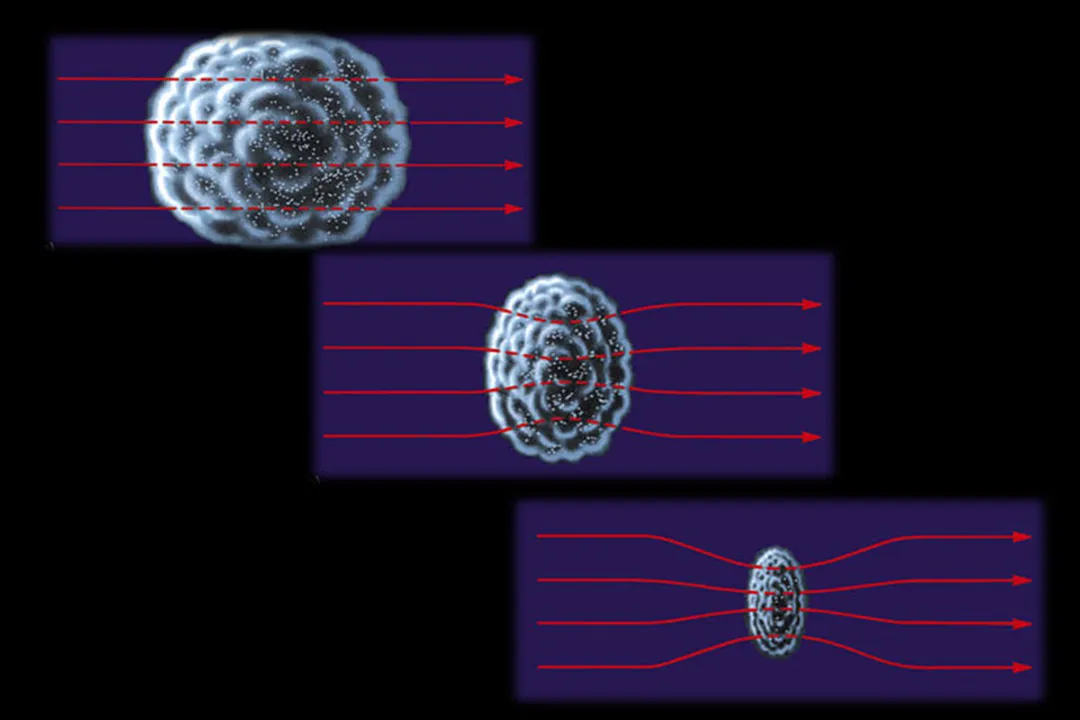
The initial stages of star creation involve a massive cloud, perhaps holding a million times the mass of our Sun, becoming unstable. This instability can be triggered by external events like a shock wave from a nearby supernova or the passage through a galactic spiral arm. Once triggered, the cloud begins to break apart, or fragment, into smaller pieces. [4] Each of these smaller lumps contains enough mass for gravity to start winning the initial battle against the cloud's internal thermal pressure.
As a fragment contracts, it spins faster due to the conservation of angular momentum—much like an ice skater pulling in their arms to increase their rotation speed. [4] This rotation, combined with magnetic fields present in the gas, resists the collapse along the equatorial plane, causing the fragment to flatten into a spinning structure often called a protostellar disk. [4] Crucially, during this early, low-density phase, the energy generated by the compression (the conversion of gravitational potential energy into heat) escapes easily as radiation from the surface. This allows the collapse to continue unabated.
# Ignition Point
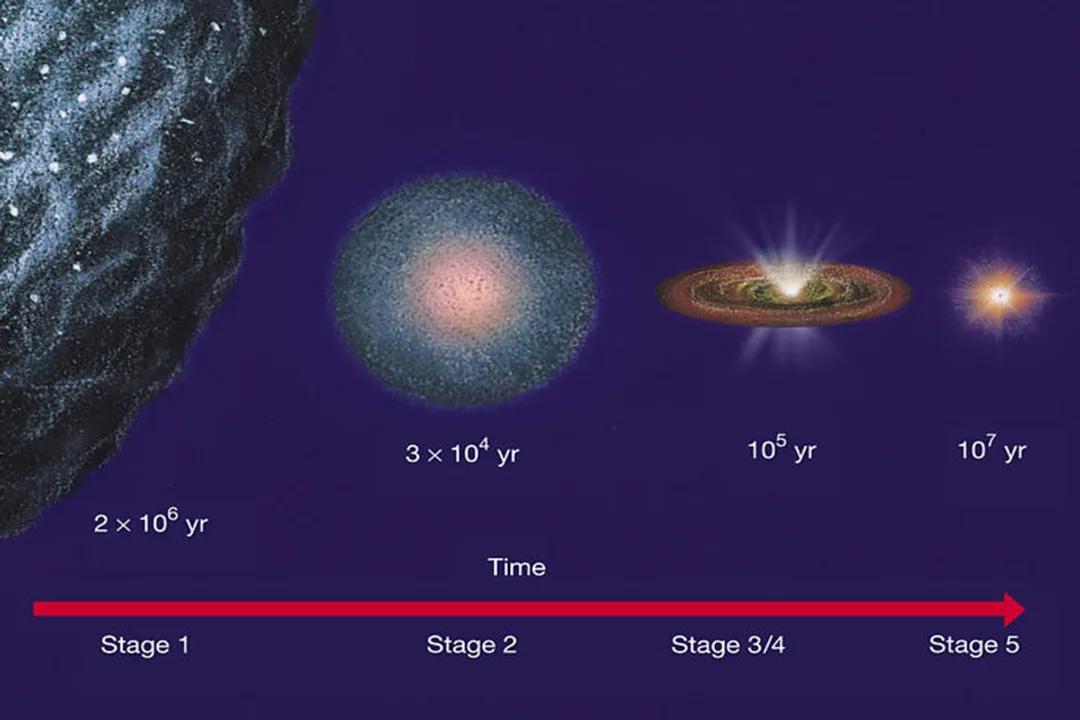
The contraction phase is a relentless squeeze that drives up the density and temperature in the core of the fragment. [4] For a cloud fragment to transition from a mere collapsing ball of gas to a true, long-lived star, its core temperature must eventually hit approximately 10 million Kelvin ($10^7$ K). At this critical temperature, the kinetic energy of the hydrogen nuclei is high enough to overcome their electrical repulsion, allowing the strong nuclear force to take over and initiate the fusion of hydrogen into helium.
This ignition process is the definitive moment of stellar birth. Once fusion begins, the massive outward pressure generated by the nuclear reactions balances the inward crush of gravity, and the object settles into a state of hydrostatic equilibrium. This balance dictates that the object will spend the vast majority of its existence on the Main Sequence, steadily consuming its core fuel.

# Pressure Limits
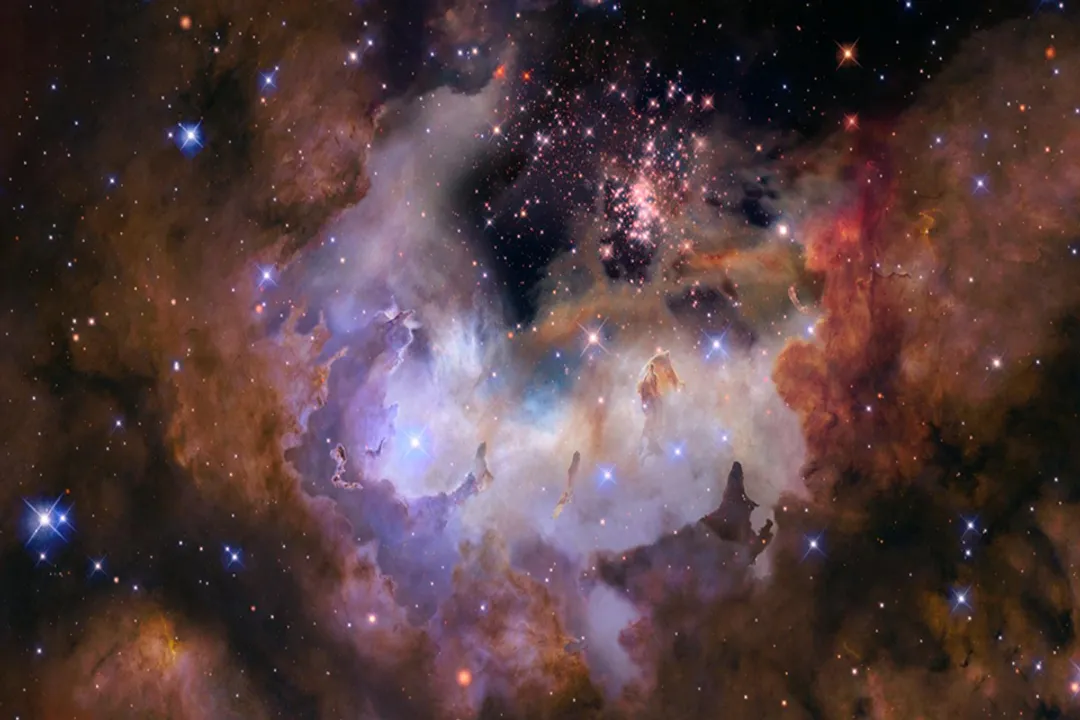
The ability of a fragment to reach that $10^7$ K threshold defines whether it becomes a star or something else. Astronomers have calculated a distinct lower boundary for this process. A protostar must possess a mass of at least $0.08$ times the mass of the Sun, which translates to roughly 80 times the mass of Jupiter ().
If the fragment falls short of this mass threshold, the collapse is stopped by a different physical mechanism before the core gets hot enough for sustained hydrogen fusion. This stopping force is called degeneracy pressure. Unlike thermal pressure, which depends on the heat content of the gas, degeneracy pressure is a quantum mechanical effect arising from the Pauli Exclusion Principle—particles cannot occupy the same quantum state in the same region of space. This pressure becomes extremely effective at resisting further compression, even if the object is relatively cool.
This difference in support mechanism is central to understanding the fate of the undersized fragment. A star is supported by thermal pressure generated by fusion; a failed object is supported by degeneracy pressure before fusion can start.
| Formation Dynamic | Successful Star (e.g., Sun) | Failed Fragment (Brown Dwarf) |
|---|---|---|
| Minimum Mass | () | () |
| Collapse Halt | Sustained fusion | Degeneracy Pressure |
| Core Temperature | Reaches K | Fails to reach K |
| Equilibrium State | Hydrostatic equilibrium (long-term) | Degenerate equilibrium (cold contraction) |
| Final Energy Source | Nuclear fusion | Residual heat from initial contraction |
When degeneracy pressure takes over, it effectively locks the core in place, preventing the temperature from ever climbing high enough to overcome the Coulomb barrier and ignite stable hydrogen burning.
# Substellar Bodies
The object that results from this arrested collapse—a fragment too small to sustain hydrogen fusion—is classified as a brown dwarf. These objects are often referred to as "failed stars" because they have the mass profile to attempt to become stars but lack the necessary gravitational punch to achieve sustained ignition.
While they cannot burn normal hydrogen, more massive brown dwarfs (those around or more) are capable of briefly fusing deuterium, an isotope of hydrogen, which is easier to ignite than regular hydrogen. However, this deuterium fuel is scarce, and once it is exhausted, the object has no further internal energy source beyond the heat retained from its initial gravitational collapse.
Unlike a main sequence star that maintains a stable temperature for billions of years, a brown dwarf's fate is a slow fade. It shines dimly, radiating away the heat left over from its formation in the infrared part of the spectrum. Over astronomical timescales, a brown dwarf simply cools down, its luminosity gradually declining as it radiates away its thermal energy, eventually becoming a cold, dark remnant. This contrasts sharply with other stellar remnants like white dwarfs, which are cores left behind after a star's life cycle is complete and which are supported by degeneracy pressure, or black holes, which require the collapse of extremely massive stars.
# Observational Hunt
The intrinsic faintness and cool nature of brown dwarfs present a significant challenge for astronomers. Because they never reach the high temperatures of true stars, their peak emission is shifted towards longer, infrared wavelengths. Finding them means conducting deep surveys specifically tailored to detect these low-temperature sources, often requiring specialized infrared telescopes that can peer through the obscuring dust clouds where they are often born. While a protostar in the T Tauri phase still has enough mass to eventually become a star, a brown dwarf is fundamentally locked out of that path.
It is fascinating to consider that the initial fragmentation process itself is not perfectly efficient. If a cloud fragment contracts so rapidly that it traps heat too early, or if it starts with insufficient mass to ever overcome the resistance of electron degeneracy pressure, it is shunted onto this substellar track. The slight variation in the initial mass of a collapsing core, perhaps differing by only a few Jupiter masses, can be the deciding factor that determines whether an object burns for eons as a star or cools eternally as a brown dwarf. The study of these "in-between" objects provides vital empirical data, allowing scientists to test the theoretical models that define the very lower boundary of stellar existence.
#Citations
Star formation
[PDF] Chapter 19 Star Formation
Solved: A cloud fragment too small to form a star becomes - Gauth
Basics of Star Formation
[PDF] Fragmentation of a Cloud