What holds our universe together?
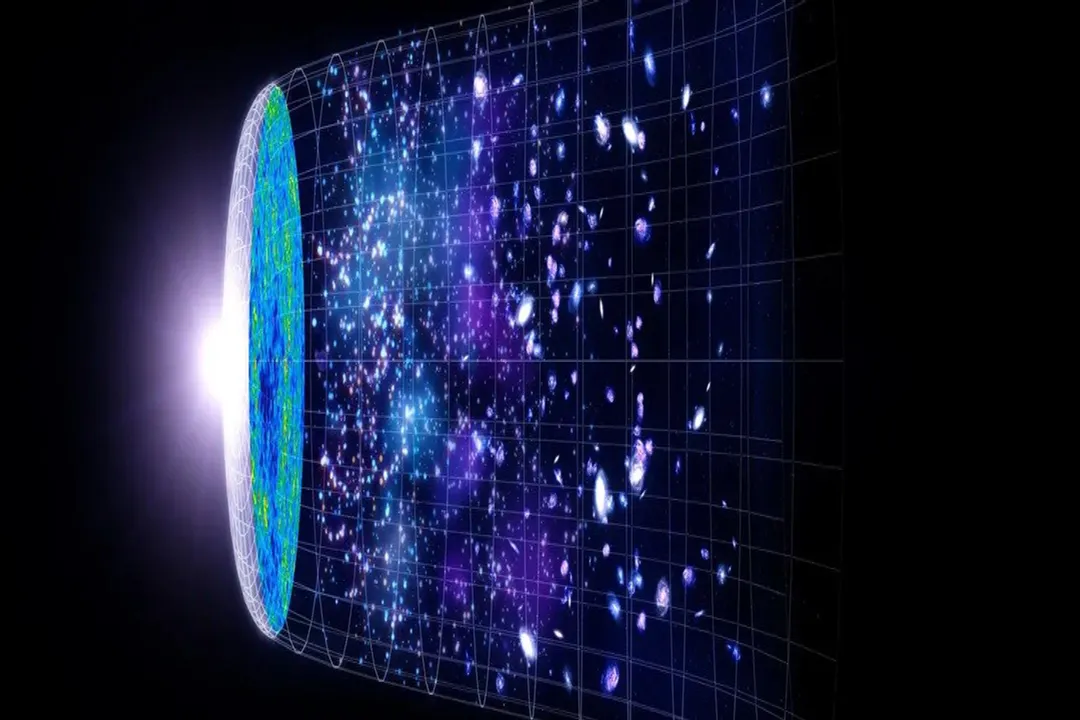
The structures we see across the cosmos, from the vastness of galactic superclusters down to the solid table beneath our hands, give the powerful impression of permanence and stability. Yet, this apparent steadfastness is an illusion maintained by a delicate, ongoing negotiation between several invisible fundamental influences. [1][4] To ask what holds the universe together is to ask about the rules governing all matter and energy, the silent architects that shape everything from a proton to a galaxy cluster. [10] It is a story told through four main actors, supplemented by two massive, mysterious contributors to the cosmic inventory.
# The Four Forces
The fundamental mechanisms responsible for binding matter are codified as the four fundamental forces of nature. [3][5][10] These forces dictate how particles interact, how energy is transferred, and how structures form and remain intact across all scales of reality. [5] They are, in order of relative strength (from strongest to weakest): the strong nuclear force, the electromagnetic force, the weak nuclear force, and gravity. [3][5] Understanding what holds things together requires looking closely at how each one operates, as their influence varies dramatically depending on distance and energy level. [10]
# Strong Nuclear Force
The strongest of the four forces is the strong nuclear force. [3][5] Its entire domain is confined to the subatomic realm, operating over incredibly short distances, roughly the size of an atomic nucleus. [3][5] This force is what keeps quarks bound together to form protons and neutrons, and more commonly recognized, it binds those protons and neutrons together to form the nuclei of atoms. [3] Without this intense binding power, the positively charged protons inside a nucleus would instantly fly apart due to electrostatic repulsion from the electromagnetic force. [3] It is the ultimate local binder, making atomic matter stable in the first place. [5]
# Electromagnetism
Next in line is the electromagnetic force. [3][5] This force operates over much larger distances than the strong force and is responsible for most of the interactions we experience daily, even though it is vastly weaker than the strong nuclear force. [3][5] It governs the attraction between positively charged protons in the nucleus and negatively charged electrons orbiting it, creating atoms. [3] Furthermore, it is the force responsible for binding atoms into molecules, which then form the solid objects, liquids, and gases we interact with. [5] When you push on a wall, it is electromagnetic repulsion between the electrons in your hand and the electrons in the wall preventing you from passing through. [3] It’s the reason chemistry works and why materials possess structure and rigidity. [3][5]
# Weak Nuclear Force
The weak nuclear force is significantly weaker than both the strong and electromagnetic forces. [3][5] Its primary role is not structural in the sense of permanent binding but rather in facilitating change and transmutation within the nucleus. [5] It governs certain types of radioactive decay, such as beta decay, where a neutron can transform into a proton (or vice versa). [3] While not directly holding matter together in a static sense, its influence is vital for the energy processes that fuel stars, which are massive structures held together by gravity. [3]
# Gravity's Dominance
Finally, we arrive at gravity, the weakest of the four forces by an enormous margin. [3][5] Paradoxically, this feeblest force dictates the structure of the cosmos on the largest scales. [9] Because gravity is only attractive—unlike electromagnetism, which can repel—and because its range is infinite, it accumulates influence over vast distances. [3][5][9] Every speck of matter exerts a gravitational pull on every other speck. [9] This relentless accumulation is what clumps gas clouds into stars, binds stars into galaxies, and draws galaxies into clusters and superclusters. [1][9] The stability of your own body, resting on Earth, is governed by gravity overcoming the negligible effects of these other forces over that scale, though the cohesion of your physical form itself relies on the stronger short-range forces. [7][8]
| Force | Relative Strength | Range | Primary Role in Binding |
|---|---|---|---|
| Strong Nuclear | Very Short (Nucleus size) | Binds quarks and nucleons together | |
| Electromagnetic | Infinite | Binds atoms into molecules; chemistry | |
| Weak Nuclear | Extremely Short | Nuclear transformation (decay) | |
| Gravity | $1$ | Infinite | Large-scale structure; stellar/galactic systems |
| [3][5] |
# Inertia's Constant State
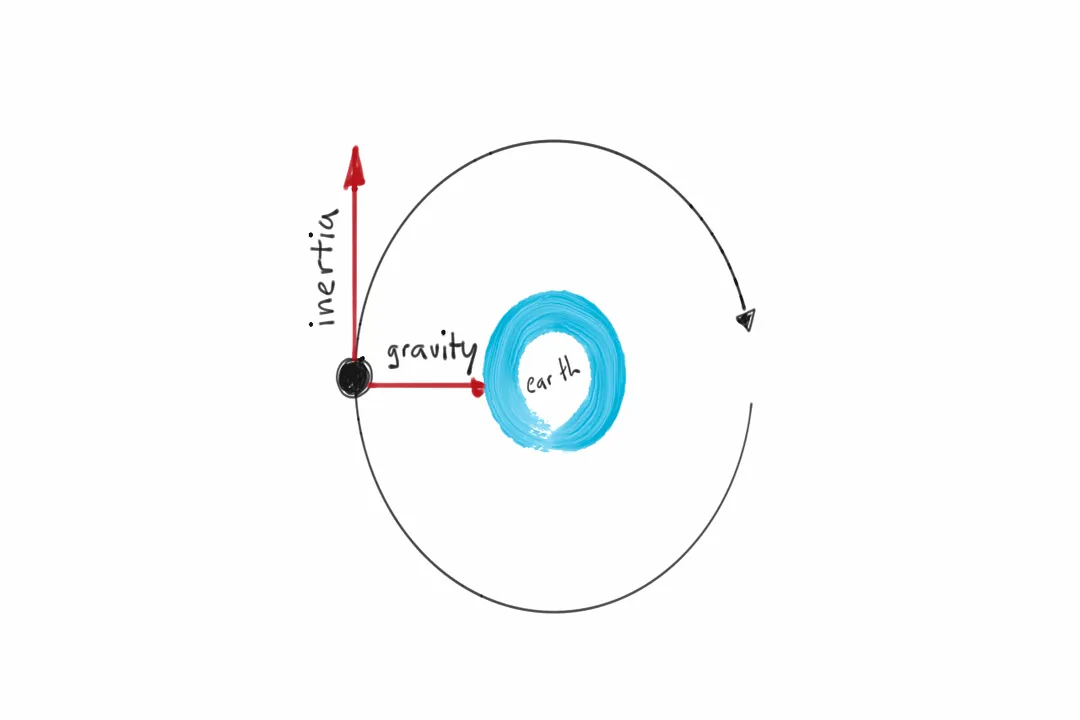
While the forces describe how things stick together or interact, the concept of inertia describes why objects maintain their existing state of motion or rest unless acted upon by one of those forces. [7] Inertia is not a force itself, but rather a fundamental property of mass—the resistance an object has to changes in its velocity. [7] For a planet orbiting a star, the balance is maintained because the planet’s inertia keeps it moving in a straight line, while gravity constantly pulls it inward, resulting in a stable curve or orbit. [7] This inherent unwillingness of mass to change its trajectory is crucial for maintaining the spatial arrangement of large celestial bodies held together by gravity, preventing them from instantly collapsing or flying apart due to slight perturbations. [7]

# The Invisible Majority
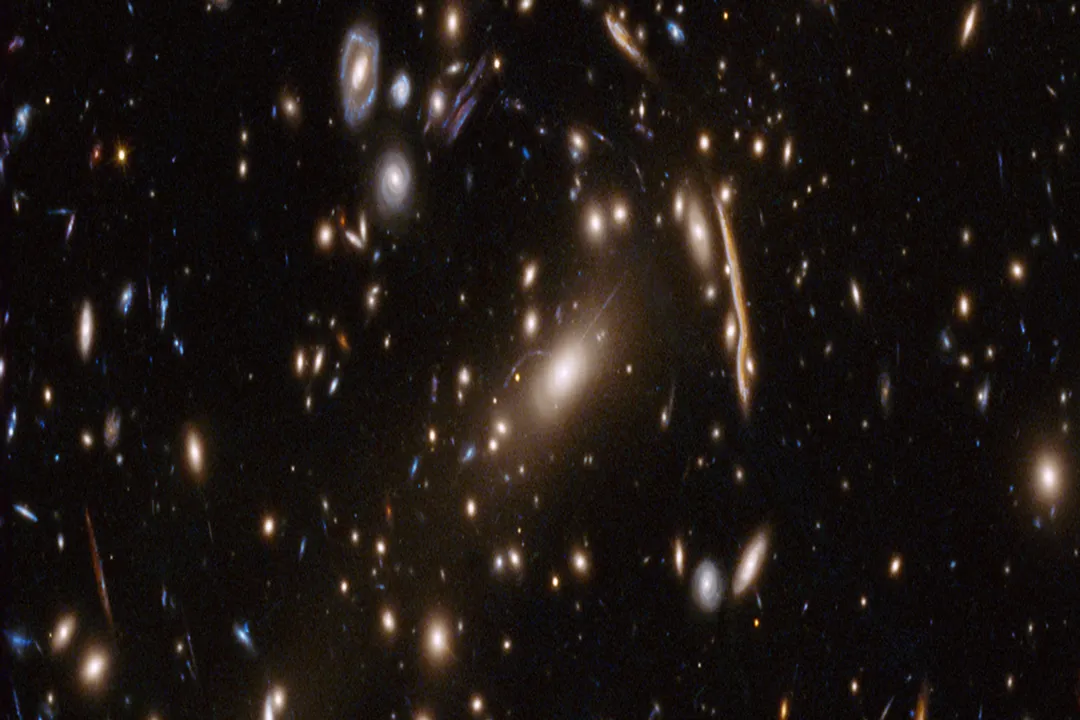
If the four known forces—particularly gravity—were the only things at work, the universe would look very different on the grandest scales. [2] Observations of galaxies spinning revealed a profound discrepancy: the stars on the outer edges of galaxies rotate far too quickly for the visible matter alone to hold them in orbit. [2] If the visible matter (stars, gas, dust) were the only source of gravitational pull, these fast-moving outer stars should have been flung out into intergalactic space long ago. [2]
This leads us to dark matter. [2] Scientists infer the existence of this substance because its immense gravitational influence is necessary to keep galactic structures from tearing themselves apart. [2][6] Dark matter, which does not interact with light or the electromagnetic force, is thought to make up about 85% of the total mass of the universe. [2] Its presence provides the necessary extra gravitational "glue" to keep fast-moving galaxies intact. [6] It forms the underlying scaffolding upon which visible matter aggregates to form galaxies and clusters. [2]
It is fascinating to compare this to the binding mechanism of an atom. In an atom, the binding force (electromagnetism/strong force) is immediate and powerful, but its effective range is minuscule. Dark matter, conversely, exerts a comparatively weak gravitational pull, yet its sheer abundance and infinite range allow it to dominate the global structure of the cosmos. [10] One might consider the gravitational field of a galaxy as a massive, diffuse net woven from dark matter threads, with the visible stars and gas simply being the knots caught within it, preventing the knots from shaking loose over billions of years. [6]
# The Countering Expansion
While the forces discussed above work to aggregate and bind matter, another component of the universe actively works against this cohesion on the largest possible scales: dark energy. [10] This is not a binding agent but an accelerating one. Current measurements suggest that the majority of the universe's total mass-energy budget—roughly 68%—is composed of this dark energy. [10] Its effect is to cause the expansion of the universe to speed up, pushing galaxies farther apart over time. [10]
This introduces a cosmic tension: Gravity and dark matter are constantly trying to pull everything together into increasingly complex structures, while dark energy is constantly stretching the space between those structures, pushing them apart. [10] For bound systems like our solar system, our Milky Way galaxy, or even the local group of galaxies, the local gravitational influence remains overwhelmingly dominant over the subtle effects of dark energy. [1] However, on the scale of the voids between galaxy clusters, dark energy is the victor, ensuring that distant galaxies are receding from each other at an ever-increasing rate. [10]
# Scales of Cohesion
The question of what holds the universe together ultimately requires a statement about scale, because the dominant binding agent changes depending on the distance you observe. [1][8] If we look at the absolute smallest scales, holding a nucleus together requires the incredible strength of the strong force. [3] Moving outward to the scale of everyday objects, stability comes from electromagnetism preventing objects from passing through one another. [3] When observing a planetary system or a single star, the organizing, long-range attractive pull of gravity becomes the primary binding agent. [9]
What is remarkable is the way this hierarchy reflects the overall composition of the cosmos. The very substance we are made of—the atoms bound by the strong and electromagnetic forces—constitutes a mere fraction of the total cosmic mass-energy content. [2][10] The large-scale universe is dominated by the invisible scaffolding of dark matter's gravity, [2] while the fate of the entire universe is dictated by the repulsive pressure of dark energy. [10]
To put this into perspective on a structural level, consider the energy investment. For the strong force to hold a single atomic nucleus together, it requires MeV (mega-electron-volt) level binding energy. [3] Contrast this with the binding energy required to keep the stars in the Milky Way together; this is vastly smaller per particle but applied across a scale of perhaps a hundred thousand light-years, relying on the cumulative, albeit weak, pull of gravity. [9] This difference underscores a key principle: the local requirement for strong binding energy diminishes as the effective range of the force increases, allowing weak, long-range forces to govern the macroscopic order. [4]
This hierarchy also leads to some non-intuitive conclusions about our place. We exist in a zone—the solar system and the local galaxy—where gravity is the master organizer of massive bodies, an organization made possible by the underlying gravitational scaffolding provided by dark matter, all while the electromagnetic force maintains the integrity of the atoms in our own bodies. [6][10]
# The Unification Quest
Physicists continue to seek a deeper, unified explanation for these forces. [3] Currently, the electromagnetic and weak nuclear forces have been successfully unified into the electroweak force at high energies. [3] However, successfully weaving gravity and the strong force into a single, coherent theory—a "Theory of Everything"—remains the grand challenge of modern physics. [3] Successfully unifying these concepts would not necessarily change what is holding the universe together today, but it would explain why these forces possess the specific strengths and ranges that they do. [3]
The search for the fundamental constants that define these interactions reveals the delicate balance required for the universe to permit structure at all. If the strong force were even slightly weaker, stable atomic nuclei heavier than hydrogen could not form, and chemistry as we know it would be impossible. [3] If gravity were marginally weaker, stars would struggle to ignite or collapse efficiently, hindering the creation of heavy elements through stellar nucleosynthesis. [9] The fact that we observe a universe rich in complex structures, rather than a diffuse soup of fundamental particles, suggests we live in a universe finely tuned by these constants. [1]
Ultimately, the question of what holds the universe together is answered in layers. It is the strong force holding matter's building blocks, electromagnetism arranging those blocks into stable forms, gravity collecting those forms into everything massive, and the unseen dark matter providing the vast gravitational reservoir that makes those massive collections stable over cosmic time. [2][6][9] It is a cosmos held together by a constant push and pull, a quiet testament to the immense power locked within the physics of the very small and the sheer scale of the very large. [1][10]
#Videos
What Holds the Universe Together? The Fundamental Forces
Related Questions
#Citations
What Holds Us Together? | Columbia Magazine
Dark Matter - NASA Science
May the Four Forces Be With You! – @nasa on Tumblr
What Holds the Universe Together? The Fundamental Forces
What holds matter together? : r/AskPhysics - Reddit
What do scientists think is holding our universe together? - Quora
Inertia: The Force That Holds the Universe Together - Farnam Street
What Holds Our Universe Together? | News Article
Gravity: The Invisible Force that Shapes Our Universe - PURKH