What causes mass extinction events?

The planet has experienced several moments in its deep history when the rate of species disappearance spiked dramatically, wiping out a significant fraction of life across the globe in what geologists call a mass extinction event. [2][5] These events are not merely large numbers of species dying off; they represent profound crises that reorganize the tree of life, often leading to the dominance of entirely new groups afterward. [1] While background extinction rates are constant—species naturally come and go—a mass extinction is defined by a loss that far exceeds this baseline, impacting a substantial percentage of life across many different taxonomic groups globally. [1][5] Five such major events punctuate the fossil record over the last half-billion years, with the Permian-Triassic extinction, often dubbed "The Great Dying," being the most severe, eliminating perhaps 90% of marine species. [3] Understanding what causes these planetary-scale die-offs involves examining catastrophic external forces and fundamental changes to Earth’s own systems.
# Defining Loss

To qualify as a mass extinction, the severity must be recognized across the entire biosphere, not just in one region or one type of organism. [1] The background rate is estimated to be between 0.1 and 2.0 species per million species per year, but during a mass extinction, this rate skyrockets. [5] The events are sometimes categorized by how quickly they unfolded. For instance, the Cretaceous-Paleogene (K-Pg) extinction, famous for ending the age of the non-avian dinosaurs, was relatively swift when viewed against the vastness of geological time, largely attributable to a single, colossal impact event. [3] In contrast, other events, like the Ordovician-Silurian extinction, appear to have occurred in pulses spanning millions of years, suggesting a drawn-out environmental struggle. [1]
# Ancient Triggers
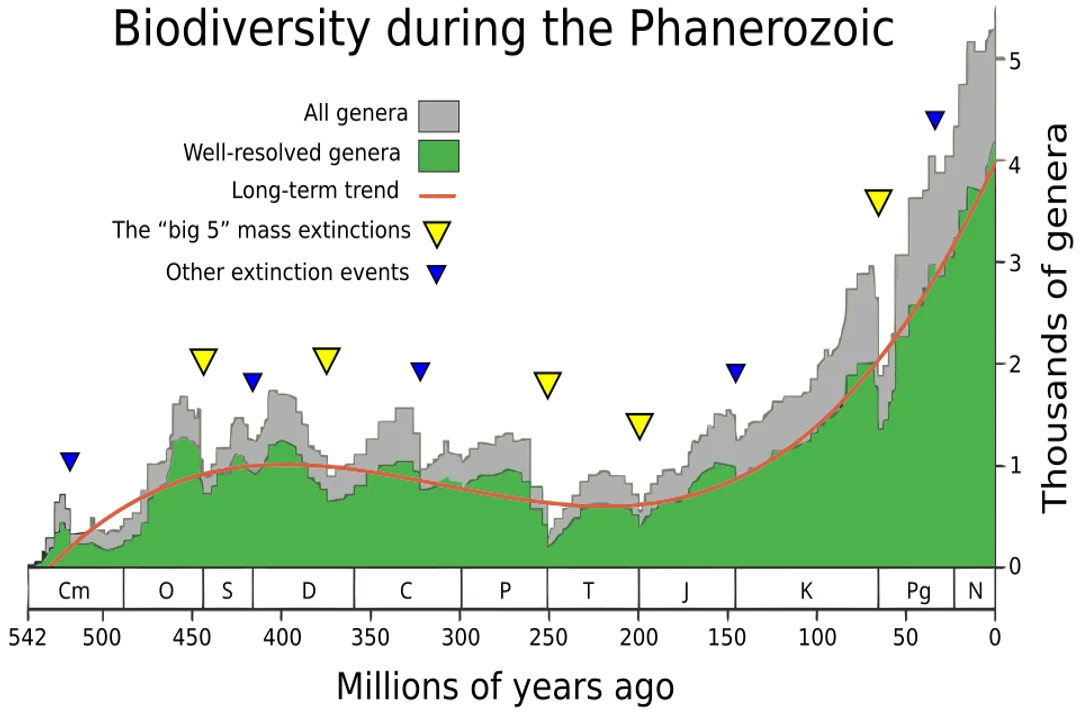
The culprits behind the "Big Five" extinctions vary, but they generally fall into a few recognizable categories of overwhelming environmental stress: massive volcanism, extraterrestrial impacts, and rapid, drastic climate change, often involving changes in sea level or ocean chemistry. [1][4][9] It is seldom just one factor operating in isolation; rather, these stressors frequently overlap or trigger one another in a devastating cascade. [1]
# Volcanic Fury
One of the most potent geological drivers observed in the fossil record is extreme, sustained volcanism, specifically the eruption of massive flood basalt provinces. [4] These are not single volcanoes; these are immense outpourings of lava over hundreds of thousands of years, covering vast areas like the Siberian Traps, linked to the Permian-Triassic extinction. [1] These eruptions pump enormous volumes of greenhouse gases, like carbon dioxide (), and sulfur dioxide () into the atmosphere. [1][4]
The initial pulse of sulfur gases can temporarily cause rapid global cooling, sometimes leading to ice ages, followed by long-term, intense global warming as accumulates. [1] Furthermore, these emissions lead directly to severe ocean acidification, dissolving the calcium carbonate shells and skeletons of marine organisms, which forms the foundation of many ocean ecosystems. [1] The sheer scale and duration of these volcanic episodes mean that ecosystems never have time to adapt before the next stressor hits. [4]
# Cosmic Hammer
The threat from space, though perhaps the most dramatic, appears responsible for only one of the Big Five events: the K-Pg extinction. [1] The impact of a massive asteroid or comet—the Chicxulub impactor—created immediate devastation near the impact site, but its global effects were far more deadly. [3] Material ejected into the atmosphere formed a global blanket, blocking sunlight for months or years, leading to a sharp, sudden cooling known as an "impact winter". [1] This shutdown of photosynthesis crippled the base of nearly every food chain, leading to starvation on a planetary scale. [4] Additionally, the impact likely triggered widespread wildfires and generated acid rain from vaporized rock, further damaging terrestrial and surface marine life. [1][3]
# Climate Shifts
Abrupt shifts in global climate, whether into deep freeze or intense heat, are consistently implicated across multiple extinction boundaries. [1] During periods of intense cooling, massive ice sheets can form, drawing water out of the oceans and causing sea levels to drop dramatically. [1] This directly destroys the vast, shallow marine habitats where a huge percentage of ancient biodiversity thrived. [1] Conversely, periods of rapid warming, often tied to volcanic activity, can cause oceans to become depleted of oxygen (anoxia) or even turn poisonous (euxinia) due to stratification and reduced circulation. [4]
It is interesting to contrast the pacing of these ancient events. A massive impact event like the K-Pg strike compresses the environmental disaster into a year or two of catastrophic conditions followed by decades of recovery stress. [3] In contrast, the sustained climate upheaval caused by the Siberian Traps eruptions leading to the P-T extinction likely imposed lethal conditions—extreme heat, suffocating oceans—over hundreds of thousands of years. [1] This difference in duration means that adaptation mechanisms, even those slow-acting ones, are completely overwhelmed by sustained forcing, which offers a critical lesson for today.
# Interacting Stressors
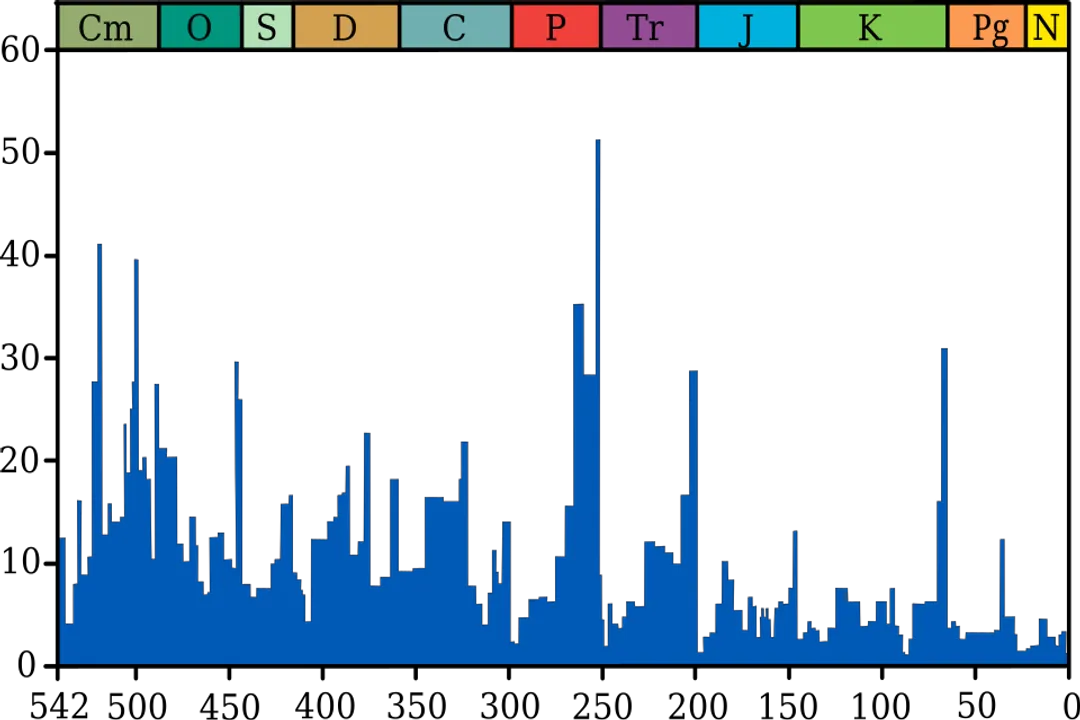
One key realization in studying these events is that singular causes are rare; the greatest die-offs resulted from synchronized stressors acting in concert. [1] For instance, the Permian-Triassic event is strongly associated with the Siberian Traps volcanism, but the ensuing climate chaos also drove the widespread anoxia observed in the fossil record. [4] The heat trapped , which warmed the globe, which slowed ocean circulation, which in turn led to oxygen depletion in the deep waters. [1]
We can model this as a chain reaction where the initial trigger pushes the Earth System past several tipping points sequentially. Imagine a planetary game of Jenga: the volcanic pulse destabilizes the climate block, which then causes the sea-level block to slide, finally leading to the collapse of ocean chemistry. [4] Survival often depended on an organism’s ability to tolerate all these successive changes, not just one. [9] A species might survive the initial temperature spike, but if the resulting ocean acidification then destroyed their food source, their fate was sealed regardless of their temperature tolerance.
If we map the major marine extinction percentages against the geological time period, the sheer scale of the events becomes apparent, showing that recovery is not immediate but often requires deep time to unfold:
| Event Name | Approximate Time Ago (Ma) | Estimated Marine Species Loss | Primary Stressor Link |
|---|---|---|---|
| Ordovician-Silurian | 443 | Glaciation/Sea Level Drop | |
| Late Devonian | Extended Anoxia/Climate Volatility | ||
| Permian-Triassic | 252 | Massive Volcanism/Global Warming | |
| Triassic-Jurassic | Central Atlantic Magmatic Province Eruptions | ||
| Cretaceous-Paleogene | 66 | Asteroid Impact/Volcanism |
Source summary synthesized from. [1][3][5]
# Modern Extinction

The evidence strongly suggests that the Earth is currently experiencing a sixth mass extinction event, driven overwhelmingly by a single species: Homo sapiens. [3][5] While the rate of extinction during the ancient events was determined by geological or cosmic forces acting over thousands or millions of years, the current crisis is characterized by an extinction rate hundreds or even thousands of times higher than the natural background rate, unfolding over decades and centuries. [5][6]
The primary mechanisms of this modern crisis are distinct from those that drove the Big Five, though the effect—widespread species loss—is similar. The top drivers include direct habitat destruction and fragmentation due to human expansion, overexploitation of resources (like overfishing or overhunting), pollution, and the introduction of invasive species. [3][6] Central to this is anthropogenic climate change, which is altering global temperatures and ocean chemistry at a pace that far exceeds the natural changes seen in the distant past. [6]
When considering the immense recovery times observed after previous catastrophes—sometimes requiring 10 to 50 million years for biodiversity to return to pre-extinction levels—the implications of the current event become starkly clear. [1] Unlike the deep-time recovery periods following the P-T or O-S events, which unfolded over epochs allowing new lineages to slowly diversify and fill empty ecological niches, the modern human-driven environmental changes are occurring within the span of a few human generations. This compression of cause and effect means that the ecological scaffolding necessary for future recovery is being dismantled faster than evolution can compensate, leaving a far less resilient planet for succeeding eras.
The danger lies in this temporal mismatch. Past mass extinctions were geological corrections; the current one is a cultural and technological one. While past life had the luxury of geological time to adapt to slow-burn volcanism or repeated ice ages, our impact ensures that many ecosystems facing current stressors—like ocean acidification coupled with rapid habitat conversion—have no historical precedent for survival within the contemporary timeframe. [6]
Related Questions
#Citations
What causes mass extinctions? - Understanding Evolution
Extinction event - Wikipedia
Mass extinction facts and information from National Geographic
There have been five mass extinctions in Earth's history
What is mass extinction and are we facing a sixth one?
On the causes of mass extinctions - ScienceDirect.com
Mass extinction event | Definition & Examples - Britannica
What caused Earth's 5 mass extinctions? - Big Think
What are the possible causes of mass extinctions? - Quizlet
Any good articles explaining all 5 mass extinction and their causes?