What causes acoustic resonance?

Acoustic resonance describes the preferential amplification of sound waves when the frequency of the incoming sound perfectly matches one of the inherent frequencies—the natural frequencies—of the system receiving it. It is a phenomenon where a small, periodic external force can elicit a vibration much larger than the force itself would suggest. This is not a rare or esoteric event; it is fundamental to how we create music, how certain technologies operate, and, occasionally, how structural damage can occur. To grasp what causes this intense energy buildup, one must first understand the concept of a natural frequency, which is dictated entirely by an object’s physical makeup.
# Natural Frequency
Every physical object or system—whether a taut guitar string, a volume of air trapped in a bottle, or the stiff structural element in a human ear called the basilar membrane—possesses a specific frequency, or set of frequencies, at which it naturally prefers to vibrate. This characteristic is determined by the object’s constituent properties: its size, its shape, and the material it is made from. When an external sound wave impinges upon this object, if the sound’s period aligns exactly with the object’s natural vibration period, resonance occurs.
The underlying physical reason for this extreme response is the efficient storage and transfer of energy. In a classic example like a child’s swing, the energy alternates between gravitational potential energy at the apex and kinetic energy at the bottom of the arc. The time it takes for this full cycle defines the swing’s resonant frequency. When an external push matches this timing, energy is added constructively at every swing, leading to a high amplitude.
Acoustically, this energy exchange often involves two forms within the system. Consider the simple case of blowing across an empty bottle, which acts as a Helmholtz resonator. Here, the acoustic energy oscillates between being stored as air pressure within the main volume of the bottle and being stored as the kinetic energy of the air moving in and out of the neck. This perfectly timed exchange between pressure and flow energy is what sustains the pure tone we hear when the frequency is right. If the external sound frequency deviates, the energy transfer breaks down, the air inside barely moves, and no significant sound is produced.
# Damping Quality Factor
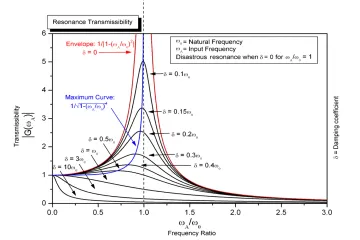
While every object has a natural frequency, not every object can be easily shaken apart by sound alone. The crucial factor differentiating a bell that rings for a long time from a block of wood that produces only a dull thud is damping, which is quantified by the Q-factor, or Quality-factor.
Damping represents any mechanism that causes the stored vibrational energy to dissipate over time. This loss can manifest as conversion to heat within the material or, importantly in acoustics, as energy radiated away as sound into the environment. The Q-factor is a measure of how good a resonator a system is: a high Q-factor means low damping and strong, long-lasting resonance, whereas a low Q-factor indicates high damping, causing the vibration to die out quickly.
A tuning fork, designed to produce a clean, sustained tone, is a strong resonator with a high Q-factor, perhaps around $1000$. This means it loses only a tiny fraction of its energy per cycle. Conversely, a material with many internal imperfections or one that is highly coupled to the surrounding environment will have a low Q-factor, making it resistant to destructive resonance.
This difference is something one can observe in the home environment. Imagine tapping the side of a thin, empty metal filing cabinet versus tapping a heavy, well-braced wooden desk. The cabinet, perhaps due to thin walls acting as efficient radiators of sound and internal flex, will likely produce a high-pitched, ringing tone that persists for a second or more—it has a relatively high Q for its structural modes. The desk, however, will produce a duller, quicker thud because its mass and rigid construction lead to significant energy loss through internal friction and heat generation, resulting in a lower effective Q-factor. If the energy input is sufficient, this high Q-factor allows the stored energy to build up until the material’s internal forces are exceeded, leading to fracture, as demonstrated by the classic (though difficult to perform reliably) feat of shattering a crystal wine glass with a sustained vocal tone matching its resonant frequency.
# Resonance Engineering
The principle of tuning a system to a specific frequency extends far beyond destructive demonstrations; it is central to much of our communication technology and musical culture.
# Musical Instruments
Nearly all acoustic instruments rely on resonance to shape and amplify sound. In string instruments like guitars or pianos, the length, tension, and mass of the string dictate its fundamental resonant frequencies and overtones. When a string is plucked, it initially vibrates across a spectrum of frequencies present in the impact, but the non-resonant frequencies are quickly attenuated, leaving the sustained, audible musical note defined by the string’s harmonics.
In wind instruments, the resonance involves standing waves inside an air column. Whether a tube is open at both ends (like a flute) or closed at one end (like a clarinet) dramatically affects which harmonics are produced. For instance, an open pipe resonates at frequencies where the ends are displacement antinodes (maximum air movement), while a closed pipe has a displacement node (no movement) at the closed end, resulting in the closed pipe producing only odd harmonics and its fundamental frequency being an octave lower than a similarly sized open pipe. Furthermore, strings or pipes can sympathetically cause other strings or pipes in proximity to vibrate if their overtones share a common frequency. For example, an A string at can excite an E string at because both share a common overtone frequency of .
# Tuned Circuits
The physics of acoustic resonance have direct parallels in electrical systems, particularly in radio and communication devices. In electronics, the necessary components for tuning are the inductor (coil) and the capacitor, which exhibit opposite reactive behaviors to alternating current (AC). A capacitor’s reactance decreases as frequency rises, while a coil’s reactance increases. When combined in a circuit, these opposing properties create a tuned circuit capable of selecting or rejecting specific radio wave frequencies.
The inventor Sir Oliver Joseph Lodge introduced this concept in $1898$, recognizing the need to isolate a single station from the broad spectrum of signals picked up by an antenna. In a parallel tuned circuit, impedance (resistance to AC) becomes extremely high at the system’s resonance frequency, forcing the desired alternating current to bypass the 'ground' path and flow instead to the output, like an earphone. This principle is the foundation for everything from early crystal radios to modern wireless LANs and cellular phones. Even modern high-frequency digital devices must contend with self-resonant frequency (), which is an unintended resonance caused by the parasitic inductance and capacitance inherent in even the shortest wire leads or component traces. Managing this unwanted resonance is key to achieving EMC (Electromagnetic Compatibility).
# Therapeutic Applications
The ability to induce precise, targeted vibration is also being developed for health applications. Some systems use bone conduction to deliver specific sound waves to an individual’s sinuses, acting like a miniature tuning fork to stimulate the air-filled cavities. Since the sinuses behave like acoustic resonators, stimulating them at their unique natural frequency allows for maximal energy transfer to the contained air and tissues, which can help loosen mucus and reduce inflammation for congestion relief. These personalized therapeutic systems often use face scans to map the individual’s unique resonant frequencies, ensuring the treatment is tailored to their specific anatomy.
# Dimensions and Sound Speed
The resonant frequency () is inextricably linked to the physical dimensions of the vibrating object and the speed () at which the wave travels through the medium. This dependency explains why different instruments produce different pitches even when played by a novice.
For a simple string fixed at both ends, the fundamental frequency is calculated using the wave speed (), string length (), and harmonic number ( for the fundamental): . The wave speed, in turn, depends on tension () and mass per unit length () as . This physical relationship means that to achieve a lower note (lower frequency), one must increase the length () or decrease the tension ().
In the realm of air columns, the speed of sound () in dry air at is approximately $343$ meters per second. This fixed speed acts as an upper constraint on the design. For an open cylindrical tube of length , the fundamental frequency is , where is the radius, accounting for a small 'end correction' where the reflection point lies slightly outside the tube's physical end. This confirms that for a given speed of sound, the only practical way to tune an instrument to a very low note is to make the resonating element very long—which is why bass instruments, like tubas or double basses, are physically much larger than their higher-pitched counterparts. The inverse relationship between length and frequency is a direct, unavoidable consequence of wave mechanics.
An interesting analysis emerges when comparing these acoustic systems to the electrical LC circuit. While the acoustic system's dimensions (, , ) and material properties (, ) determine the natural frequency, the electrical system’s components (inductance and capacitance ) serve the exact same function in establishing the resonant point: . This demonstrates a deep structural analogy between how systems store energy in mechanical/fluid forms (kinetic/potential) versus electrical forms (magnetic/electric field). In both cases, acoustic resonance is simply the physical manifestation of a system oscillating at its preferred energy exchange rate.
# Resonance Everywhere
The core mechanism—a forced oscillation matching a natural periodicity—is ubiquitous, meaning resonance isn't just an acoustic event but a universal physical concept appearing in electrical timing circuits, atomic magnetic resonance used in MRI scanners, and even optical systems like lasers. In acoustics specifically, resonance defines the very character of sound, from the timbre of an orchestra to the complex interaction between sound and room acoustics.
Composers have even embraced this phenomenon, intentionally using the resonances of large reverberant spaces, like cisterns, to shape their musical output by allowing the room itself to sustain and prolong the decaying energy of percussion instruments. The interplay between the sound source and the room modes—the resonant frequencies of the container—becomes the composition itself, creating sonic bridges between live and recorded sounds. This highlights that resonance is not purely about destruction or pure tone generation; it is about selective persistence of vibration. The result hinges entirely on the quality factor of the interacting elements. A system with a low Q-factor may absorb the driving energy without noticeable build-up, while a high Q-factor system will act as a superb energy amplifier, capable of producing remarkable effects or, if unchecked, causing structural stress. Understanding the cause means realizing that every sound you hear, from a knock on a table to the deepest note from a pipe organ, is, in part, the ringing of that object's natural resonances.
Related Questions
#Citations
Acoustic resonance - Wikipedia
The Science behind Acoustic Resonance Therapy - SoundHealth
8 • The World Through Sound: Resonance - Acoustics Today
Acoustic Resonance - Structural Integrity Associates
ELI5 - What is Acoustic Resonance? : r/explainlikeimfive - Reddit
What is Resonance Phenomenon? Mechanism of tuning circuits.