What are the three components of the universe?
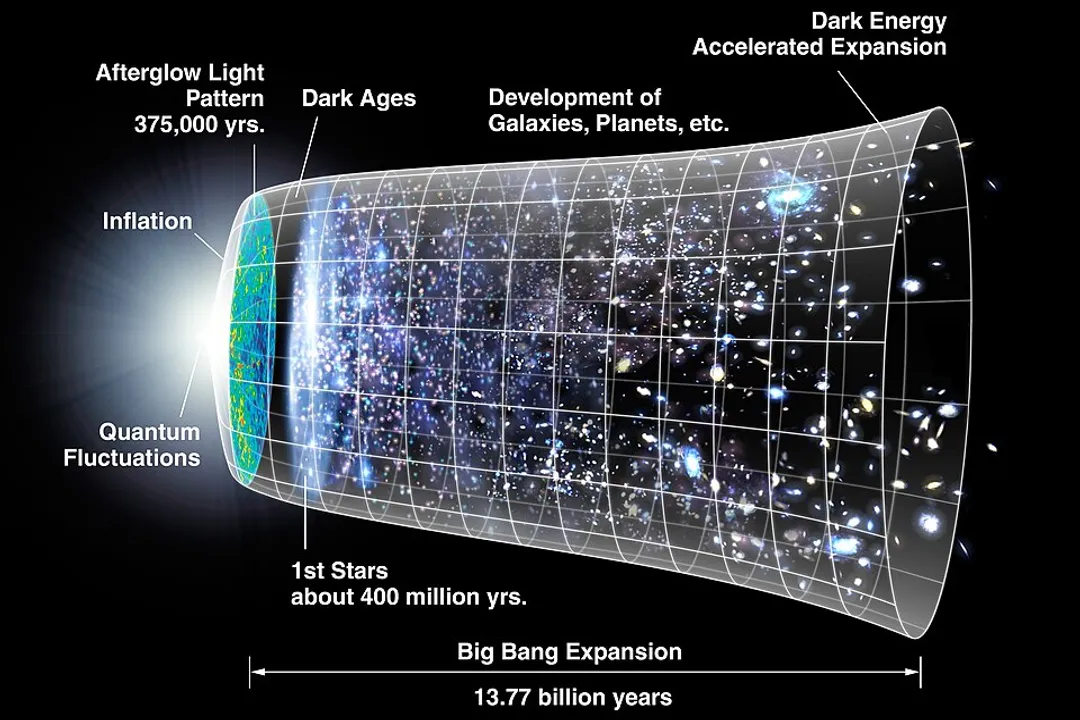
The universe, in its entirety—all space, all time, and everything within them—is governed by a handful of fundamental forces and composed of three distinct, yet interconnected, substances. While our everyday experience is entirely built upon the things we can see, touch, and measure, the vast majority of the cosmos is comprised of two components that remain profoundly mysterious to modern science: dark matter and dark energy.
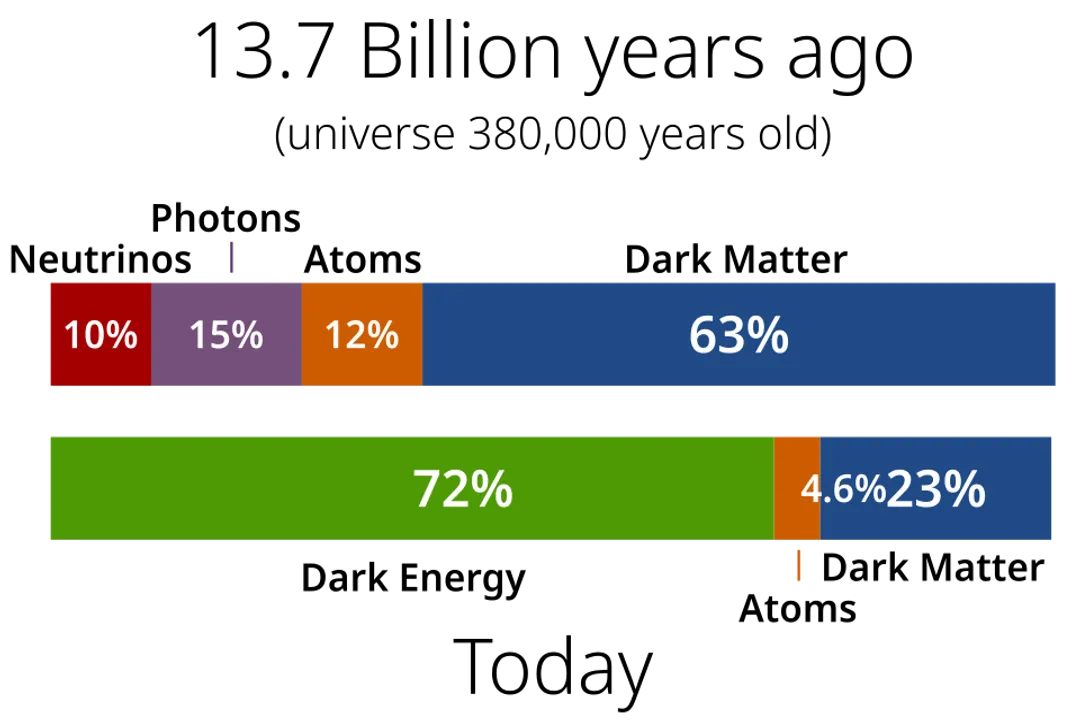
When we survey the cosmos based on its total mass-energy content, the picture that emerges is startling. The components are not equally distributed. The familiar stuff—the stars, planets, nebulae, and the very dust between the stars—accounts for a mere sliver of the total budget. The universally accepted Lambda-CDM cosmological model suggests the composition breaks down roughly like this: Dark energy makes up about 68.3%, dark matter around 26.8%, leaving ordinary (baryonic) matter to constitute only about 4.8% of the universe's total mass-energy budget. Some presentations simplify this to $68%$, $27%$, and $5%$ respectively. This realization—that the visible universe is essentially a cosmic afterthought—sets the stage for understanding the true architecture of reality.
# Visible Matter
The first component is the matter we can interact with, the material that forms atoms, stars, planets, and life itself. In physics, this is referred to as ordinary matter or baryonic matter. This matter has the property of having mass and occupying space. It is defined by its ability to emit, absorb, or reflect electromagnetic radiation, allowing us to detect it across the spectrum, from radio waves to X-rays.
# Atomic Foundation
Ordinary matter is built from elementary particles described by the Standard Model of particle physics. These building blocks are the quarks and leptons. Protons and neutrons, which form the atomic nucleus, are hadrons, composites of three quarks held together by the strong nuclear force. For instance, a proton is made of two up quarks and one down quark. Electrons, which orbit the nucleus, are a type of lepton. An atom, the fundamental unit of chemistry, consists of this nucleus orbited by electrons.
The very early universe, immediately after the Big Bang, was a hot, dense plasma of these subatomic components. As it cooled, the universe went through an hadron epoch where quarks bound into hadrons. After the majority of hadrons and anti-hadrons annihilated, the universe entered the lepton epoch, dominated by leptons like electrons. Following this, through a process called Big Bang nucleosynthesis in the first few minutes, the primordial protons and neutrons fused to create the lightest elements: primarily hydrogen (about 75% of the mass) and helium (about 25%), with only traces of deuterium and lithium. Heavier elements—everything else on the periodic table—would require the extreme conditions of stellar interiors or supernova explosions to form later on.
It is significant to note that even within this small $4.8%$ slice dedicated to ordinary matter, the amount we see is even smaller. The visible components—stars, planets, and the gas clouds filling the space between them—account for less than 10 percent of the total ordinary matter budget. In one detailed breakdown, stars account for only about $0.5%$ of the total universe, while free hydrogen and helium floating in intergalactic space make up about $4%$. This means that the luminous, easily identifiable structures that populate our night sky are just the visible tips of the baryonic iceberg.
Thinking about the density reveals just how diffuse even this familiar matter is. The overall density of ordinary matter is incredibly low, equating to roughly one proton for every four cubic meters of volume. If one considers a standard cubic meter—the space occupied by a large refrigerator—that volume in the universe contains less than half a proton on average. This low density is a fascinating consequence of expansion, yet it still provided enough gravitational concentration for structure formation to begin once dark matter provided the necessary gravitational scaffolding.
# Dark Matter
If ordinary matter is the $5%$ we recognize, the next major constituent, accounting for roughly $27%$ of the total mass-energy, is dark matter. This substance is characterized by what it does not do: it does not emit, absorb, or reflect light at any significant level across the electromagnetic spectrum, rendering it entirely invisible to conventional telescopes. Its existence is inferred purely through its gravitational effects on visible matter, radiation, and the overall large-scale structure of the cosmos.
# Historical Deduction
The concept of missing mass emerged from clear observational discrepancies. In the 1930s, Swiss astronomer Fritz Zwicky, studying the Coma Cluster, noted that the galaxies within it were moving far too quickly for the cluster's visible mass to hold them together gravitationally; they should have scattered into intergalactic space. Zwicky proposed the existence of "dunkle Materie" to supply the required gravitational binding energy.
Decades later, in the 1970s, American astronomer Vera Rubin provided crucial confirmation by studying the rotation curves of individual spiral galaxies. She observed that stars on the outer edges of these galaxies were orbiting at nearly the same high speeds as stars closer to the center. According to Newtonian mechanics, the rotational speed should decrease further from the center where most of the visible mass resides, but this was not the case. This implied that a large, unseen halo of mass, dark matter, must be enveloping and permeating the galaxy, providing the extra gravitational anchor.
The existence of dark matter gained even more striking visual confirmation through observations of colliding galaxy clusters, most famously the Bullet Cluster. When two clusters smashed together, the hot gas (ordinary matter) from each cluster interacted and slowed down, glowing in X-rays. However, mapping the total mass using gravitational lensing—the bending of light from background objects due to mass—showed that the majority of the mass passed right through the collision without slowing down, separating cleanly from the gas. This provided direct evidence that dark matter is collisionless on scales relevant to the gas interaction, acting as a distinct component from baryonic matter.
# Nature and Candidates
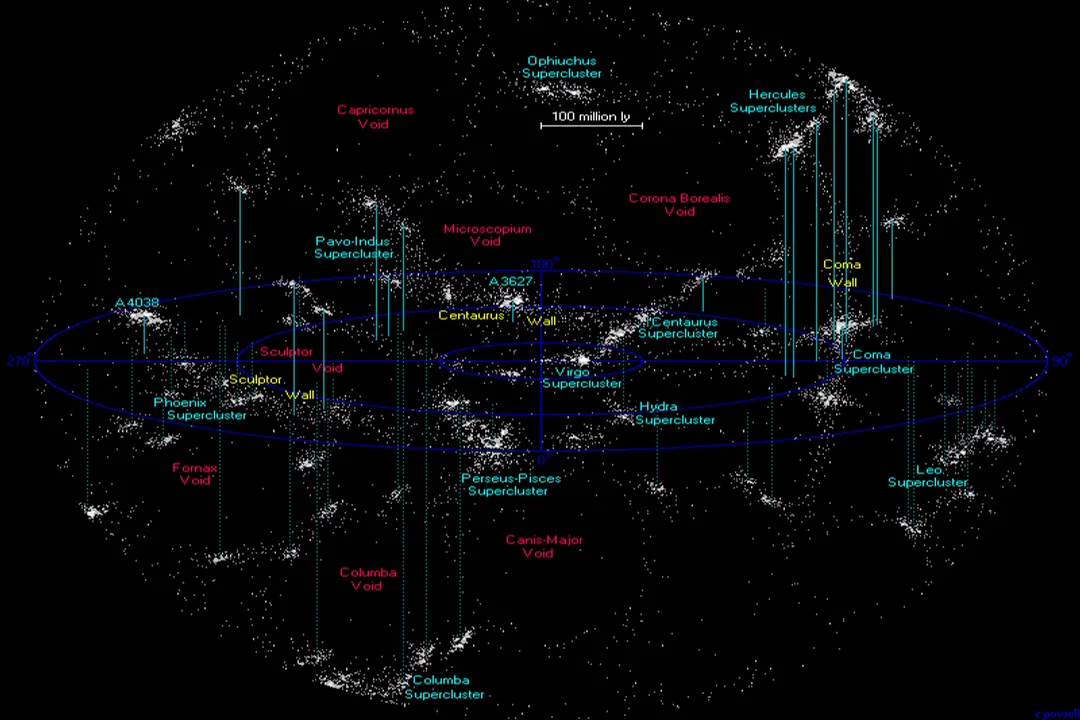
Scientists overwhelmingly favor the idea of Cold Dark Matter (CDM)—meaning the particles that constitute it are slow-moving—because simulations incorporating CDM successfully predict the filamentary, web-like structure we observe in the universe today. Faster-moving, or "hot," dark matter particles would have smoothed out these structures too much, preventing galaxies from clumping as they have.
The identity of the dark matter particle remains one of astrophysics' greatest mysteries. Current leading candidates include:
- WIMPs (Weakly Interacting Massive Particles): Hypothetical particles that are heavy and slow, interacting via gravity and perhaps the weak nuclear force, but slipping through ordinary matter almost unimpeded.
- Axions: Very light, low-energy particles theorized to resolve a fundamental issue in particle physics known as the strong CP problem.
- Primordial Black Holes: Hypothetical black holes formed in the immediate aftermath of the Big Bang, perhaps ranging from subatomic size up to stellar masses.
The investigation into dark matter relies heavily on indirect detection methods, such as searching for gamma rays produced if WIMPs annihilate each other, or meticulously mapping its gravitational influence via lensing. The upcoming Nancy Grace Roman Space Telescope is a key instrument designed to map the distribution of dark matter with unprecedented detail to better constrain its nature.
# Dark Energy
If dark matter provides the cosmic glue that holds structures together, dark energy is the force driving them apart, acting as a cosmic repellant. It is the single largest constituent, dominating the universe at roughly $68%$ of the total mass-energy budget.
# The Accelerating Void
Astronomers confirmed the universe was expanding in the late 1920s, but for decades, it was assumed that the collective gravity of all matter would cause this expansion to slow down over time. This expectation was shattered in the 1990s through observations of distant Type Ia supernovae. These specific stellar explosions, which act as standard candles, revealed that the expansion of the universe is not slowing down—it is accelerating. Something must be actively pushing spacetime apart, overwhelming gravity on the largest scales. This mysterious agent has been named dark energy.
Unlike dark matter, which clumps in halos around galaxies, dark energy appears to be uniformly distributed across space, permeating the vacuum itself. This uniformity is critical: even though its density on a mass-energy equivalence basis is very low compared to matter, its omnipresence allows it to dominate the universe’s overall dynamics today.
# Models of Repulsion
Scientists currently propose two main theoretical categories for dark energy:
- The Cosmological Constant (): This is an inherent, constant energy density of space itself, essentially the energy of the vacuum. If this model holds, the energy density never changes, meaning as space expands and creates more vacuum, the total dark energy increases proportionally to the volume, maintaining a constant energy density throughout time.
- Quintessence/Scalar Fields: These are dynamic fields whose energy density might vary over time and space, offering a more flexible explanation for the observed acceleration.
Observations from X-ray observatories like XMM-Newton have even led to controversial interpretations suggesting that galaxy clusters in the early universe were growing faster than expected under the standard dark energy model, implying a higher overall density or perhaps even casting doubt on the need for dark energy altogether, though this is a highly contested result. Nevertheless, the leading consensus maintains that the observed acceleration points strongly to dark energy as the current driver of cosmic evolution.
# Cosmic Proportions Evolution
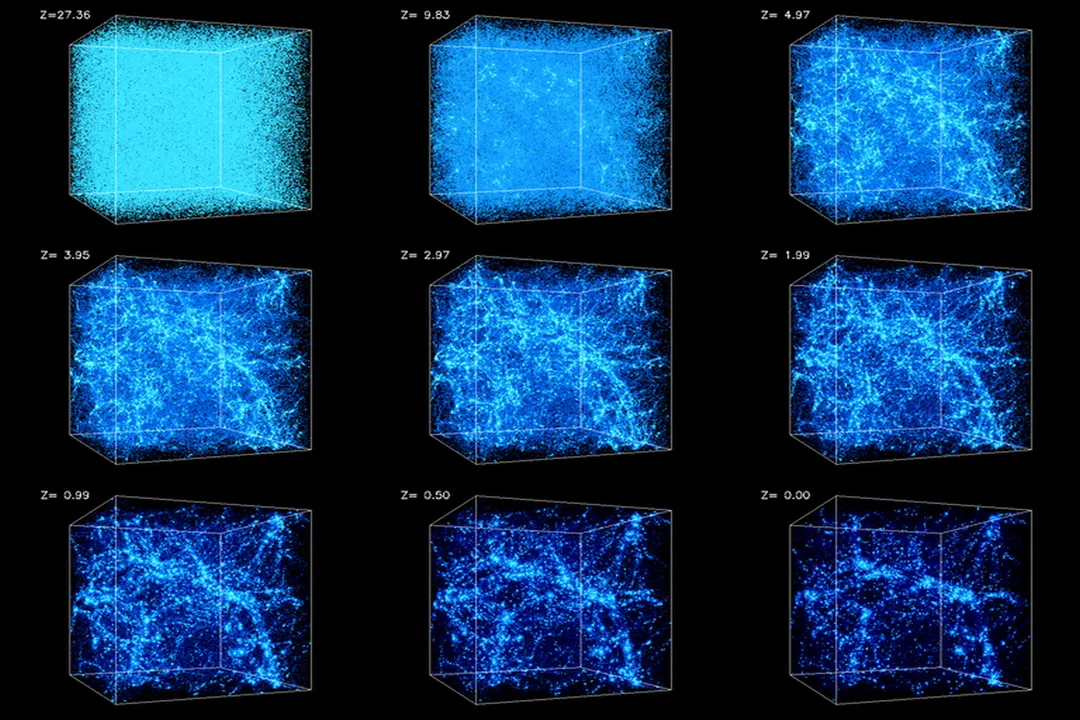
The three components—visible matter, dark matter, and dark energy—do not maintain the same relative importance throughout cosmic history; the universe has transitioned through distinct eras defined by which component dominated the total energy density.
| Component | Approximate % of Total Mass-Energy (CDM) | Nature/Role |
|---|---|---|
| Dark Energy | $68.3%$ | Drives accelerated expansion; uniform in space |
| Dark Matter | $26.8%$ | Provides gravitational scaffolding; clumps via gravity |
| Ordinary Matter | $4.8%$ | Forms atoms, stars, planets; interacts electromagnetically |
In the very earliest stages after the Big Bang, the universe was so hot and dense that radiation (photons) dominated, leading to a radiation-dominated era. As the universe expanded, the energy density of radiation dropped faster than that of matter because photons become redshifted, losing energy. Around 47,000 years after the Big Bang, matter's density surpassed that of radiation, beginning the matter-dominated era. During this long period, gravitational clumping—guided by the dark matter scaffold—led to the formation of the first structures, stars, and galaxies.
The shift to the current state began much later, around $9.8$ billion years ago, when the density of matter had decreased enough that the constant density of dark energy became the dominant factor, initiating the dark-energy-dominated era.
This transition from a matter-dominated universe, where gravity was the primary large-scale regulator, to a dark-energy-dominated one marks a profound turning point in cosmic destiny. If the universe had been significantly denser, gravity could have won out, leading to a potential recollapse (a Big Crunch). Because dark energy is now in charge and causing an acceleration, the current trajectory points toward perpetual expansion, a likely "Big Freeze" or perhaps even a "Big Rip," depending on the precise nature of dark energy. The shift in dominance dictates whether the universe ends in a bang, a crunch, or a slow fade into cold emptiness.
# Unraveling Mysteries
Understanding the universe requires resolving the nature of the two dark components. The search is conducted through both terrestrial experiments, hoping to catch a faint interaction of a WIMP, and ambitious space missions.
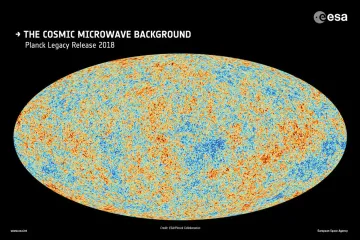
The current generation of astronomical tools is designed to probe these deep unknowns. For instance, studying the Cosmic Microwave Background (CMB)—the faint afterglow radiation from when the universe became transparent 380,000 years after the Big Bang—reveals slight temperature fluctuations that map the initial density variations where structure was seeded. Missions like Planck have provided high-precision measurements of these fluctuations, which confirm the current standard model percentages, even as new data from X-ray observations occasionally hints at inconsistencies that demand re-examination.
Furthermore, while we cannot yet observe the entirety of existence, our view is fundamentally limited by the speed of light to the observable universe, which currently spans about 93 billion light-years in diameter. Philosophically, there are theories suggesting that our universe might be just one bubble in a vast multiverse, though such concepts remain speculative and beyond our current ability to measure or verify. For now, the three established components—visible matter, dark matter, and dark energy—represent the totality of our physical reality, demanding continued investigation to finally place the invisible majority into their proper context.
Related Questions
#Citations
Building Blocks - NASA Science
ESA - What is the Universe made of? - European Space Agency
Components of the Universe | Texas Gateway
Universe - Wikipedia
What Is the Universe Made Of? - Northrop Grumman
All the Contents of the Universe, in One Graphic - Visual Capitalist
What are the major components of the universe, including visible ...