How fast does water drain through soil?

Water movement through soil is not a single, constant rate; it is a dynamic process influenced by what the soil is made of and how wet it already is. Understanding this speed—often referred to as the infiltration or percolation rate—is vital for everything from planning a garden to ensuring a stable foundation for a building. [8] When rain falls, the water first infiltrates the surface layer before moving downward through the soil profile. This rate of downward movement determines whether your soil stays adequately moist for plants or becomes waterlogged and suffocating for roots. [1]
The speed at which rainwater can travel through the ground once it soaks in varies dramatically. [2] While rainwater can move through the ground profile fairly quickly in some areas, in others, the movement is painstakingly slow, leading to standing water or runoff. The key determinant in this process is the soil's physical makeup. [8]
# Soil Properties
The structure of the soil acts like a complex plumbing system. Water travels through the pore spaces between soil particles, and the size and interconnectedness of these spaces dictate the speed of drainage. [5][8]
# Particle Size
Soil texture is classified based on the proportion of three main components: sand, silt, and clay. [8]
- Sand: Sand particles are the largest, creating large pores that are highly interconnected. Water moves through sandy soil very quickly because there are fewer obstacles and the pathways are wide open. [8]
- Clay: Clay particles are the smallest, packing together to form very small pore spaces. These tiny pathways restrict water movement significantly, leading to slow drainage rates. [8]
- Silt: Silt particles fall between sand and clay in size, offering moderate drainage characteristics. [8]
A soil described as "well-draining" typically has a balanced composition, often leaning toward loam, which allows for sufficient moisture retention while permitting excess water to move out of the root zone. [9]
# Structure and Compaction
Beyond the particle size (texture), the way those particles are arranged (structure) heavily influences drainage speed. Good structure means stable aggregates that create voids for water flow. [5] When soil becomes compacted—perhaps from heavy equipment traffic or walking on wet ground—these pore spaces collapse. Even soil that is naturally sandy might exhibit poor drainage if it has been severely compacted because the physical pathways for water are crushed shut. [3] This compaction can drastically slow down the initial infiltration rate, even if the deep soil structure remains reasonably porous. [5]
# Drainage Check

To move from general theory to practical knowledge for your own yard, you need a way to measure the actual drainage speed of your specific soil. This is commonly done using a percolation test. [6] This test is designed to measure the rate at which water drains from a saturated soil layer, giving you an idea of how quickly the ground can accept more water after a heavy rain event. [1][4]
# Test Method
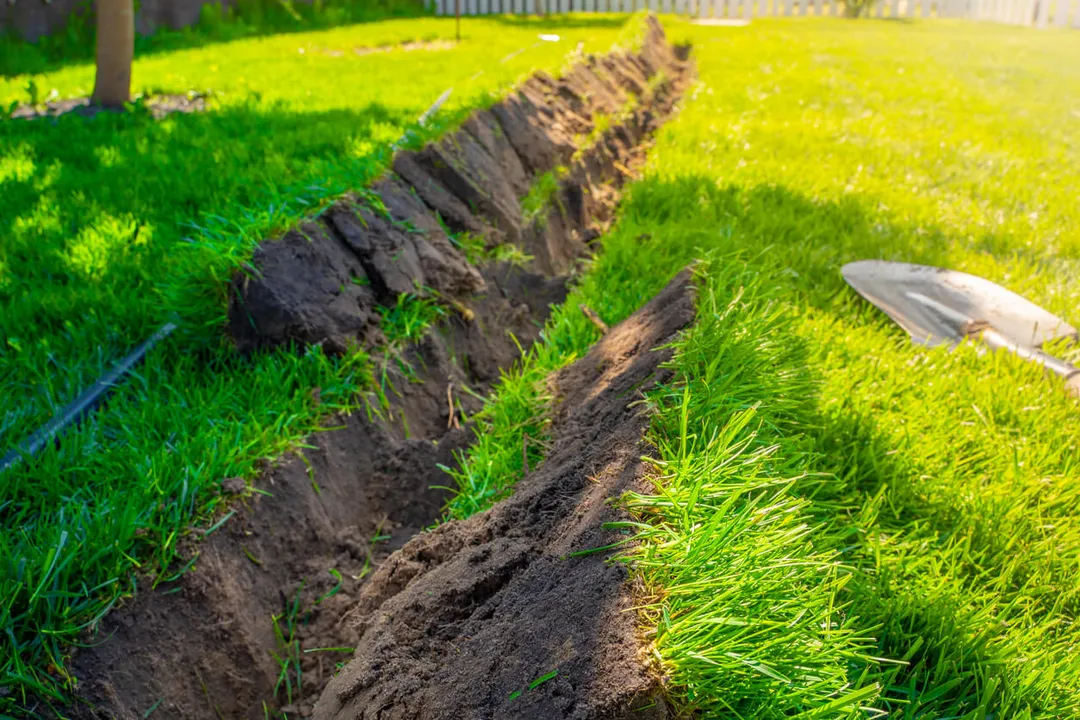
The standard procedure for checking drainage involves creating a small test basin in the soil:
- Digging: Select an area that represents the soil you are interested in testing, such as a spot where you plan to install a garden bed or rain garden. Dig a hole roughly one to two feet deep and about one foot across. [1][4] For a more accurate representation of the entire root zone, some guidance suggests digging the hole to the depth you intend to plant or amend the soil. [6]
- Pre-wetting: This step is crucial. Before timing the final drainage, you must saturate the soil completely. Fill the hole with water and allow it to drain. This ensures the soil is fully swollen and mimicking conditions after a significant rain. [1][4] If the soil is very dry, it may absorb the initial water quickly, giving you an inaccurate reading of its saturated state capacity.
- Timing: Once the water has fully drained from the initial soaking, refill the hole to a depth of about 6 inches. [1][6] Start a stopwatch immediately. Measure the time it takes for the water level to drop by one inch. [4]
- Calculation: The rate is calculated by dividing the drop in inches by the time elapsed in hours. For example, if it takes 30 minutes (0.5 hours) for the water to drop one inch, the rate is . [1]
An important practical consideration often overlooked when performing this check is when you conduct the test. If you test dry soil, the result may show a very fast rate because the dry soil structure readily pulls water in. To get a reading that truly reflects how the soil handles heavy rainfall during the active growing season, it is best to perform the test after a natural soaking period, when the soil is already near field capacity. [1]
# Rate Variation
It is worth noting that the initial entry of water (infiltration) can be much faster than the subsequent deep percolation rate, especially if the surface layer is less permeable than the layers beneath it. [5] If you observe that the water takes a very long time to soak in during the pre-wetting phase, it might indicate surface sealing or a very high clay content near the top, regardless of what happens an inch lower down. [8] If the water from the first fill does not drain completely within several hours, you might have a very poorly draining layer, and timing the second drain might not be practical. [4]
# Rate Meaning
Once you have calculated the drainage rate in inches per hour, you need a benchmark to determine if your soil is healthy for typical landscaping or gardening needs. [1]
# Ideal Range
For most ornamental plants and vegetable gardens, a soil that drains too quickly—like pure coarse sand—will not hold enough moisture, requiring constant irrigation. Conversely, soil that drains too slowly retains too much water, leading to anaerobic conditions that kill roots. [9]
The generally accepted range for well-draining soil in gardening applications is often cited as 1 to 2 inches per hour. [1] Soil that drains at a rate of less than 0.5 inches per hour is often considered poorly draining and may require modification before planting sensitive species. [1][4] If the drainage rate is extremely slow, approaching zero, it indicates a heavy clay layer or hardpan that prevents effective water movement downward. [9]
| Drainage Rate (Inches/Hour) | Classification | Implication |
|---|---|---|
| Greater than 2.0 | Rapid/Excessive | High irrigation need; nutrient leaching risk [1] |
| 1.0 to 2.0 | Ideal/Well-Draining | Supports most plant roots effectively [1] |
| 0.5 to 1.0 | Moderate | Acceptable, but may need occasional monitoring |
| Less than 0.5 | Slow/Poor | High risk of waterlogging; amendment recommended [4] |
# Deeper Travel
While the percolation test measures vertical movement in a localized area, the actual travel speed of rainwater deeper into the water table can be surprisingly fast in certain circumstances. In highly permeable, non-saturated, deep soil profiles, groundwater recharge can occur quite rapidly. [2] However, this deeper, long-term movement is often slower than the initial one- or two-inch drop measured in the surface test because the water has to navigate a much longer path through more restrictive layers. [5]
If you are managing a landscape or structure that depends on water moving away from a specific foundation or retaining wall, you must consider the soil's lateral permeability as well. Water doesn't just move down; it moves toward existing voids or less dense material, which means a localized area of slow drainage can still cause problems by pushing water horizontally into another area. [8]
# Garden Impact
The speed of water draining through soil directly affects plant health and the success of water management features, like rain gardens. [3]
For the home gardener, recognizing slow drainage is the first step toward correction. If your test shows a rate significantly below the ideal range, simple physical amendment can help. Incorporating coarse organic matter, such as aged compost or aged wood chips, over time improves soil structure by creating larger, stable aggregates, which increases the effective pore space for drainage. [3] Unlike adding pure sand to clay, which can sometimes create a concrete-like mix, focusing on organic matter builds better structure across different soil types. [3]
When you are designing features meant to manage stormwater runoff, like a rain garden, you are intentionally trying to create an area with slightly slower drainage than the surrounding lawn to maximize infiltration time without causing long-term saturation. [3] The goal is to hold water long enough for plants to absorb it and for microbes to process it, but not so long that anaerobic conditions set in. Thus, the "ideal" rate can shift slightly depending on the intended use of the land parcel. [3]
A scenario to watch out for involves layered soils. If you have a clay layer a foot down, but the top six inches are loamy, your percolation test might give you a misleadingly fast reading based on the topsoil alone. However, once the water reaches that clay barrier, it will sit and saturate the soil above it, leading to root rot even though the initial measurement suggested good drainage. This is why digging deep enough for the test—at least one foot—is critical to capture the general condition of the rooting zone. [1][6] Understanding that the fastest rate you observe might only be indicative of the top layer, while the slowest layer dictates the worst-case scenario for prolonged wetness, is a key piece of practical drainage insight. [5]
Related Questions
#Citations
[PDF] How To Test Soil Drainage | TreePeople
How fast can rainwater travel through the ground when it infiltrates ...
Is fast drainage in a percolation test good or bad for a rain garden?
Testing Soil Drainage - Western Garden Nursery
Water Movement in Soils — Welcome - Soil Physics
Testing Soil Drainage and Texture | HGTV
The Science of Drainage How Does Water Move Throughout the ...
What exactly is well draining soil? : r/Horticulture - Reddit