Why is my water not soaking into the ground?
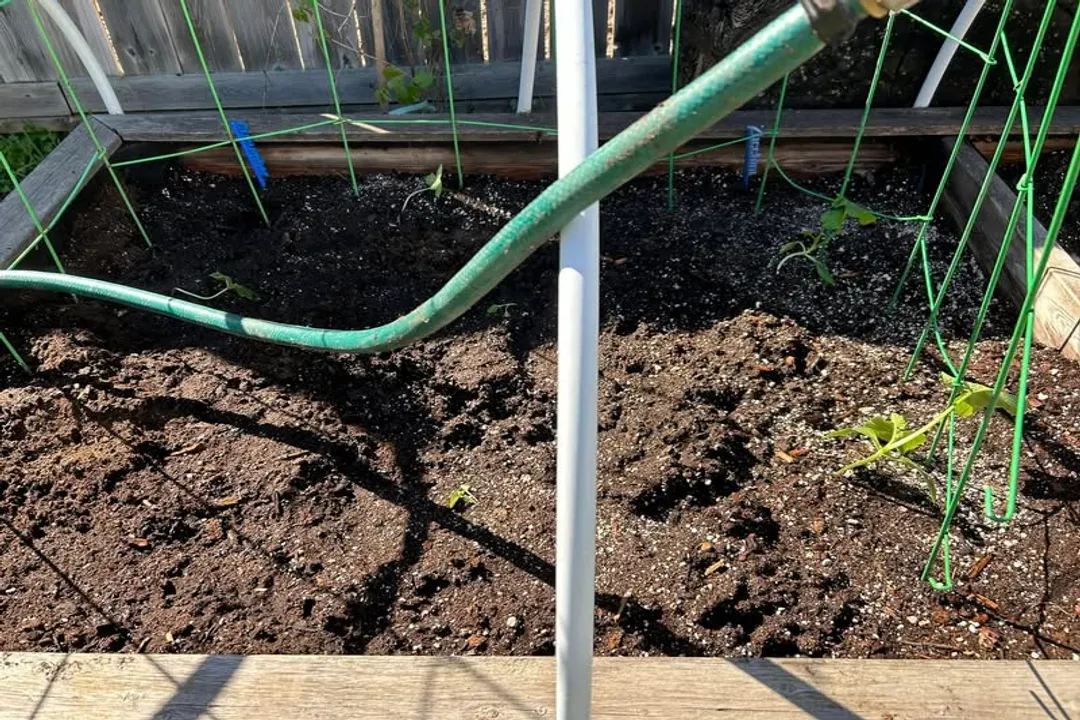
That frustrating moment when you turn on the sprinkler, and instead of watching the moisture sink gracefully into the lawn or garden bed, you see rivulets forming and water pooling uselessly on the surface is a common headache for homeowners and gardeners alike. [4] When water runs off instead of soaking in, it means the soil’s ability to accept moisture, known as its infiltration rate, has been compromised. This issue isn't usually down to a single culprit; it’s often a combination of physics, chemistry, and poor soil management over time. [2][4] Understanding why the ground is rejecting the water is the first step toward a solution, whether you are dealing with a thriving lawn or just trying to manage rainfall in your yard.
# Water Repellent Surface
One of the most surprising reasons water refuses to penetrate the soil involves surface tension, leading to a condition known as hydrophobic soil. [2] This isn't about the soil being completely saturated; it's about the soil particles themselves actively resisting water contact. [2]
This phenomenon frequently occurs in sandy soils or areas where the soil has dried out extensively. During these dry periods, organic matter—like fine roots, dead plant material, or microorganisms—can coat the soil particles. [2] These coatings often contain waxy, non-polar substances that naturally repel polar water molecules. When water finally hits this barrier, it beads up rather than spreading out and soaking in, much like water on a freshly waxed car. [2] This repulsion creates a significant surface tension problem that prevents initial entry, even if the deeper soil profile is perfectly capable of holding moisture. [2]
This specific type of resistance is fundamentally different from standard drainage issues. In a hydrophobic scenario, water sits on top because the surface tension overcomes the gravitational pull downward. [2] If you observe water stubbornly forming perfect droplets that refuse to merge with each other on the soil surface, hydrophobicity is a strong candidate for your problem. [2]
# Particle Squeeze
The most common physical impediment to water absorption is soil compaction. [4] Think of healthy soil as a sponge full of microscopic air pockets and channels that allow water and oxygen to move freely. When soil particles are pressed too closely together—usually through foot traffic, running machinery over wet areas, or heavy rainfall impact—these vital air spaces are crushed.
When soil structure collapses due to compaction, the large pores that facilitate rapid water movement disappear, leaving behind only tiny, tortuous pathways. Water can eventually seep through these minute gaps, but the rate is dramatically reduced, leading to pooling or runoff on the surface. [4] The denser the soil becomes, the less room there is for air, and air is necessary to allow water to push its way down.
A good way to visualize this structural failure is to compare healthy soil to a pile of marbles, where water can easily flow through the gaps, versus that same pile of marbles that has been violently shaken into a dense, tightly packed container. In the latter case, the water has to navigate around every single particle one by one, which takes significant time. While the sources often point to lawns being susceptible because of their frequent use, any area subjected to heavy, repeated loading—like a garden pathway or a construction staging area—will suffer from this particle squeeze, slowing infiltration to a crawl. [4]

# Underlying Layers
Beyond surface conditions, the geology or construction beneath the topsoil can create impenetrable barriers. This often manifests as a hardpan layer or a natural layer with very high clay content. [4][6]
When surface water does manage to penetrate the top few inches, it might hit a sub-layer that simply cannot accept any more moisture. In agricultural or natural settings, this can be a natural clay layer that has built up over millennia. [1] For constructed landscapes, this might be compacted fill dirt or poorly graded base material that was never broken up before topsoil was placed on top. [4]
This problem is particularly evident around ponds or lakes, where the water body remains stable year-round. [1][6] If a pond doesn't drain away, it’s usually because the underlying soil is composed of fine silts or heavy clay, which have very low permeability. [1] The water table might even be naturally high in that location, meaning the soil is already saturated up to the surface level. [6] In your yard, if you dig down and find a distinct, dense layer beneath the topsoil that is significantly different in color or texture and feels almost cement-like when dry, you have likely found the obstruction. [4] Water hitting this layer cannot go down, so it spreads out horizontally or pools above it. [6]
# Thatch and Debris
For turfgrass, a layer of accumulated organic material just above the soil line—known as thatch—can act as a temporary sponge that prevents water from reaching the mineral soil beneath. [4] Thatch consists of dead and living stems, roots, and stolons that accumulate faster than they decompose. If this layer exceeds about half an inch in thickness, it becomes a physical impediment to water movement. [4] The water soaks into the thatch, becomes momentarily trapped, and then evaporates or runs off the lawn before it ever has a chance to enter the ground below. [4]
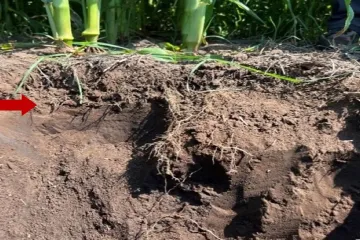
# Fixing the Ground Water Flow
Resolving poor water absorption requires addressing the root cause, whether it is chemical repellency or physical blockage. [2] The approach changes depending on whether the issue is on the surface or deeper down.
# Surface Treatments
If you suspect hydrophobicity due to dry soil, the primary goal is to lower the water’s surface tension so it wets the soil particles rather than beading up. [2] Surfactants, sometimes sold as commercial wetting agents, are designed for this exact purpose. [2] These materials act as soaps, allowing water to spread out across the soil surface and penetrate more easily. Applying these products according to instructions can often restore absorption capacity quickly, especially in areas that have been dry for extended periods. [2] Following up the surfactant application with a light, gentle watering can help pull the treatment into the upper soil layer.
# Relieving Compaction
For compaction, the physical remediation is necessary. The general practice used to combat this is aeration. [4] While poking a few holes with a garden fork provides temporary relief, core aeration—the process that physically removes small plugs of soil—is the most effective method. [4] By removing these plugs, you create immediate vertical channels for water and air, and the remaining soil structure has room to temporarily relax and expand as the pulled cores eventually break down. This process is best performed when the soil is slightly moist, not soaking wet or bone dry, to maximize the effectiveness of the plug removal.
A key consideration often overlooked is the timing of remediation. If you aerate when the soil is bone dry, the compaction relief is minimal because the compressed particles are too rigid to shift. If you aerate when the soil is saturated, you risk pulling out mud plugs and simply creating new, sloppy voids instead of stable air channels. The sweet spot for effective aeration is when the soil yields slightly under pressure but doesn't stick to tools—often described as soil that crumbles nicely when squeezed.
# Improving Soil Structure Long Term
Physical restructuring is only a temporary fix if the soil lacks the necessary binding agents to maintain air space. To prevent the particles from collapsing again, you need to increase the amount of stable organic matter. [2] Incorporating well-aged compost or other organic amendments into the affected area works wonders over time. [2] Organic material acts like glue, helping smaller particles aggregate into larger, porous clumps that resist compaction and maintain pathways for water and air. [2] This applies whether you are dealing with overly sandy soil that repels water or heavy loam that compacts easily.
If the issue is a lawn, managing the thatch layer is crucial. If the layer is significant, dethatching—mechanically raking out the excess material—may be required before aeration can be truly effective. [4]
# Addressing Deep Barriers
If you discover a hardpan or dense clay layer just below the topsoil, the solution becomes more intensive. Aeration might help slightly, but it cannot break through a true, cemented hardpan. [4] In these severe cases, physical breaking of that lower layer is necessary, often requiring mechanical equipment to till or loosen the soil deeply below the standard root zone. [4] For areas where water is consistently pooling due to a high water table or deep, unchangeable clay, managing the landscape might involve grading the area to direct excess water elsewhere or installing drainage systems like French drains to physically remove the standing water rather than relying on soil absorption. [6]
Ultimately, soil that doesn't soak in is soil crying out for better structure. Whether you need to chemically persuade waxy particles to accept water, physically create space between tightly packed grains, or add organic material to stabilize those spaces for the long run, understanding the specific failure point ensures your effort isn't wasted watching water disappear down the street instead of into your landscape. [2][4]
#Videos
How To Get Water To Soak Into A Dry Lawn - YouTube
Hydrophobic Soil And How To Correct It - YouTube
Related Questions
#Citations
Why does the water in a lake or pond not absorb into the ground ...
What Causes Soil to Become Hydrophobic and How to Fix it?
Why is water not penetrating my garden soil after adding new soil ...
Soil not absorbing water - Lawn Care Forum
How To Get Water To Soak Into A Dry Lawn - YouTube
Why doesn't water in a pond just soak into the ground? - Quora
Serious problem with water not penetrating my sandy soil - Houzz
dirt does not soak up water - DoItYourself.com Community Forums