To restore order to disturbed flow immediately upstream of a sensor sensitive to turbulence, what is a common guideline for straight pipe runs?
Answer
A minimum length of ten times the pipe diameter.
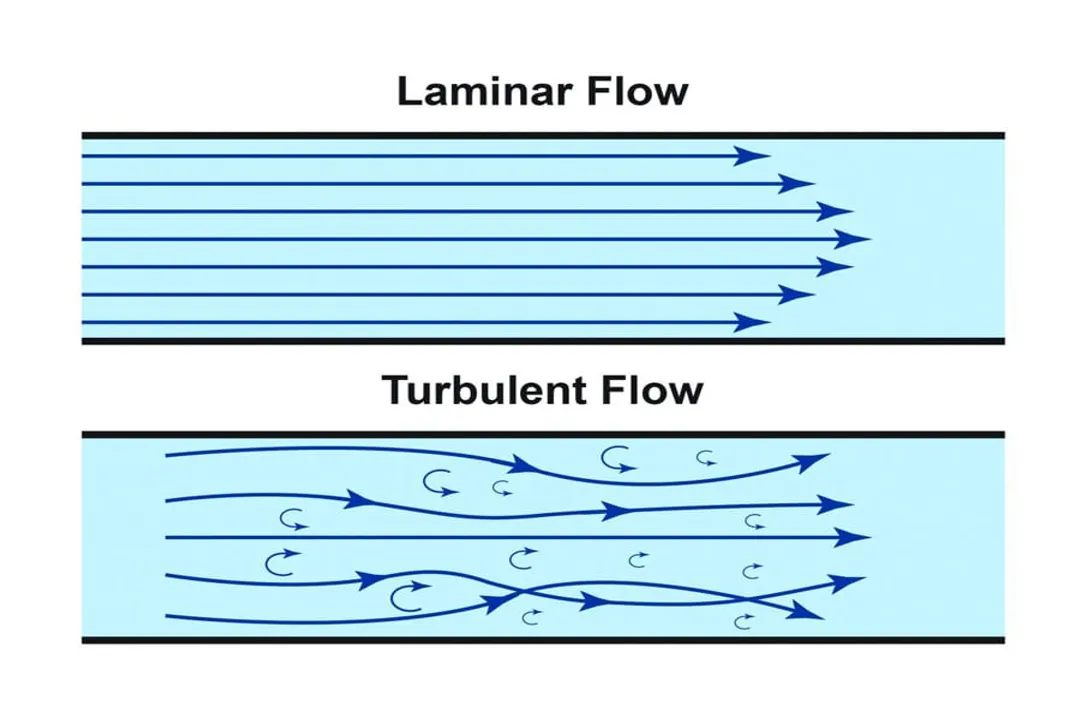
A common guideline for applications sensitive to turbulence is to allow a minimum pipe length of ten times the pipe diameter immediately upstream of the instrument to permit the flow profile to develop into a more organized state.
Related Questions
What is the fundamental characteristic distinguishing laminar flow from turbulent flow?How is the velocity profile typically described in a steady laminar flow condition?Under which fluid dynamic conditions is laminar flow typically observed?In engineering applications focused on maximizing heat transfer between a fluid and a surface, which flow regime is generally preferred?The Reynolds number ($ ext{Re}$) is fundamentally a ratio representing which two forces in fluid dynamics?What is a general consequence of turbulence within the boundary layer on moving objects like aircraft?Why is Direct Numerical Simulation (DNS) often computationally prohibitive for fully turbulent flows?To restore order to disturbed flow immediately upstream of a sensor sensitive to turbulence, what is a common guideline for straight pipe runs?Which flow behavior is explicitly listed as a subdivision of laminar flow characteristics?According to generally accepted ranges cited for pipe flow, which Reynolds number range defines the transitional flow regime?