Did a meteor bring life to Earth?

The concept that the raw materials for life on Earth might have originated in the cold darkness of space, rather than entirely within our planet’s primordial soup, remains one of science's most compelling and testable hypotheses. While the idea of fully formed organisms hitching a ride on a passing comet—classical panspermia—is highly speculative, modern research heavily suggests that meteorites and asteroids served as vital cosmic delivery trucks, ferrying the essential chemical components necessary for biology to begin its work. [3][4] These ancient celestial bodies were essentially time capsules, preserving organic molecules formed under conditions unavailable on early Earth, eventually depositing them onto our cooling world billions of years ago. [1][9]
The sheer volume of material bombarding the early Earth played a significant role in shaping its habitability. Water, perhaps the most critical solvent for known life, is strongly suspected to have been significantly supplemented by icy comets and water-rich asteroids. [2] This delivery mechanism bypasses the need for an extremely long period of abiogenesis—the natural creation of life from non-living matter—to occur solely within Earth's atmosphere and oceans, suggesting instead a cosmic head start for terrestrial biochemistry. [4]
# Impact Agents
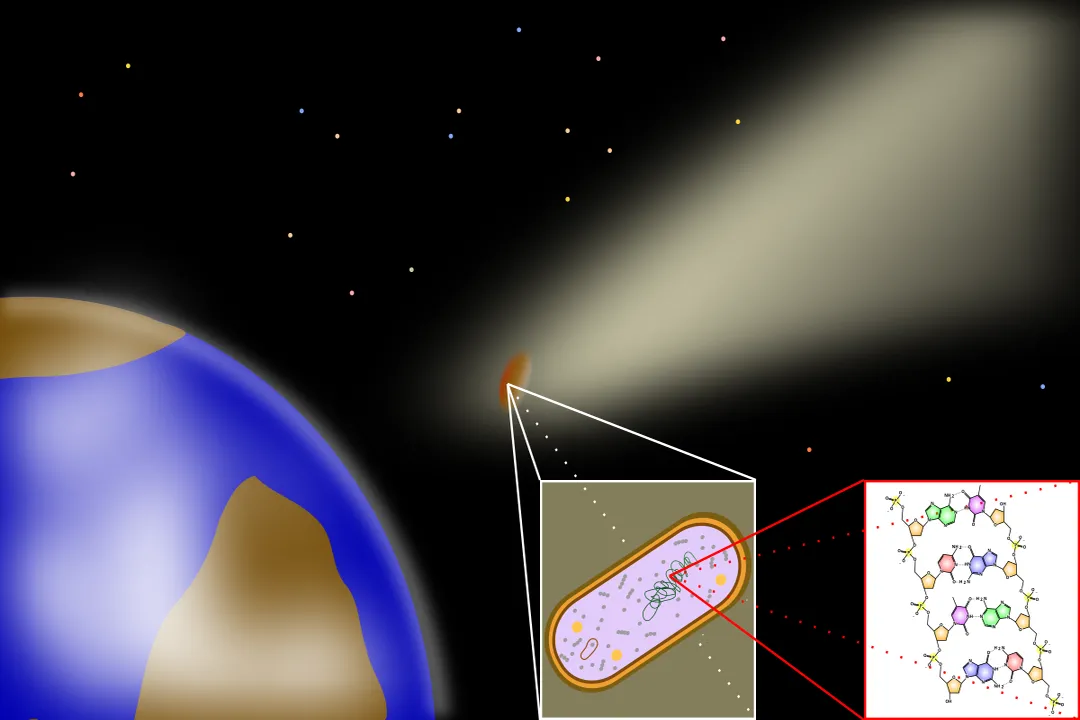
The main contenders for delivering these life-giving materials are comets and meteorites, which represent remnants from the solar system's formation period. [4] Comets, often characterized by their icy composition, and asteroids, which are generally rockier, both retained complex chemistry that was largely destroyed on the young, volcanically active Earth. [1][4]
When examining these impactors, scientists look for evidence of organic molecules. Asteroids, in particular, are recognized as carrying a blueprint that could have contributed to the initial stages of life on Earth. [1] The materials they carry are diverse, ranging from simple sugars and amino acids—the building blocks of proteins—to more complex nitrogen-containing compounds crucial for genetic material. [5][9] Think of the early solar system as a massive chemical laboratory where different temperature gradients caused different reactions; the materials formed in the colder outer regions, later encapsulated in comets and asteroids, represent a distinct chemical history compared to what formed closer to the Sun. [1]
# Nucleobase Delivery
One of the most striking pieces of evidence supporting cosmic delivery comes from the discovery of nucleobases in meteorites. [7] Nucleobases—adenine, guanine, cytosine, thymine, and uracil—are the fundamental nitrogenous bases that form the structure of DNA and RNA, the molecules that carry genetic instructions. [7] Finding precursors to these molecules, such as adenine, within meteorites like the Murchison meteorite, indicates that the chemical pathways required to build genetic code were operating outside of Earth long before life itself took hold here. [7]
This discovery shifts the narrative from asking if the building blocks were present on Earth to where they were first assembled. The presence of these complex organic compounds in extraterrestrial material suggests that the initial steps toward synthesizing the genetic machinery were already completed in space. [7] The delivery simply provided the necessary raw materials for Earth's emerging biological systems to assemble them into functional chains.
# S2 Impact
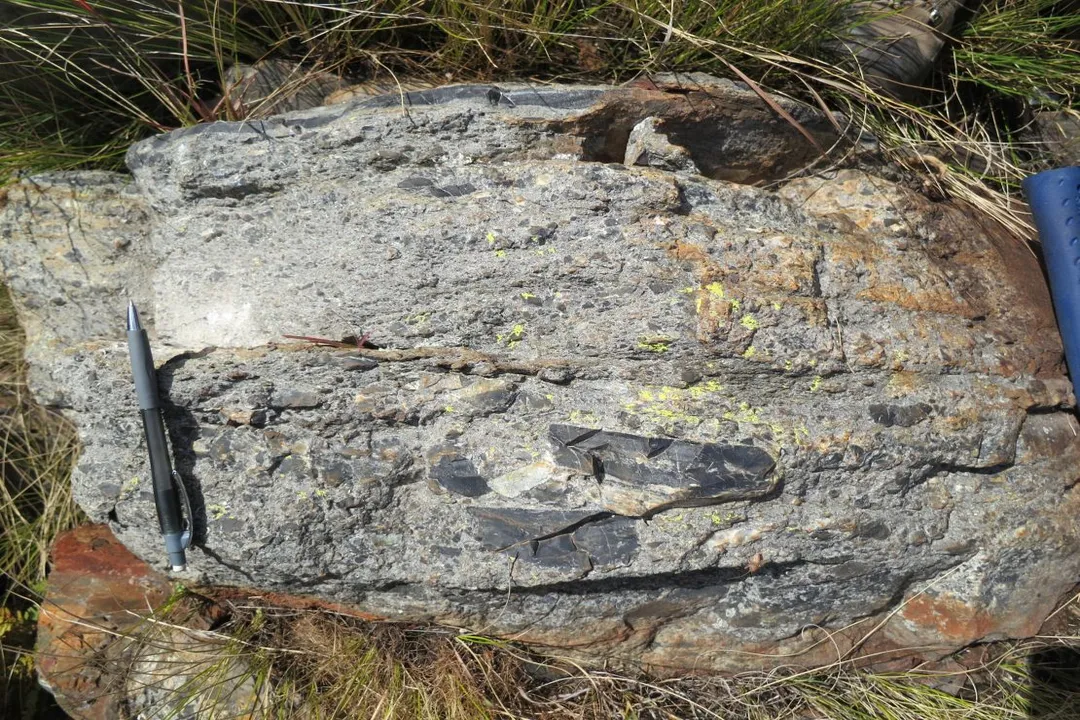
The influence of impacts extends beyond simply dropping off chemicals; the physical event itself may have created the right conditions for those chemicals to organize. The study concerning the ancient S2 meteorite offers a fascinating perspective on this dynamic interplay. [8] Researchers simulated the impact of the S2 meteorite on early Earth, finding that the resulting high-temperature, high-pressure environment could have actually promoted the formation of life-supporting structures. [5]
This research contrasts with the older view that massive impacts were purely destructive events that sterilized the planet. While impacts certainly caused mass extinctions later in Earth’s history, the early, specific conditions created by the S2-type impact—brief periods of high heat followed by cooling—may have acted as an incubator or a necessary energetic push for prebiotic chemistry to transition into biological activity. [5][8] It suggests a dual role for extraterrestrial material: providing the bricks (organic molecules) and providing the initial, high-energy construction site (the impact event itself). [1]
Here is a brief comparison of the hypothesized roles of major impactors:
| Impactor Type | Primary Composition | Proposed Contribution | Supporting Evidence Focus |
|---|---|---|---|
| Comets | Ice and Rock | Delivery of bulk water and volatile organics | Early Earth hydration [2] |
| Asteroids | Rock and Metal | Delivery of refractory organics and nucleobase precursors | Chemical complexity [1][7] |
| Specific Meteorites (e.g., S2) | Varied | Creation of high-energy, transient habitable zones | Impact-driven synthesis [5][8] |
What this tells us is that the nature of the impact matters immensely. A gentle drizzle of organic dust is one thing; a high-velocity, high-temperature impact is another, potentially acting as the catalyst that accelerates the otherwise slow chemical reactions needed for abiogenesis. [5]
# Ancient Idea
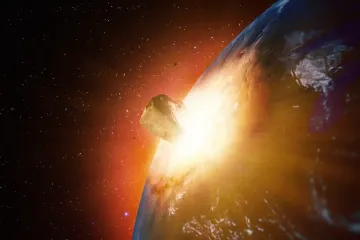
The core concept behind this theory is Panspermia, which posits that life or its precursors are distributed throughout the universe and can be transferred between celestial bodies. [3] While the term often conjures images of microbes encased in rock traveling for eons, modern scientific consensus often favors a gentler version, sometimes called exogenesis, focusing on the non-living chemical building blocks. [4] The historical context is important because thinkers have long suspected that the origins of life might not be strictly local, even if the final assembly occurred here. [3] The recent wealth of data from meteorite analysis lends significant observational weight to the delivery mechanism, even if the debate over the exact chemistry continues.
The challenge in proving this theory definitively lies in discerning what constitutes "life's ingredients" versus "life itself." A meteorite containing amino acids is strong evidence for exogenesis; a meteorite containing fossilized, self-replicating prokaryotes would confirm true, classical panspermia, a much higher bar to clear. [3] Currently, the evidence firmly supports the former. [7][9]
To place this into practical context, consider the timing. If the materials arrived too early, before Earth had formed a stable crust or retained an atmosphere, they would have simply vaporized upon entry or been blown away by intense early solar radiation. If they arrived too late, after the oceans formed and complex terrestrial biochemistry was already underway, they would simply have been incorporated into existing ecosystems without being the origin of the chemistry itself. [1] This suggests that there was a critical "window of delivery"—likely during the Late Heavy Bombardment period or shortly thereafter—when the planet was cool enough to retain surface water and organics, yet hot enough from impacts to drive necessary chemical reactions. [5] The chemistry arriving from space was perfectly timed to integrate with an Earth environment that was becoming hospitable, acting as a crucial bridge between inert planetary matter and burgeoning biology.
Another analytical point arises when comparing the energy required for molecular creation versus survival. Creating complex organic molecules like nucleobases requires specific energy inputs (UV radiation, thermal vents, or, as suggested, impact shockwaves). [1][7] If these components were synthesized entirely on Earth, the energy needed to sustain their creation over geological timescales, against the backdrop of an oxidizing or highly volatile atmosphere, might have been prohibitive. The fact that these molecules appear "pre-packaged" and protected within the matrix of a meteorite means that the energy expenditure occurred elsewhere, and Earth only needed to provide the liquid water environment for the final assembly and polymerization steps. [4][6] This effectively outsources the most energy-intensive and chemically precarious phase of early molecular evolution to the stability of space rocks.
In essence, the question evolves from Did a meteor bring life? to Did meteorites provide the essential, pre-assembled chemical instructions that allowed life to start on Earth sooner and more successfully than it otherwise could have? The accumulating evidence from contemporary chemical analysis of space debris strongly suggests the answer to the latter is a resounding yes. [1][6][9]
#Videos
Did we find microbial LIFE on an ASTEROID? - YouTube
Related Questions
#Citations
Could the Blueprint for Life Have Been Generated in Asteroids?
r/space - Earth was brought to life by ancient water-rich asteroids ...
Panspermia - Wikipedia
Life on early Earth could have been seeded by comets, meteorites
A giant, ancient meteorite may have helped life on Earth thrive
Asteroid discovery suggests ingredients for life on Earth came from ...
Meteorites could have brought DNA precursors to Earth
How a giant, ancient meteorite impact helped fledgling life on Earth
The key ingredients for life on Earth came from space, new evidence ...
Did we find microbial LIFE on an ASTEROID? - YouTube