Why does the sky appear blue instead of black?
The reason we see the sky as a brilliant expanse of blue during the day, rather than the inky blackness of outer space, hinges entirely on the composition of our atmosphere and the physics of light. When sunlight reaches Earth, it doesn't just travel straight through to our eyes; it interacts with the tiny particles floating around us. If Earth had no atmosphere, like the Moon, the sky would appear black even when the Sun was shining brightly, because there would be nothing present to redirect that light toward us. [5][9]
# Gas Molecules
The key components responsible for this daily light show are the gases that make up our atmosphere, predominantly nitrogen () and oxygen () molecules. [1][5][6] These individual molecules are incredibly small—far smaller than the wavelengths of visible light coming from the Sun. [6] This size relationship is critical to understanding the specific color we perceive. Sunlight, which appears white to us, is actually a composite of all the colors of the rainbow, each traveling as an electromagnetic wave with a different length. [1][6] Red light has a long wavelength, while blue and violet light have very short wavelengths. [1][5]
# Wavelength Dependency
When sunlight slams into these tiny atmospheric gas molecules, the light is scattered in all directions. This process is known scientifically as Rayleigh scattering. [1][5][6] What makes Rayleigh scattering so important is its strong dependency on wavelength: shorter wavelengths are scattered much more effectively than longer ones. [1][5] Specifically, the amount of scattering is inversely proportional to the fourth power of the wavelength ().
This mathematical relationship means that blue light, having a shorter wavelength, is scattered across the sky far more vigorously than red light. [1][5] Imagine the atmosphere acting like a sieve; it catches the short, quick blue waves and throws them everywhere, while the long, sluggish red waves mostly pass straight through unimpeded. Because this scattered blue light reaches our eyes from every direction above us, the entire overhead dome appears blue. [1][6] When you look directly at the Sun (which you should avoid doing), you are seeing the remaining, less-scattered, yellower light. [5]
# Eye Sensitivity
A natural follow-up question arises: If shorter wavelengths scatter more strongly, why isn't the sky violet, since violet light has an even shorter wavelength than blue? The answer involves both the Sun and our biology. [1][5] Firstly, the Sun does not emit all colors with equal intensity; the light spectrum radiating from the Sun contains slightly less violet light compared to blue light to begin with. [1][5] Secondly, and more importantly, the human eye is less sensitive to violet light. [1][5] Our visual system perceives the combination of scattered blue and violet light, plus the less-scattered green, as the distinct color we call "sky blue". [1]
To put this into perspective regarding the mechanics of scattering versus perception, consider the relative effectiveness of scattering for different colors by the air molecules:
| Color | Approximate Wavelength Range (nm) | Relative Scattering Intensity (Rayleigh) |
|---|---|---|
| Violet | 380–450 | Highest |
| Blue | 450–495 | Very High |
| Green | 495–570 | Moderate |
| Red | 620–750 | Lowest |
| [1][5] |
If our eyes were optimized for violet, the daytime sky would certainly have a distinctly purplish cast.
# Vacuum Contrast
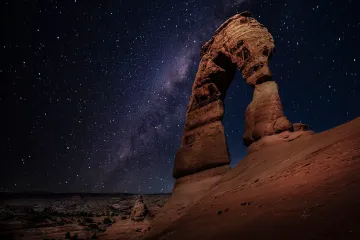
The contrast between the daytime sky and the blackness of space is one of the most profound illustrations of this physical principle. When we look up at the Moon from Earth, we see a dark sky because our atmosphere is gone, and there are no scattering particles to redirect the sunlight. [5] Astronauts floating above the atmosphere witness the Sun as an intensely bright disc set against an absolutely black backdrop, even when the Sun is visible to them. [5][9] The phenomenon we observe as a blue sky requires the presence of air; the darkness of space confirms the necessity of the medium for the scattering effect. [9]

# Angle Effect
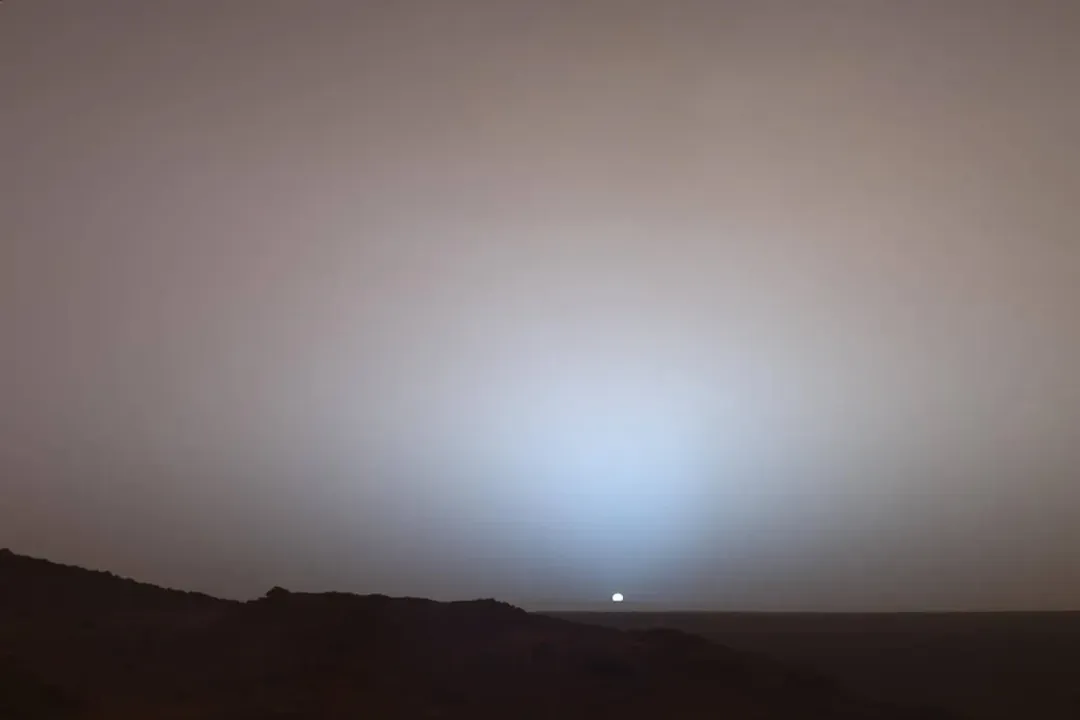
The sky’s color is not static; it dramatically shifts during sunrise and sunset. When the Sun is low on the horizon, its light must travel through a significantly greater thickness of the atmosphere to reach our eyes than when it is directly overhead. [1] This extended path means that nearly all of the short-wavelength blue and green light gets scattered away, often multiple times, far before the light beam reaches the observer. [5]
What remains dominant in the direct line of sight are the longer wavelengths—the oranges and reds—which scatter the least. [1] This is why the Sun and the clouds near the horizon take on warm, fiery hues at dawn and dusk. This principle also explains why the sky near the horizon during sunset can sometimes look pink or yellow, even as the overhead sky retains a deeper blue shade, illustrating a gradient of atmospheric path length across the visual field.
The size of the scattering particle is a major determinant of the resulting color. While the clear blue sky is a result of Rayleigh scattering (particles much smaller than the light's wavelength), the appearance of clouds or hazy skies points to a different process. When larger particles, such as water droplets or dust, are present, they cause Mie scattering. [6] Mie scattering is less dependent on wavelength, meaning it scatters all colors more or less equally. [6] When all colors are scattered equally, the resulting light mixture appears white—which is why clouds and hazy skies often look white or pale gray rather than intensely blue. [6] On a day with high humidity or dust, you might notice the blue is slightly muted or whiter than on a very crisp, dry day at high altitude, where the scattering is dominated purely by the tiny gas molecules. [1]
Consider the effect of altitude on the purity of the blue. If you were standing on a high mountain peak, you would be looking through less atmosphere overall than someone at sea level. While the air is thinner, the blue light that is scattered towards you has traveled a shorter, less obstructed path. This often results in a deeper, richer blue because there are fewer lower-atmospheric aerosols and water vapor particles present to induce some degree of Mie scattering and wash out the pure Rayleigh blue. [1] It’s a practical demonstration that the "cleaner" the air (fewer larger particles), the purer the blue dictated by Rayleigh physics.
In essence, the blue sky is a spectacular, everyday demonstration of wave physics in action. It is not inherent to the light itself, nor is it a property of empty space; it is a product of sunlight encountering the specific molecular architecture of Earth's gaseous blanket, filtered by the biology of our eyes. [1][5] The color we see is the scattered remainder, a constant signal that our protective atmosphere is doing its job, bending the incoming star power just enough to paint our world blue.
#Videos
Why Is the Sky Blue? - YouTube
#Citations
Why Is the Sky Blue? | NASA Space Place – NASA Science for Kids
Why is the sky blue? Do I understand it correctly: : r/askscience
Why Is the Sky Blue? - YouTube
Why is the sky blue on Earth, but black in space or on the Moon?
What causes the sky to appear blue if outer space is predominantly ...
Blue or black sky? | Causes of Color - Webexhibits
Why the Sky Appears Blue Due to Rayleigh Scattering - Facebook
Why is the sky blue? | Royal Observatory
Why does the sky change color? Why is the sky blue during the day ...