How big was the asteroid that made the Barringer crater?
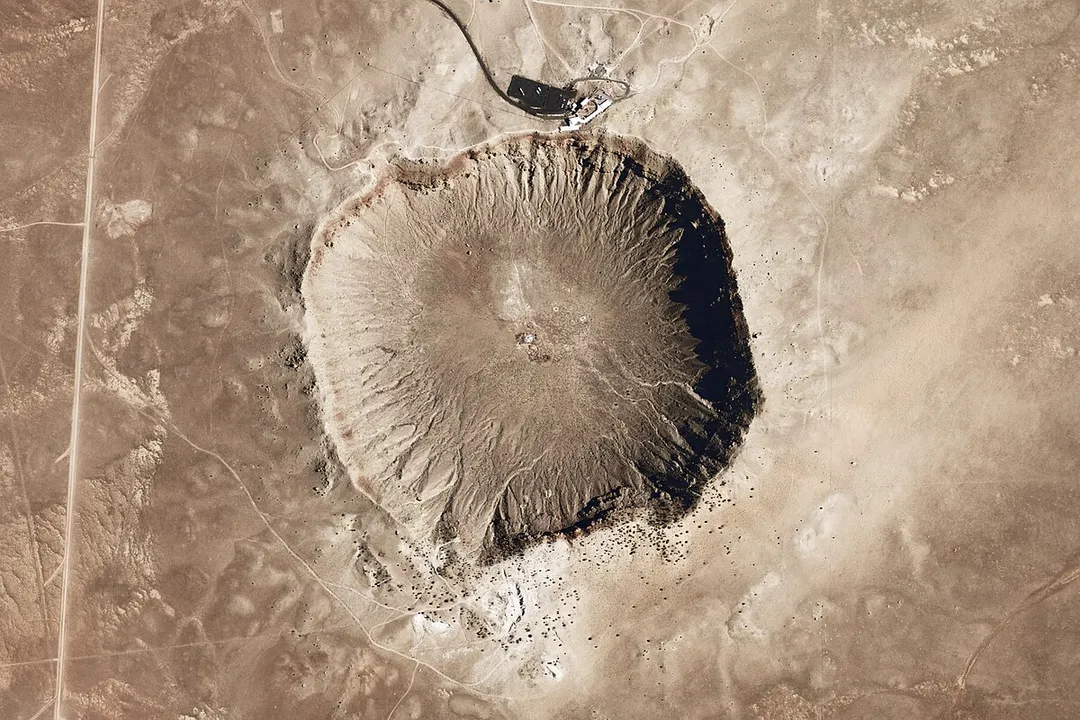
The asteroid that carved out the famous Barringer Crater, often simply called Meteor Crater in Arizona, was a significant chunk of iron, yet surprisingly small when viewed in the context of global extinction events. Estimates place its diameter at approximately 30 to 50 meters across, [1] or closely aligned with 50 meters [4] and 160 feet. [2] This object, a nickel-iron meteorite whose fragments are known as the Canyon Diablo Meteorite, struck the relatively cool and damp Colorado Plateau about 50,000 years ago. [1][2][4]
The resulting terrestrial scar is immense for an impactor of that scale. The event excavated an astonishing 175 million tons of rock, [1] leaving behind a crater nearly one mile wide [1]—specifically, 1.186 kilometers (0.737 miles) in diameter [2] or 1.19 km. [4] Its initial depth was estimated around 570 feet [1] or 560 feet (170 m), [2] with the rim rising about 148 feet (45 m) above the surrounding plains. [2][4] It is this combination of relatively young age, dry climate, and iron composition that has allowed the crater to remain the "best-preserved meteorite crater on Earth". [2][3]
# Impact Velocity Energy
To truly appreciate the scale of the damage, the sheer energy released is a more telling metric than size alone. The impact velocity has seen some revision over the decades of study. Initial modeling suggested the object struck at speeds as high as 45,000 mph (20 km/s). [2] However, more recent research indicates a substantially slower arrival, clocked around 29,000 mph (12.8 km/s) [2] or close to 30,000 mph (48,000 km/h). [4]
Regardless of the precise speed, the kinetic energy conversion was catastrophic on a local scale. The explosive force has been estimated at 10 megatons of TNT equivalent (), [2] or nearly 20 Megatons of TNT. [4] For context, this is comparable to the largest atmospheric nuclear weapon ever tested, though without the complicating factor of ionizing radiation. [1]
It’s noteworthy that even with this colossal blast, about half of the impactor's bulk is believed to have been vaporized during its atmospheric descent and subsequent impact. [2] This realization, confirmed by later findings of minerals like coesite and stishovite, was key to shifting scientific consensus away from earlier volcanic theories. Early investigators like Daniel M. Barringer, who passionately championed the impact origin, assumed the bulk of the meteorite remained buried, basing his multi-decade, fortune-draining search on an estimated mass of 10 million tons. [2] The later physics calculations, which suggested vaporization, pointed toward an impactor weighing as little as 300,000 tonnes, [2] a figure much closer to what is suggested by the 30-50 meter diameter iron asteroid estimate. This discrepancy highlights how profoundly early impact physics was misunderstood before the energy release was properly modeled against the known crater dimensions. [2]
# Geological Fingerprints
The immediate effects of the impact were devastating for the local environment, which at the time was an open grassland dotted with pinyon-juniper woodlands inhabited by fauna like mammoths and giant ground sloths. [1][4] The primary force wasn't the meteorite itself, but the shockwave.
# Blast Effects
The explosion created effects similar to a nuclear blast, though confined to a smaller radius. [1]
- Vaporization: The asteroid, bedrock, and any life at ground zero were instantly vaporized. [1]
- Shockwave Winds: Winds exceeding 1000 km/hr would have been present within 3 to 5 km of the impact point. [1] These winds would have stripped grass and flattened trees for a radial distance of about 14 to 19 km. [1]
- Injuries: Animals within a few kilometers would have been killed outright. Injuries from the shockwave itself—internal hemorrhaging and displacement—could extend out to 16 to 24 km. [1]
- Debris: Accelerated debris acted as shrapnel, causing wounds out to 10 to 13 km. [1]
- Thermal Emission: Intense heat may have caused burns on vegetation and animals up to about 10 km away, potentially starting fires, though direct evidence is lacking. [1]
The total area experiencing significant destruction of vegetation is estimated to be between 800 to 1500 , with lesser damage extending even further. [1] It is a stark illustration of localized planetary defense failure—an event small enough not to cause extinction, yet large enough to destroy a modern city. [1]
# Rock Rearrangement
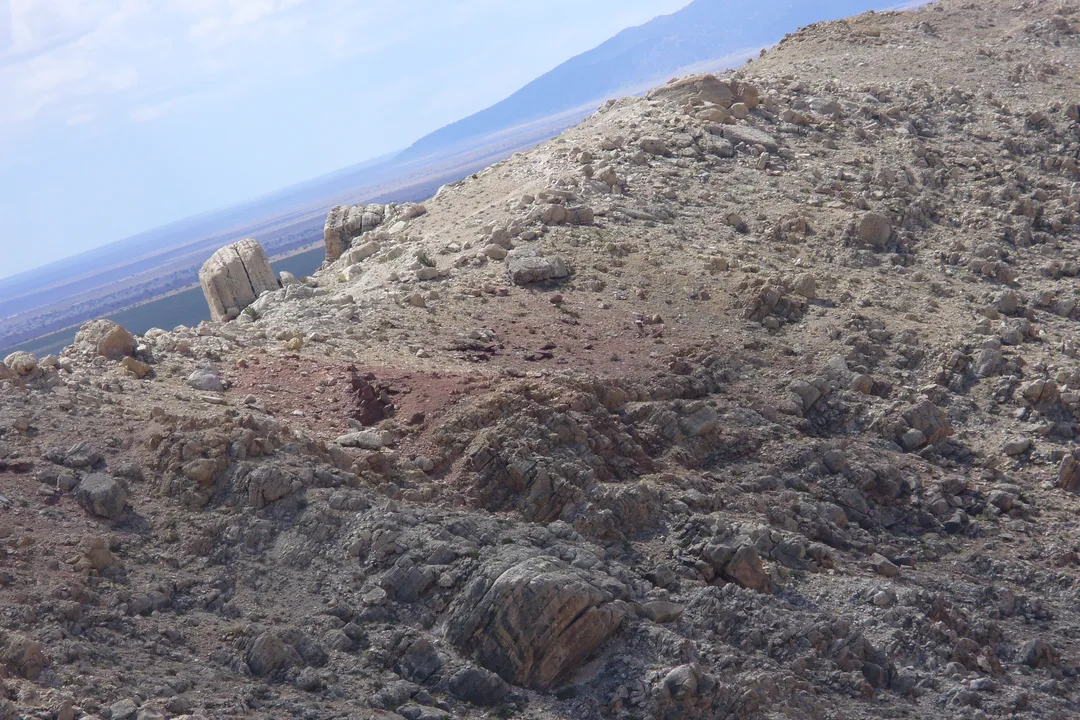
The impact literally turned the ground inside out, a feature now recognized as a signature of impact events. [4] The intense pressure instantly compressed and rearranged the layers of sedimentary rock that formed the target area. [2]
The normal sequence of rock layers in the region, from oldest (bottom) to youngest (top), involves:
- Coconino Sandstone (oldest, ~265 million years old) [2][4]
- Toroweap Formation [2][4]
- Kaibab Formation [2][4]
- Moenkopi Formation (youngest, ~240 million years old) [4]
At the crater's edge, this sequence is found in reverse order in the ejecta blanket or overturned flap, with the youngest rock lying on top of the oldest, pushed outward and upward. [2][4] This inverted stratigraphy extends for about 1 to 2 km from the rim. [1][4] The fact that this structure remains so clear, even after 50 millennia of erosion, is due to the low rate of geological activity in the area. [2]

# Scientific Confirmation
The history of proving the crater's origin is a mini-narrative of scientific persuasion. For a long time, scientists, including Grove Karl Gilbert of the USGS, proposed a volcanic steam explosion origin, noting the apparent lack of impactor mass. [2] Daniel M. Barringer, however, was convinced by the geology—especially the pulverized silica and uplifted rim—and spent his personal wealth trying to recover the iron meteorite. [2]
The ultimate scientific proof arrived much later, through detecting the tell-tale signs of hyper-velocity shock metamorphism. The key discoveries were:
- Impactite/Spherules: Harvey Nininger discovered iron-nickel spherules—melted remnants of the impactor mixed with target rock—around the site. [2]
- High-Pressure Minerals: In the 1960s, Eugene Shoemaker and others found coesite and stishovite within the shocked quartz of the Coconino Sandstone. [2][4] These silica polymorphs can only form under the extreme, instantaneous pressures generated by an impact (or a nuclear blast). [2][4] The subsequent comparison of the crater's structure to nuclear test craters in Nevada provided the final, convincing evidence. [4]
# Sizing Up the Iron Impactor
While the size range is the standard derived from modern modeling, it’s fascinating to consider the density of the material. Being a nickel-iron meteorite (a coarse octahedrite), [4] it was significantly denser than a typical stony asteroid or comet fragment.
If we take a mid-range figure of in diameter for a sphere, and assume a density typical for an octahedrite (around or ), [1] we can estimate a mass to compare with the historical guesses:
This calculated mass of approximately 261,000 tonnes aligns remarkably well with the lower estimate of 300,000 tonnes suggested by F.R. Moulton's physics report, which preceded the vaporization realization. [2] Barringer's initial guess of 10 million tons [2] indicates he was likely overestimating the size or assuming a lower density for the projectile. The sheer mass of the vaporized component is difficult to overstate—a quarter of a billion kilograms of metal and rock instantly turned into superheated gas and plasma.
| Parameter | Estimated Value | Supporting Source Data |
|---|---|---|
| Impactor Diameter | () | , , [1][2][4] |
| Impact Age | , , [1][2][4] | |
| Crater Diameter | , [2][4] | |
| Excavated Rock Mass | [1] | |
| Impact Energy | () | [2] |
| Impactor Composition | Nickel-Iron ( type) | , [2][4] |
# Visitor Context and Scale Perception
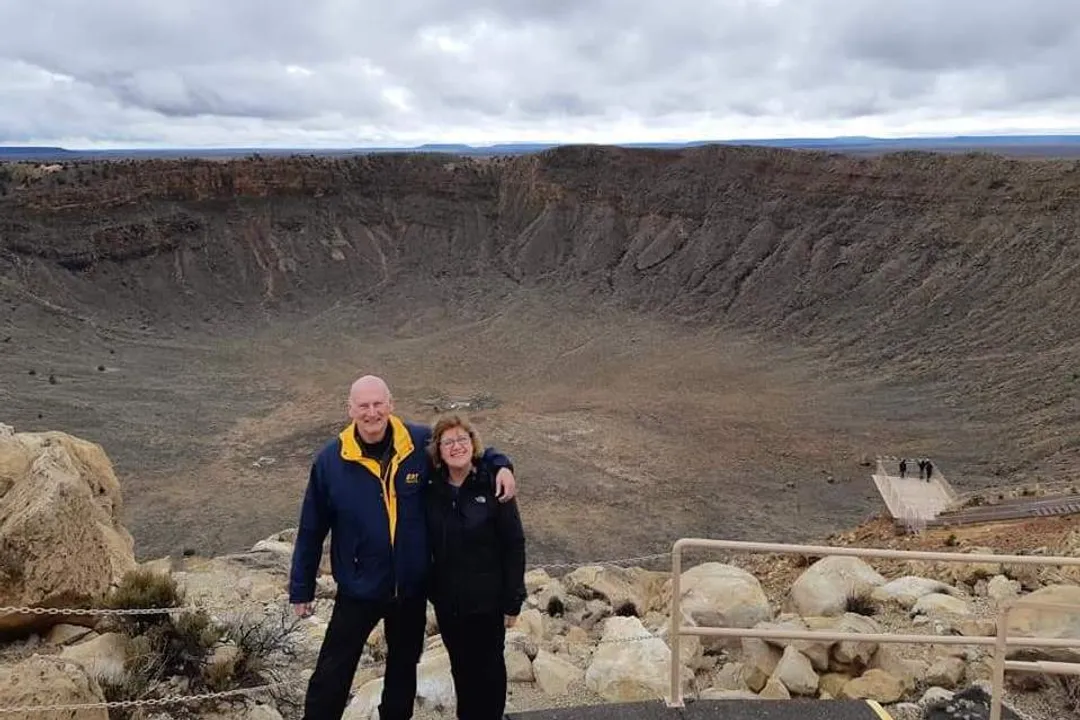
For a modern visitor standing on the rim today, the preservation of scale is immediate. The Visitor Center, which often displays meteorite specimens like the Holsinger fragment, [3] helps ground the abstract numbers in physical reality. [3] Even the largest recovered piece is a mere fraction of the original mass. [2]
When you observe the crater, notice its unusual squared-off outline. [1][4] This is not typical for an impact but is attributed to the existing regional jointing or cracks in the sedimentary rock strata at the impact site, which dictated how the ground fractured and rebounded during the impact. [1][4] This local geological context, coupled with the dry climate, is what makes the site an internationally recognized Geoheritage Site. The preservation is so good that NASA used it as a primary training ground for Apollo astronauts preparing to walk on the Moon. [2][3]
One interesting failure scenario that emphasizes the scale is the 1964 Cessna crash. Two pilots attempted to fly low over the crater and, upon crossing the rim, could not maintain level flight due to the dense, rising air layer within the bowl. [2][4] The pilot tried to circle inside to gain altitude to clear the rim, stalled, and crashed, although both occupants survived the subsequent fire. [2][4] This incident, happening on a calm day, demonstrates the physical monumentality of the hole—it creates its own localized weather phenomenon (a cold-air pool) and presents a physical barrier that even a small aircraft can fatally underestimate, underscoring the drop-off and steep rim walls. [1][2]
#Citations
Meteor Crater - Wikipedia
Meteor Crater: A Must-See Natural Wonder | Top Things to Do in ...
Barringer Meteor Crater and Its Environmental Effects
BARRINGER IMPACT CRATER