What is the typical mass range of the progenitor star that forms a pulsar?
Answer
Eight to twenty times the mass of our Sun
A pulsar is fundamentally a type of neutron star, which is born from the supernova explosion of a star whose initial mass was between roughly eight and twenty times the mass of the Sun.
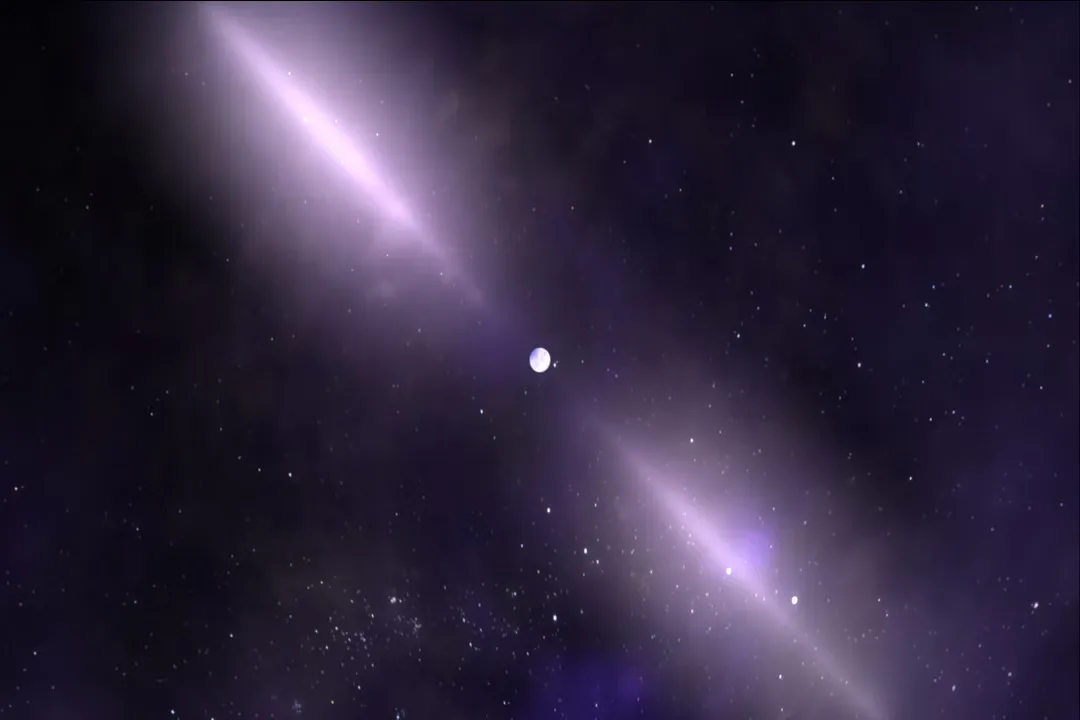
#Videos
How Do Pulsars Create Their Regular Radio Pulses? - YouTube
Related Questions
What does the term 'pulsar' represent as a portmanteau?What is the typical mass range of the progenitor star that forms a pulsar?What physical principle explains the extreme increase in rotation speed during the stellar collapse that forms a pulsar?What drives the energy source for the continuous emission observed from a pulsar?What is the consequence of the outward streaming of charged particles on a pulsar's rotation over millions of years?Which feature of the magnetic field relative to the rotation axis is responsible for the observed pulsing or lighthouse effect?What specific process enables radio pulsars to produce intense, sharp pulses detectable over vast interstellar distances?What astronomical discoveries can be indicated by timing deviations, or small variations in the pulse period?What term describes the small, abrupt speeding-up of a pulsar's rotation detected by an advance in pulse arrival time?What measurement is used to quantify the delay experienced by lower-frequency radio waves due to interstellar electrons, which aids in calculating distance?According to some emission models, where might the radiation generation region be located relative to the star's rotational dynamics?