How do pulsars emit regular signals?
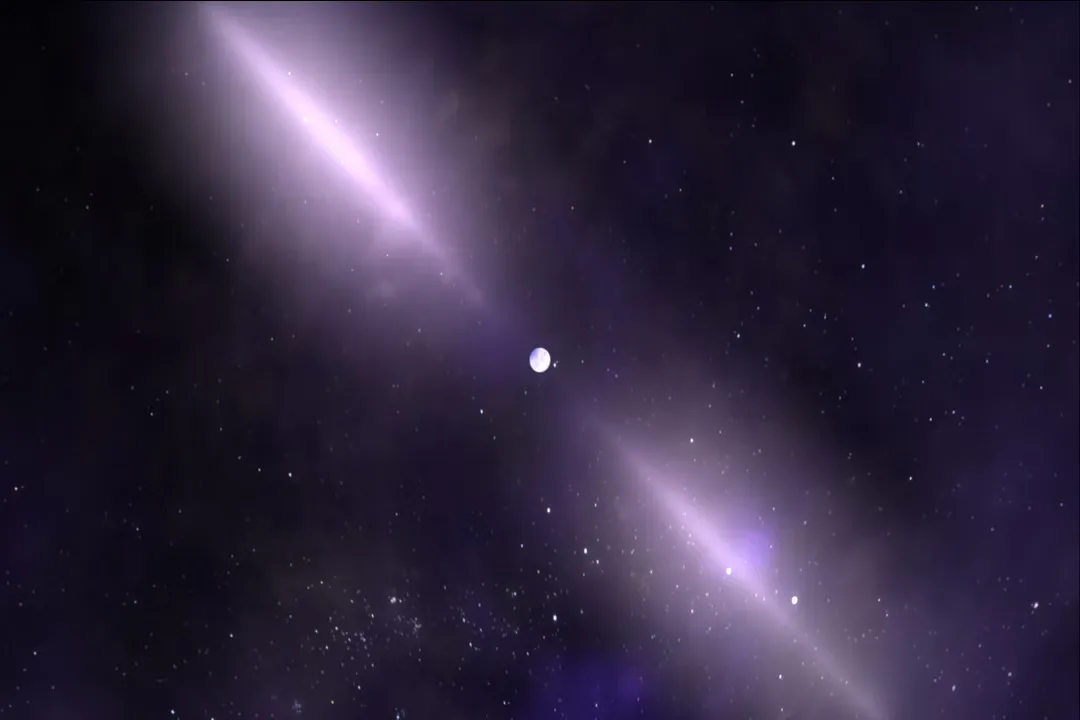
The ticking regularity that astronomers observe from pulsars is one of the cosmos' most precise natural clocks. These enigmatic celestial objects appear to flash on and off with astonishing consistency, leading to their name—a portmanteau of "pulsating radio source". [2] Far from being distant lighthouses blinking due to internal mechanics, a pulsar is actually an extraordinarily dense, rapidly spinning remnant of a massive star that has exhausted its nuclear fuel and undergone gravitational collapse. [7] The regularity we perceive is a direct consequence of this extreme physical state combined with the geometry of its radiation emission. [3]
# Stellar Endpoints
A pulsar is fundamentally a type of neutron star, an object born from the catastrophic supernova explosion of a star roughly eight to twenty times the mass of our Sun. [7] When the core of such a giant star collapses under its own gravity, the pressure is so immense that protons and electrons are squeezed together to form neutrons. [7] This leaves behind an incredibly compact object, typically having a mass greater than the Sun compressed into a sphere only about 10 to 20 kilometers across. [2]
This collapse also has a dramatic effect on the star's magnetic field and its spin rate due to the conservation of angular momentum. Imagine a spinning ice skater pulling their arms in; they spin much faster. [7] A star rotating perhaps once per month can be compressed to the size of a city, causing its rotation speed to increase to many times per second. [7] Simultaneously, the magnetic field, which was already present, becomes incredibly concentrated, resulting in fields trillions of times stronger than the Earth's magnetic field. [2] It is the interplay between this intense magnetism and rapid rotation that dictates the pulsar's distinctive emission pattern. [1][8]
# Field Generation
The immense magnetic field of a neutron star is the key driver behind the detectable signals, whether they are radio waves, X-rays, or gamma rays. [6][8] This field is typically aligned with, or close to, the star's rotation axis, much like Earth’s magnetic poles are near its geographic poles. [3] However, in pulsars, this alignment is rarely perfect; the magnetic axis is usually tilted relative to the rotation axis. [3] This misalignment is crucial for creating the observed beams. [1]
The magnetosphere surrounding the star becomes filled with plasma—charged particles—stripped from the surface or remnants of the progenitor star. [6] These particles are forced to travel along the powerful magnetic field lines emanating from the magnetic poles. [1][8]
One of the long-standing mysteries involved how these particles were accelerated to such high energies to produce detectable radiation in the first place. [6] While earlier theories were complex, contemporary understanding suggests that the staggering potential difference created between the magnetic poles and the magnetic equator drives an enormous voltage, perhaps reaching volts. [6] This powerful electric field strips electrons from the surface and accelerates them outwards along the field lines in beams extending far into space. [6][8]
A particularly insightful analysis reveals that the energy source for this continuous emission is not a steady power supply, but rather the rotational kinetic energy of the star itself. [3] As the charged particles are forced to stream outward, they effectively act as a brake on the star's spin, causing the pulse period to gradually lengthen over millions of years. [3]
# Radiation Beams
The radiation from a pulsar is not emitted in a steady sphere around the star; rather, it is focused into narrow, intense beams emanating from the vicinity of the magnetic poles. [1][8] Think of it as light shining from a flashlight, not a bare lightbulb. [1]
The exact mechanism that generates the light within these beams is complex, but it involves relativistic effects due to the speed of the particles and the incredibly strong magnetic field. [6] In the vicinity of the magnetic poles, charged particles are accelerated to near the speed of light along the magnetic field lines. [1][8] This intense flow of high-energy particles generates electromagnetic radiation, predominantly in the radio spectrum for many pulsars, although some emit in X-rays or visible light. [1][2]
Different emission models exist to explain where in the magnetosphere this radiation originates. Some theories place the emission region near the stellar surface, perhaps a few hundred kilometers up, while others suggest the radiation originates much further out, perhaps near the light cylinder—the boundary where the speed required to remain co-rotating with the star would equal the speed of light. [3] The actual location of the emission site can influence the characteristics and profile of the observed pulses. [3]
For radio pulsars specifically, the coherent emission process is necessary to produce the sharp, intense pulses we detect. If the radiation were merely incoherent thermal emission, the signal would be far too weak to observe across interstellar distances. [1] The coherent emission means the particles in the beam are organized, vibrating or gyrating in unison, leading to a signal amplified far beyond what random motion would permit. [1]
If you were to observe a pulsar from a position where its beam passes directly over your telescope, you would detect a sharp pulse. [2] If your telescope happened to be positioned directly in the beam path for an entire rotating sweep, you would receive a continuous signal, though this is rare. [2]
# Lighthouses Timing
The spectacular regularity—the pulsing aspect—arises because the magnetic axis is usually tilted relative to the rotation axis. [3] As the neutron star spins, these two focused beams sweep across the sky. [2] When one of these beams crosses Earth's line of sight, we observe a flash, or pulse. [2][3] This is the famous lighthouse effect. [2]
The period between these pulses, known as the pulse period, is the rotation period of the neutron star itself. [2] For millisecond pulsars, this period can be incredibly short, rotating hundreds of times every second. [2] The short, precise pulses allowed early observers like Jocelyn Bell Burnell and Antony Hewish to realize they were measuring the rotation of a compact object, not some artificial signal. [7]
The timing precision of these signals is frequently superior to the best atomic clocks on Earth. This characteristic makes them invaluable tools for astrophysics. [3] For instance, timing deviations—small variations in the pulse period—can reveal the presence of orbiting exoplanets in systems where a pulsar is actively spinning, or even indicate gravitational waves passing between us and the pulsar. [3]
It is interesting to note the difference between pulsars observed in radio versus those detected in other wavelengths, like X-rays or visible light. While a single pulsar can emit across the entire electromagnetic spectrum, the alignment of the optical beam versus the radio beam might differ slightly depending on the underlying physics driving the emission at that specific energy level. [6] A pulsar might be perfectly aligned for us to see its radio beam, but its X-ray beam might point elsewhere in space, meaning we only detect the radio pulses, or vice versa. [6]
| Pulsar Type | Typical Period Range | Characteristic | Primary Use in Astronomy |
|---|---|---|---|
| Normal Radio Pulsar | Milliseconds to seconds | Gradual spin-down | Testing stellar evolution theories |
| Millisecond Pulsar (MSP) | Below 10 milliseconds | Extremely fast rotation, recycled via accretion | Gravitational wave detection |
| Magnetar | Seconds to tens of seconds | Exceptionally strong magnetic fields | Studying extreme magnetic field physics |
When considering the stability of the signal, it is important to recognize that the period of the pulse changes predictably, following a spin-down law. [3] This means the rotation is slowing down, causing the pulses to arrive slightly later each day. [3] However, abrupt, tiny changes in the period, known as glitches, do occur. [3] These glitches are often attributed to sudden internal adjustments within the superfluid interior of the neutron star, perhaps involving the sudden unpinning of vortices in the neutron superfluid. [3] A glitch is essentially a minuscule, sudden speeding-up of the rotation, which we immediately detect as a slight advance in the expected pulse arrival time. [3]

# Signal Detection
The process of detecting these signals requires highly sensitive instruments, particularly for radio pulsars, as the energy reaching Earth is spread across vast distances and a very narrow beam. [1] Radio telescopes collect these faint signals over long integration times to pull the repetitive pulse pattern out from the background noise of the universe. [1]
When the signal is received, the timing analysis begins. Astronomers look for the Dispersion Measure (DM), which is a measure of how much the signal has been delayed by the free electrons in the interstellar medium between the pulsar and Earth. [3] Lower-frequency radio waves travel slightly slower than higher-frequency waves because they interact more with this intervening plasma. [3] By measuring this frequency-dependent delay, scientists can not only clean up the arrival time but also estimate the distance to the pulsar. [3]
If one were to map the pulse profile—the shape of the signal intensity versus time within a single rotation—it often shows one or two distinct peaks. [2] This profile remains remarkably consistent from pulse to pulse for stable pulsars, reinforcing the idea that the emission source is fixed relative to the star's magnetic poles. [2] This consistency is what allows us to use them as clocks, far more reliable for long-term measurements than terrestrial devices, even considering the occasional glitch. [3]
It's a fun thought experiment to realize that if a pulsar with a 10-millisecond period were located just 100 light-years away, its signal would still be incredibly faint, yet detectable by modern radio arrays, highlighting the sheer power packed into that focused beam. [1] The energy output, while tiny when averaged over the entire sphere of emission, is concentrated so effectively that it slices through the intervening space like a laser pointer, rather than a simple lightbulb. [1] The physics driving this coherent emission remains an active area of research, linking plasma physics, general relativity, and extreme electromagnetic environments. The successful modeling of the radio beam’s structure and its relationship to the magnetosphere remains a triumph of modern astrophysics, allowing us to peer into the engines of these collapsed stars. [6][8]
#Videos
How Do Pulsars Create Their Regular Radio Pulses? - YouTube
Related Questions
#Citations
What produces the radio waves from a pulsar, and why do they form ...
Pulsar - Wikipedia
Chapter 6 Pulsars
How does a pulsar emit light? : r/Astronomy - Reddit
How Do Pulsars Create Their Regular Radio Pulses? - YouTube
Why Pulsars Shine Bright: A Half-Century-Old Mystery Solved
Pulsars and the Discovery of Neutron Stars | Astronomy
Physicists Explain Pulsars' Radio Beams, And It's Still Not Aliens
On the nature of pulsar radio emission - Oxford Academic