Do satellites reflect or emit light?
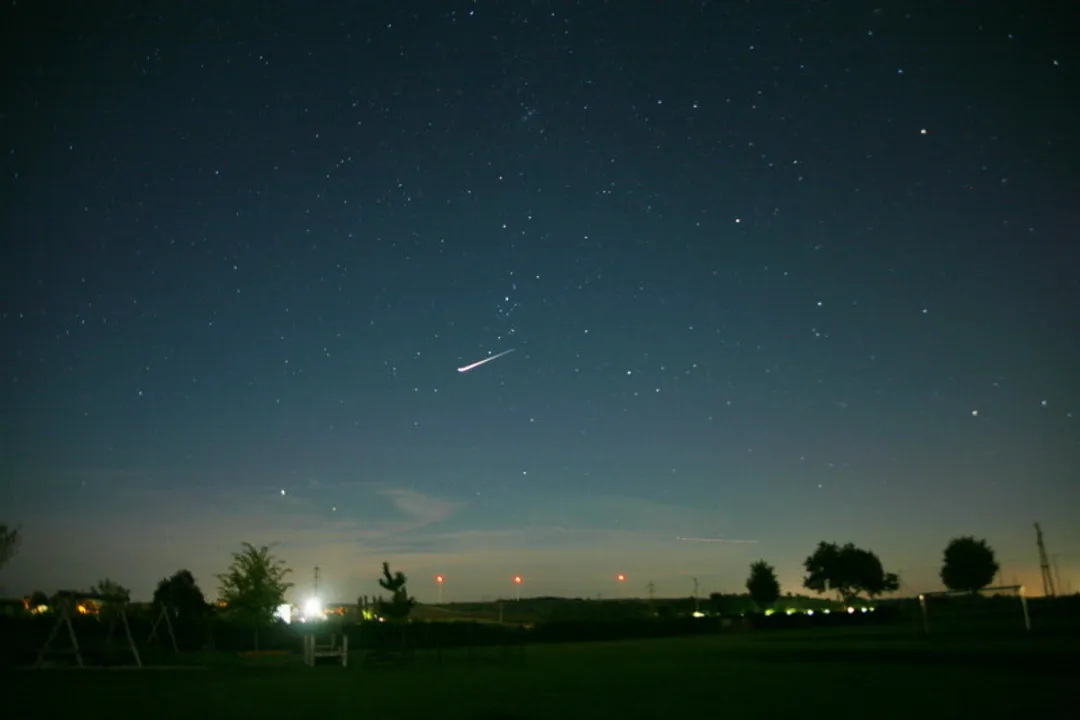
Observing the night sky reveals occasional streaks of light that move steadily across the darkness, distinct from meteors or aircraft. This visibility immediately prompts a fundamental question about these objects orbiting Earth: are we seeing light that the satellites produce themselves, or are they simply acting like tiny, fast-moving mirrors reflecting light from a source we cannot see directly? The answer, for the vast majority of cases, leans heavily toward reflection. [3]
Satellites, whether mapping the weather, relaying communications, or observing distant galaxies, do not typically operate like terrestrial lighthouses beaming signals across the globe for us to see with the naked eye. Instead, their visibility is almost entirely dependent on their position relative to the Sun, even when the ground observer is experiencing night. [7][8] This phenomenon is fundamentally about geometry and illumination.
# Reflection Dominates

The reason we perceive satellites passing overhead after sunset or before sunrise is that they are still high enough in their orbits to catch direct sunlight. [7][3] When you look up and see a bright object traversing the sky, it is almost always the Sun’s rays bouncing off the satellite’s structure—its solar panels, metallic body, or antenna dishes—and traveling to your eye. [6][2]
This is comparable to seeing an airplane at very high altitude just after the Sun has dipped below your local horizon. The ground is dark, but the plane is high enough to still be bathed in sunshine, reflecting that light toward you. [3] Satellites in Low Earth Orbit (LEO) or Medium Earth Orbit (MEO) remain illuminated by the Sun long after twilight has settled in specific regions. [8]
The brightness of a satellite is a direct function of the Sun’s angle and the satellite's reflective properties, or albedo. [5] A large, flat surface oriented perfectly toward the observer and the Sun can create a surprisingly bright spectacle. The newer generations of large constellations, such as Starlink, have drawn significant attention precisely because their sheer number and the reflective nature of their bodies, particularly their large solar arrays, cause noticeable light paths in the night sky. [5][6] These satellites shine because the Sun is illuminating them while the observer is in shadow. [7]
Here is a comparison showing the primary mechanism for visibility:
| Visibility Mechanism | Primary Cause | Typical Intensity | Observer Condition |
|---|---|---|---|
| Reflection | Sunlight bouncing off the structure | Can range from barely visible to extremely bright (flares) | Observer is in darkness |
| Emission | Onboard devices actively producing light | Usually faint, specific to device function | Can occur day or night, dependent on operational mode |
It’s important to grasp the scale difference. Sunlight, even when diffused by distance, is immensely powerful compared to the tiny LEDs or navigation lights a satellite might employ. For instance, a satellite designed primarily for Earth observation or communication, even if fitted with tiny status lights, will almost always be dominated visually by reflected sunlight when the geometry is right. [1][3]
# Flares Spectacular
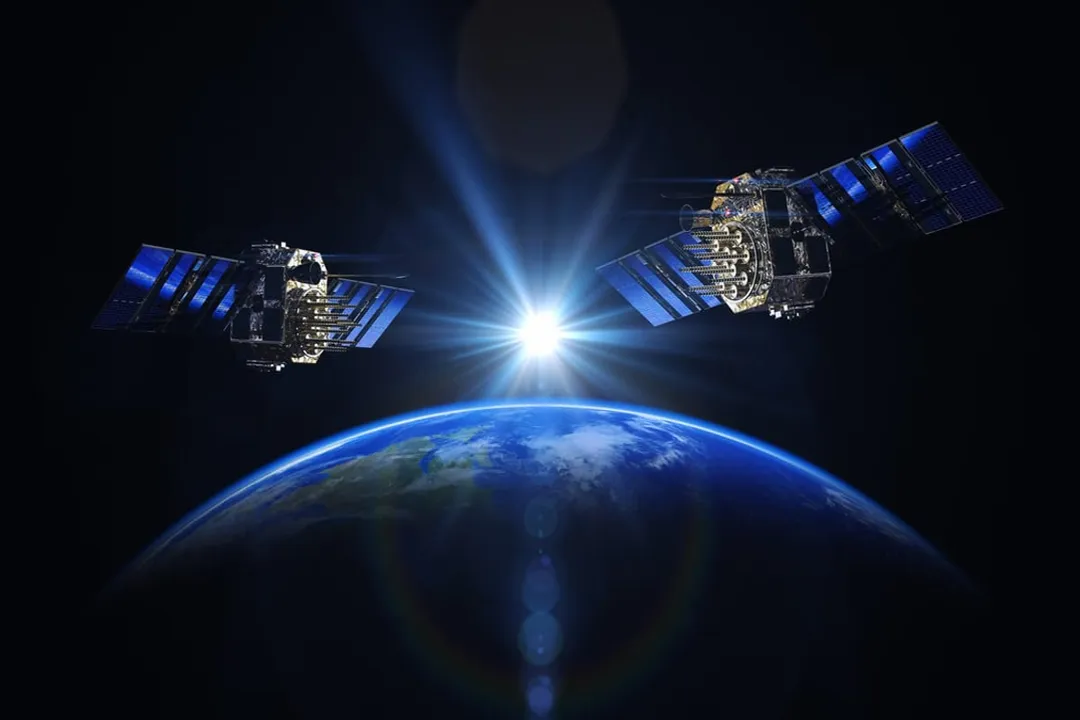
When the geometry between the Sun, the satellite, and the observer aligns just right, the reflected light phenomenon transforms from a gentle glow into an intense, brief flash known as a satellite flare. [2] These events are responsible for the brief, brilliant streaks sometimes mistaken for unidentified aerial phenomena. [2]
The specific term for a very bright, predictable reflection event, often associated with Iridium satellites before they were decommissioned or specific orientations of newer constellations, is a satellite flare. [2] Flares occur when a smooth, flat surface on the spacecraft, like a large antenna or a solar panel, acts like a perfect mirror, sending a concentrated beam of sunlight directly toward the ground observer. [2][5] A flare can, for a few seconds, outshine even the brightest stars and planets visible at that moment. [2]
When discussing the reflectivity of these objects, we must remember that the materials chosen are often functional—solar panels must absorb light, and thermal blankets must manage heat—but the resulting surface finish, especially when oriented correctly, acts as an unintended reflector. [5][8] This is a critical point for astronomers; the reflected sunlight, however brief, can interfere with sensitive observations, creating streaks across telescopic images. [6][4] While some newer satellite designs attempt to mitigate this by using darker materials or non-flat surfaces, the fundamental physics of illumination remains. [5]
# Onboard Sources
While reflection is the primary reason satellites are visible to the unaided eye in the dark, satellites do sometimes emit light. However, this emitted light is usually functional rather than intended for broad public viewing. [1]
Operational lighting serves several purposes. Some satellites are equipped with lights for attitude control or collision avoidance, making them visible to other spacecraft or aircraft, especially those operating in low-light conditions or during docking maneuvers. [1] Furthermore, instrumentation might require internal lighting that could leak slightly, or they might use specific beacon lights for ground tracking or communication verification. [1]
If you are tracking a satellite and it suddenly turns on a very faint, steady light source while crossing a dark patch of sky where reflected sunlight is impossible (i.e., deep in Earth's shadow), you are likely seeing an emitted signal. [3] Yet, these emitted signals are generally much dimmer than the reflected midday-like brilliance seen during a perfect solar reflection event. [3]
It is interesting to consider the extreme end of intentional light emission. There have been concepts proposed, such as a startup aiming to deliver "sunlight on demand" after dark, which involves complex orbital mechanics to bounce or redirect sunlight. [9] While this proposal focuses on redirecting reflected light via mirrors rather than the satellite itself producing light, it underscores how much energy is available in sunlight and how much human ingenuity is applied to manipulating it, whether intentionally or as a side effect of orbiting technology. [9]
# Visibility Context
Understanding when a satellite is visible is key to discerning reflection from emission. The viewing window for reflected sunlight is quite narrow: it occurs only when the satellite is high enough to see the Sun, but the observer is not. [7][3] This generally means looking within about an hour or two after sunset or before sunrise. [3] During the middle of the night, once the satellite has orbited past the point where it catches the Sun’s rays, it effectively disappears because its onboard lights, if present, are too weak to notice against the backdrop of space.
This reliance on the Sun’s position allows sky-watchers to predict visibility with precision. If you know the orbital path and altitude of a satellite, you can calculate the precise moment the Sun will cross the plane separating the Earth’s shadow from the sunlit upper atmosphere. A practical tip for ground observers is to note that if a satellite’s visibility begins or ends abruptly with a massive flare, it signifies crossing that specific illumination boundary where its angle to the Sun changed drastically, switching from non-reflective shadow to full solar exposure, or vice versa. This is a signature of reflected light rather than an intentional on/off switch.
The astronomical community has long tracked these reflections due to their impact on sensitive instruments. [4] While the early, bright Iridium flares were a concern, the ongoing deployment of massive constellations presents a new challenge where the sheer volume of reflected light can create streaks across long-exposure photographs, potentially hindering scientific discovery if not accounted for. [4][6] In essence, the "shining" of these objects is a testament to the raw, unblocked power of the Sun hitting metallic and mirrored surfaces high above the atmosphere, a clear demonstration of reflected energy rather than internal power generation. [8]
#Citations
Question: why do satellites need to have lights? I've heard that future ...
Satellite flare - Wikipedia
How do we see satellites at night? Is it the sun reflecting off them ...
Astronomers are worried by a satellite brighter than most stars - Nature
How do the Starlink satellites shine?
Light from satellites will photobomb many space telescope images ...
Illumination of satellites. Satellites are only visible when the Sun...
Earth from Orbit: Satellites and Solar Energy | NESDIS - NOAA
A US start-up plans to deliver 'sunlight on demand' after dark. Can it ...