Are we all made out of stars?

The statement that we are made of star stuff is more than just poetic; it is literally true based on our current understanding of cosmic composition. [2][6] Every single element required to build the complex structures of a living being—from the nitrogen in your DNA to the calcium in your teeth—was forged in the nuclear furnaces of stars that lived and died long before our Sun ever formed. [6][7] We are, quite literally, the recycled ashes of ancient, massive celestial bodies.
# Primordial Elements
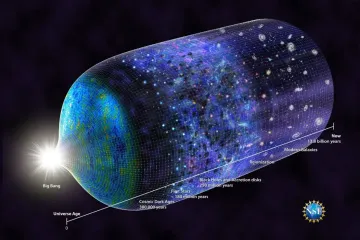
To understand the stellar contribution, we must start at the beginning: the Big Bang, which occurred nearly fourteen billion years ago. [3][7] When the universe was incredibly hot and dense, it expanded and cooled just enough, within the first few minutes, for the very first, simplest atoms to form. This process, known as Big Bang nucleosynthesis, yielded almost exclusively Hydrogen (H), most of the Helium (He) found today, and only trace amounts of Lithium (Li). [5][7]
This means that the foundation of all matter was set in place by the universe’s birth, but this elemental inventory was limited. The universe was a vast sea of gas, but it lacked the building blocks—the heavier elements—necessary for rocky planets and complex life. [4]
# Stellar Forges
For elements beyond the very lightest, intense cosmic alchemy was required, and that happens only inside stars. [6] Gravity pulls hydrogen and helium gas clouds together, igniting nuclear fusion in the core and birthing the first generation of stars. [4][5]
Within a star's core, hydrogen atoms are fused together, releasing energy and creating helium. As the star ages and its fuel changes, the temperature and pressure increase, allowing for the creation of progressively heavier elements. [3][7] Stars like our Sun primarily fuse lighter elements into medium-weight ones, such as Carbon (C) and Oxygen (O), the two elements that account for roughly 84% of our body mass. [5] Fusion continues through various stages until the core creates Iron (Fe). [3][7]
The physics here dictates a hard stop: fusing iron consumes more energy than it produces. [3][5] Once a massive star’s core turns to iron, its furnace shuts down. Gravity takes over, leading to catastrophic collapse. [3]
While sun-sized stars simply cool down and puff away their outer layers as a planetary nebula, stars more massive than about eight times the Sun's mass die violently in a supernova explosion. [5][7] These intermediate elements—Carbon, Oxygen, Nitrogen, Silicon—are blasted out into the cosmos. [3]
The creation of elements heavier than iron requires even more energy than core fusion provides. This happens in the immediate aftermath of that stellar death, often catalyzed by the shockwave of the supernova itself. [3][5] It is the ultimate violent recycling mechanism.
# Elemental Diversity
The elements essential for life are forged across different stellar environments, illustrating the complexity of the cosmic ingredient list. While a star like our Sun can create elements up to iron via standard fusion, the formation of something like silicon or sulfur requires a more massive star undergoing later fusion stages. [4] Furthermore, it's now understood that the heaviest, rarest elements—such as Gold and Uranium—are thought to be created in the most extreme stellar events, often during the merger of two neutron stars (a kilonova event). [5][7] Therefore, the iron in your blood may have a different, though equally stellar, origin story than the gold in a wedding band. [3]
# Cosmic Lineage
The star stuff we are composed of has been recycled through multiple stellar generations. The very first stars, called Population III stars, were composed almost entirely of primordial hydrogen and helium. [5][7] These stars lived fast and died young in massive supernovae, seeding the interstellar medium with the first batch of heavier elements. [5][7]
The subsequent generation of stars (Population II) formed from this enriched material, meaning they contained more "metals" (astronomer shorthand for elements heavier than helium). [7] Our own Sun is considered a third-generation star, having formed about $4.6$ billion years ago from a nebula already rich in these recycled stellar byproducts. [5][7]
The planets, including Earth, accreted from the leftover dust and gas swirling in the protoplanetary disk around our young Sun. [5] Therefore, the matter making up the Earth—and us—is not from one star, but from the combined remnants of several, perhaps many, supernovae that preceded the Sun. [6][7]
Thinking about the timeline itself offers perspective on this recycling. The universe is about $13.8$ billion years old, and our Earth formed around $4.5$ billion years ago. [3][7] This gap of several billion years means the material that makes up your bones and blood atoms had to pass through at least two, possibly more, prior cycles of stellar birth, life, and explosive death before it condensed into the solid ground beneath our feet. [7]
# Your Personal Inventory
When we look at the mass of the human body, the story becomes deeply personal. By mass, we are primarily made of Oxygen (), Carbon (), Hydrogen (), Nitrogen (), and Calcium (). [6]
The crucial distinction is between the primordial and the processed. While the hydrogen atoms in the water that makes up much of your body likely originated in the Big Bang, [5] the carbon, oxygen, nitrogen, and calcium are all products of stellar nucleosynthesis or supernovae. [5][6] If we account for the fact that over half your mass is water (), and hydrogen makes up only about one-third of that water mass, it means a very small percentage () of your total mass is genuinely primordial, while the vast majority () is matter forged in stars. [6]
You cannot produce these elements yourself. Your body is adept at chemical rearrangement—turning the food you eat into energy and new structures—but changing one element into another (like turning an oxygen atom into a carbon atom) requires nuclear forces that are only available in stellar cores or explosions; your biology cannot do this. [3][6]
The atoms are borrowed, not manufactured by you. The iron that allows your blood to carry life-giving oxygen was synthesized in an ancient star, ejected, cooled in space, incorporated into a planetesimal, joined to form Earth, weathered into soil, consumed by a plant or animal, and eventually ingested by you. [6]
# A Shared Existence
This elemental genealogy means that the difference between the elements in your left hand and those in your right hand is a staggering record of cosmic history; they likely originated in distinct stars, separated by vast gulfs of time and space, before congregating here. [6] When you inhale or eat, you are simply swapping out atoms with your surroundings, constantly taking in and releasing the same ancient material. [6]
The connection is complete, extending to every structure around us. That desk you are working on, the oxygen you are breathing, the water you drink, and every other living organism—from the simplest bacteria to the largest tree—shares this same celestial genesis. [2][6] We are all, quite literally, mobile clumps of recycled cosmic debris, temporarily configured into conscious life through a chain of billions of years of stellar death and rebirth. [6] The ability to ponder this very connection is perhaps the most interesting feature of this entire process. [3]
#Videos
How Are We Made of Star Stuff? We Asked a NASA Expert - YouTube
Related Questions
#Citations
ELI5: how exactly are we made of stardust : r/explainlikeimfive - Reddit
1.1. Are we really made of star stuff? - NASA Astrobiology Program
How Are We Made of Star Stuff? We Asked a NASA Expert - YouTube
Are we all made of stardust? - Quora
Are We Really Made of Stardust? | Psychology Today
Are we made of the stuff of one star or more stars?
Are we really made of 'star stuff?' And what does that even mean ...