What is an example of the Goldilocks effect?
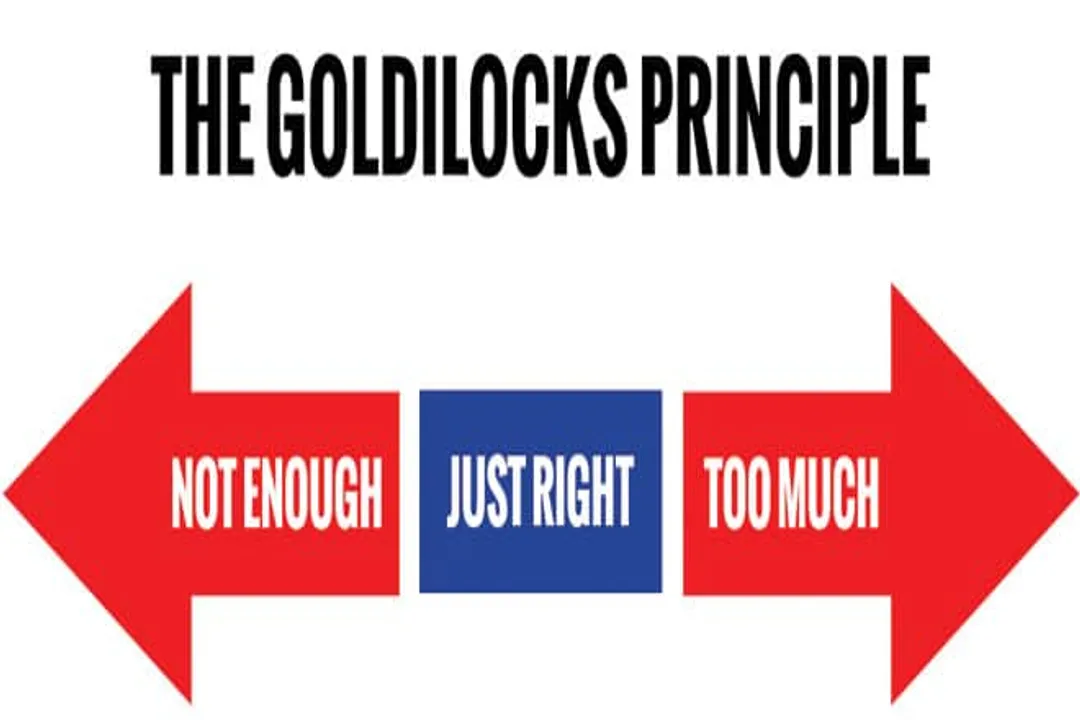
The notion of finding something that is neither too much nor too little, but perfectly balanced, appears repeatedly across human experience, from scientific inquiry to everyday purchasing decisions. This concept is universally recognized through the lens of the "Goldilocks effect," a descriptor originating from the familiar fairy tale where a young girl chooses porridge, a chair, and a bed that are just right. [3] While the story is simple, the underlying psychological and strategic implications are profound, influencing fields as diverse as astronomy, habit formation, pricing, and leadership development. [3][7][8] Essentially, the effect describes a preference for, or optimal outcome achieved at, a middle point between two extremes. [9]
# Fairy Tale Origin

The narrative foundation comes from "Goldilocks and the Three Bears," where Goldilocks tests three bowls of porridge, three chairs, and three beds belonging to a family of bears. [3] She rejects the first (too hot, too big, too hard) and the second (too cold, too small, too soft), invariably selecting the third option because it is just right. [3] This story, often used to illustrate the idea of finding a middle ground, became a metaphorical tool in science and business to describe conditions that are optimal or within a specific habitable range. [3]
# Scientific Context
In scientific disciplines, the concept is often framed as the Goldilocks Principle or the Goldilocks Zone. [3] This term gained significant traction in planetary science and astrobiology to describe the orbital distance of a planet from its star where temperatures are moderate enough for liquid water to exist on the surface—not too hot to boil away, and not too cold to freeze solid. [3] This specific range is critical for habitability as we understand it. [3]
A similar concept applies to environmental conditions, such as atmospheric composition or ocean temperatures. [4] For instance, in climate studies, researchers look for the "Goldilocks effect" in environmental data, seeking conditions that are stable or conducive to life, as opposed to the extremes of too much heat or too much cold that lead to drastic, unlivable states. [4] This scientific perspective anchors the "just right" standard to measurable, survival-critical parameters, contrasting with the more subjective assessments found in consumer behavior.

# Habit Formation Rule
The Goldilocks concept also translates into behavioral science, famously articulated as the Goldilocks Rule regarding habit formation. [7] According to this framework, people have the greatest motivation to persist with behaviors that are challenging but not impossible. [7] If a task is too easy, it becomes boring, leading to a loss of interest. [7] Conversely, if a task is too difficult, it induces frustration and a higher likelihood of quitting. [7]
The sweet spot, the Goldilocks zone for motivation, is when the task requires just enough effort to keep the mind engaged and progressing toward mastery. [7] For example, if someone is learning a new language, a lesson that introduces one or two new vocabulary words and a single new grammatical structure might be perfectly calibrated—enough novelty to be interesting, but not so much new information as to feel overwhelming. [7] This principle suggests that sustained engagement hinges on finding that precise edge of manageable difficulty.
If we consider the integration of a new digital workflow, for instance, observing user completion rates can act as a proxy for this optimal difficulty. [7] A feature that is too complex might see completion rates plummet below 50%, indicating frustration. Conversely, a feature used by nearly 100% of users might be too simplistic and add no real value, offering little challenge for growth. The zone of true habit adoption and satisfaction might actually reside where the completion rate hovers between 70% and 90%, signaling that the task is engaging enough to warrant focus but achievable enough to encourage consistent return.
# Marketing Value
In the realm of business strategy, particularly pricing and product presentation, the Goldilocks effect is actively employed to steer consumer choice. [1][5] This is often called the Goldilocks Pricing Strategy. [1] Consumers, when presented with multiple options, frequently exhibit an inherent bias toward the middle-ground choice, perceiving it as the safest, most reasonable option compared to the extremes. [1][5]
When a company offers three tiers of a service—Basic, Standard, and Premium—the Standard option is frequently positioned as the Goldilocks selection. [1] The Basic tier might seem too limited, while the Premium tier appears overly expensive or features capabilities the average customer doesn't need. [1] The Standard or Middle tier is designed to strike the right balance of features for the average user at a perceived reasonable price point, making it the default selection. [1][5]
This strategy relies heavily on the concept of anchoring. [1] The highest-priced option (the anchor) makes the middle option appear much more palatable in comparison, even if the middle option is significantly more profitable than the lowest tier. [1]
Consider a subscription service offering:
| Tier Name | Price (Monthly) | Features | Consumer Perception |
|---|---|---|---|
| Starter | $$9$ | Core functions only | Too restrictive, missing key features |
| Optimal | $19 | Most popular features included | Just right, best value |
| Elite | $$49$ | All features plus dedicated support | Overkill, too expensive for general use |
If the company only offered the Starter and Elite tiers, the decision becomes a much harder choice between scarcity and high cost. [1] Introducing the $$19$ "Optimal" tier pulls the majority of decision-makers toward it because it appears to be the most balanced choice, thus increasing overall sales volume compared to a polarized two-option scenario. [1] This technique capitalizes on aversion to risk and the desire for perceived efficiency in decision-making. [5]

# Leadership Balance
The principle of balance extends into the assessment and development of effective leadership character. [8] In this context, the Goldilocks advantage is found in avoiding over- or under-application of essential leadership traits. [8] Extremes in character traits can often become liabilities rather than strengths when applied without moderation. [8]
For example, a leader who exhibits too little decisiveness might suffer from analysis paralysis, constantly delaying necessary actions. [8] However, a leader who is too decisive, lacking the ability to pause and consider input, risks making quick, poorly informed decisions that alienate their team. [8] The Goldilocks leader finds the appropriate middle ground: decisive when necessary, but appropriately consultative when required. [8]
Another key dimension is assertiveness. [8] A leader who is not assertive enough may fail to stand up for their team or uphold necessary standards. [8] Conversely, a leader who is excessively assertive can come across as aggressive or domineering. [8] The effective leader navigates these personality dimensions by modulating their expression based on the specific context, ensuring their behavior is just right for the situation at hand. [8] This necessitates a high degree of self-awareness and situational expertise.
When we look at the spectrum of empathy, the middle ground is crucial for high-performing teams. A leader who lacks empathy may miss critical cues about team burnout or individual struggles, leading to high turnover. Yet, a leader who exhibits too much empathy might struggle to make tough, necessary personnel decisions or hold individuals accountable, prioritizing immediate comfort over long-term organizational health. [8] The successful executive demonstrates calibrated compassion.
# Practical Application Nuances
While the core idea is finding the middle ground, applying the Goldilocks concept requires deep understanding of the context, as the "just right" point is dynamic, not static. [9] What constitutes optimal difficulty for a beginner in a habit loop will be stiflingly easy for an expert. [7] Similarly, the price point that anchors a consumer to the middle tier in one market might be considered the expensive premium option in another. [1]
This dynamism is where expertise comes into play, drawing parallels between the scientific search for a habitable zone and business strategy. [3][9] In science, the zone is constrained by physical laws; in business, the zone is constrained by customer psychology and market competition. [9]
Here is a way to structure an internal review based on this principle across different functions:
| Domain | Extreme A (Too Low) | Extreme B (Too High) | Goldilocks Target |
|---|---|---|---|
| Product Usability | Too simple/lacking depth | Too complex/feature-bloated | Optimal Feature Set/Ease of Use |
| Habit Formation | Boring/No challenge | Frustrating/Too difficult | Manageable challenge/Engaging effort |
| Leadership Style | Too passive/indecisive | Too aggressive/domineering | Balanced assertiveness/Contextual authority |
| Pricing | Basic/Unappealing | Premium/Overpriced | Value-packed middle option (Anchor) |
To truly embed this concept, organizations must treat the Goldilocks zone not as a fixed location but as a moving target that requires continuous monitoring. [9] In product development, this means that what was "just right" last year might be perceived as too basic this year as customer expectations inevitably rise. [7] This mirrors the scientific requirement to constantly refine measurements of planetary habitability as understanding of stellar evolution changes.
The greatest challenge in adopting this approach is often the temptation to push toward an extreme for a perceived immediate gain—offering the absolute cheapest product to dominate a market, or adopting the most aggressive management style to enforce speed. [8][1] However, these extremes almost always lead to long-term instability, whether it is customer churn due to poor value perception or employee burnout due to unrelenting pressure. [7][8] The sustained success found through the Goldilocks effect comes precisely from the discipline of not choosing the easiest or the most extreme path, but rather the one that requires the most thoughtful calibration. [9]
Related Questions
#Citations
The Goldilocks Effect: What It Is & How to Apply It
What is the Goldilocks Effect and how to apply it in your business?
Goldilocks principle - Wikipedia
[PDF] INTERPRETING THE GOLDILOCKS EFFECT (1)
The Goldilocks Effect: Simple but clever marketing. - Medium
The Goldilocks Effect: The Communication Principle That Will Make ...
The Goldilocks Rule: How to Stay Motivated in Life and Business
The Goldilocks Advantage: Why Balance Is Important for Leader ...
Goldilocks Effect | Think Insights