What color is blood in space?

The color of blood, whether viewed through the skin or out in the cosmos, is fundamentally dictated by the chemistry within the circulatory fluid, specifically the protein responsible for oxygen transport. While we instinctively associate human blood with a singular color, the reality is more nuanced, even before considering the extreme environment of space. Understanding what happens when that crimson fluid leaves the confines of our atmosphere requires first establishing why it looks the way it does here on Earth. [4]
# Earthly Hue
On our planet, blood appears red because of a molecule called hemoglobin. [2][4] This protein, housed within red blood cells, contains iron, which readily binds with oxygen. [2] When hemoglobin is fully saturated with oxygen, it reflects the longer wavelengths of visible light, which we perceive as bright, scarlet red. [4][7] This is the arterial blood, the kind flowing away from the lungs. [4]
When that oxygen has been delivered to the body’s tissues, the hemoglobin changes slightly in structure and reflects light differently, appearing as a darker, deeper shade of red—often described as maroon or purplish-red—which is the venous blood returning to the heart and lungs. [4][7] Therefore, human blood exists on a spectrum between bright red and dark red, depending entirely on its oxygen load. [7]
# Optical Illusion
A common point of confusion arises not from the blood itself, but from how we view it when it is contained beneath the surface layers of skin, leading to the well-known phenomenon of blue veins. [3][5][8] If you were to draw blood into a clear syringe, it would look unmistakably red, yet the veins visible through the forearm appear blue or greenish. [3][8]
This discrepancy is purely an effect of light scattering and tissue depth. [3][5] Skin acts as a natural filter. Red light, having longer wavelengths, penetrates the skin more deeply before being absorbed or scattered back. [3] Blue light, with its shorter wavelength, is scattered more readily by the tissues closer to the surface. [3][5] Because the blue light scatters back toward the observer’s eye more efficiently than the red light coming from the vein itself, the vein appears blue. [3][5][8] It is an optical illusion created by the combination of the dark red blood inside and the way our overlying tissues interact with sunlight or room light. [3][8] The blood inside the vein is not blue; it is deoxygenated dark red. [8]
# Vacuum Environment
The question of blood color in space fundamentally shifts the focus from optics affected by biological tissue and atmosphere to optics affected by a near-perfect vacuum and direct solar radiation. [1] On Earth, our atmosphere constantly scatters sunlight, diffusing it and providing ambient light, which contributes to how we perceive color even in shadow. [3] In the vacuum of space, this atmospheric scattering is entirely absent. [1]
Space presents two primary viewing conditions: direct sunlight or shadow/ambient darkness. [1]
# Color in Darkness
If a drop of blood were exposed to the deep vacuum of space, far from any direct light source, it would appear black. [1] This is not because the blood has chemically changed its color, but because there is no external light source to be reflected or scattered back to an observer's eyes or visor. [1] For us to perceive any color, light must hit an object and return to the observer. In the infinite blackness, unless the blood is directly illuminated, it simply merges with the background, appearing as an opaque void. [1]
# Illuminated Crimson
Conversely, if that same drop of blood were struck by direct, unfiltered sunlight in space, it would appear its true, chemically determined color: red. [1] The light spectrum from the Sun in a vacuum still contains all the colors, and the hemoglobin molecules within the blood will absorb the blue/green wavelengths and reflect the red wavelengths just as they do on Earth. [1] The only difference is the intensity and purity of the light; there is no atmospheric diffusion softening the edges or adding ambient blue tones. [1]
Consider a sample on an exterior surface, such as an astronaut's glove or a piece of equipment. Against the deep black background, the illuminated portion of the blood would register as a startlingly bright, pure red, contrasting sharply with the shadow areas that would appear pitch black. [1] This sharp contrast, where the color abruptly disappears into nothingness when moving from light to shadow, is characteristic of viewing objects without atmospheric diffusion. On Earth, even a deep shadow retains some ambient light scattered from surrounding objects or the sky, which slightly softens the transition. [3] In space, the transition is absolute. [1]
The chemical nature of the pigment remains the constant. Whether the blood is bright red (oxygenated) or dark red (deoxygenated) depends on the metabolic state of the organism it came from, not the void itself. [7] The vacuum merely strips away all the visual intermediaries—the skin, the air, the diffuse light—leaving only the direct interaction between photon and molecule. [1]
# Considering Other Fluids
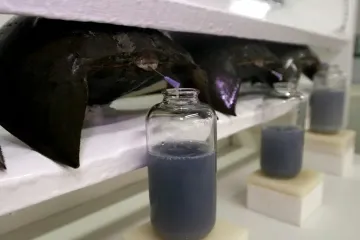
While the focus here is on human blood, the broader scientific consideration of what could serve as a life-sustaining fluid elsewhere adds important context to the discussion of "blood color" in space. [6] Scientists who study hypothetical extraterrestrial biology engage in exohematology, which examines what non-water-based or differently pigmented compounds might perform the equivalent functions of carrying oxygen or nutrients in alien life forms. [6] For instance, some terrestrial organisms utilize different respiratory pigments, such as hemocyanin (which contains copper and makes fluids appear blue or greenish when oxygenated). [2][6] This reminds us that while our universe features a red standard for oxygen transport, it is not a mandated universal law for all potential biological systems. [6]
To solidify the visual distinction between terrestrial and vacuum viewing, imagine a small, contained splash on a bright white lunar dust sample, viewed from a helmet visor. On the Moon, the blood would absorb the direct solar radiation hitting it and reflect the red wavelengths vividly against the bright, white backdrop, making it strikingly visible as red. [1] However, any part of that splash just outside the direct beam of the Sun would be visually indistinguishable from the black, star-filled sky just inches away. [1] The difference in appearance between our shadowed veins and the vastness of space boils down to a simple equation: biological chemistry sets the reflection color (red), and the environment dictates whether that color is visible at all. [1][3]
#Citations
What color is human blood in the vacuum of space? - Quora
Is blood blue? - Ask A Biologist - Arizona State University
If Blood Is Red, Why Do Veins Look Blue? - Mental Floss
Is blood blue? - Medical News Today
Color of blood - Questions and Answers in MRI
The Color of Blood and “Exohematology” | ASH Clinical News
Is Blood Blue? Unveiling the Answer - Verywell Health
Why does blood in our veins look blue? Ask a Science Teacher!