How is combustion possible in space?
The notion that fire needs air often leads people to assume that combustion is impossible outside of Earth’s atmosphere, yet we see rocket launches and know that experiments happen aboard spacecraft. The key lies in understanding that outer space is not the same as the environment inside a spaceship. [3] Traditional fire, the kind that flickers in a campfire or flickers on a candle wick here on the ground, depends on a familiar trinity: fuel, heat, and an oxidizer, which is typically oxygen from the surrounding air. [4] In the near-vacuum of space, these conditions are absent, meaning a stray spark won't ignite anything unless it finds a ready-made atmosphere. [9]
# Recipe Found
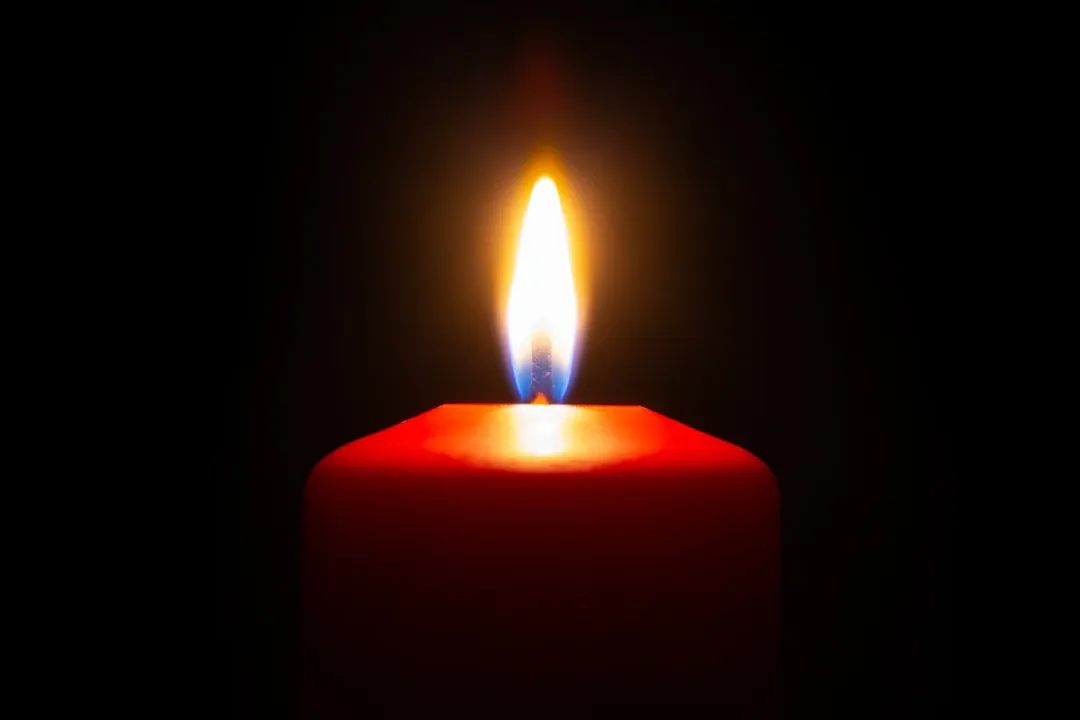
Combustion, at its heart, is a chemical reaction involving rapid oxidation that produces heat and light. [4] On Earth, gravity plays a vital, unacknowledged role in this process. Hot gases produced by the fire are less dense than the cooler ambient air, causing them to rise. This rising motion pulls cooler, oxygen-rich air in from below—a process called convection. This constant, gravity-driven flow ensures the flame is continuously fed fresh oxidizer and that waste products, like carbon dioxide (), are carried away. [5][8][10]
If you imagine trying to light a match in the true vacuum between planets, it would simply fail, not because there is no fuel (a match head contains both fuel and oxidizer), but because there is no medium to sustain the chemical chain reaction in the way we expect it. [3] While some debris or even small spacecraft parts might contain materials that are technically fuel, without an oxidizer present, they will not burn in the classic sense. [9] Combustion requires that the fuel and the oxidizer must be in intimate contact for the reaction to proceed rapidly enough to be called "fire."
# Atmosphere Matters
The primary reason combustion is possible in spacecraft, such as the International Space Station (ISS), is that they carry their own miniature, controlled Earth environments. Spacecraft cabins are pressurized with a breathable mix of gases, primarily nitrogen and oxygen, maintaining sea-level atmospheric pressure or slightly lower. [3] This onboard atmosphere supplies the crucial oxidizer needed for any fire to start. [4] In essence, a fire inside the ISS is burning the cabin air, just as a fire in a sealed room on Earth would consume the room's air until the oxygen ran out or the fuel was consumed.
This dependence on the internal atmosphere is precisely why fire safety is a paramount concern for long-duration space missions. If a fire were to start, it wouldn't just be a danger due to heat and smoke; it would rapidly deplete the very air the crew needs to breathe. Furthermore, the waste products, primarily carbon dioxide, would accumulate, posing an additional, immediate threat to life support systems. [2] This is why NASA and other agencies conduct extensive research on how flames behave in microgravity environments; understanding fire dynamics is fundamental to designing reliable life support and fire suppression systems. [2]

# Gravity's Role
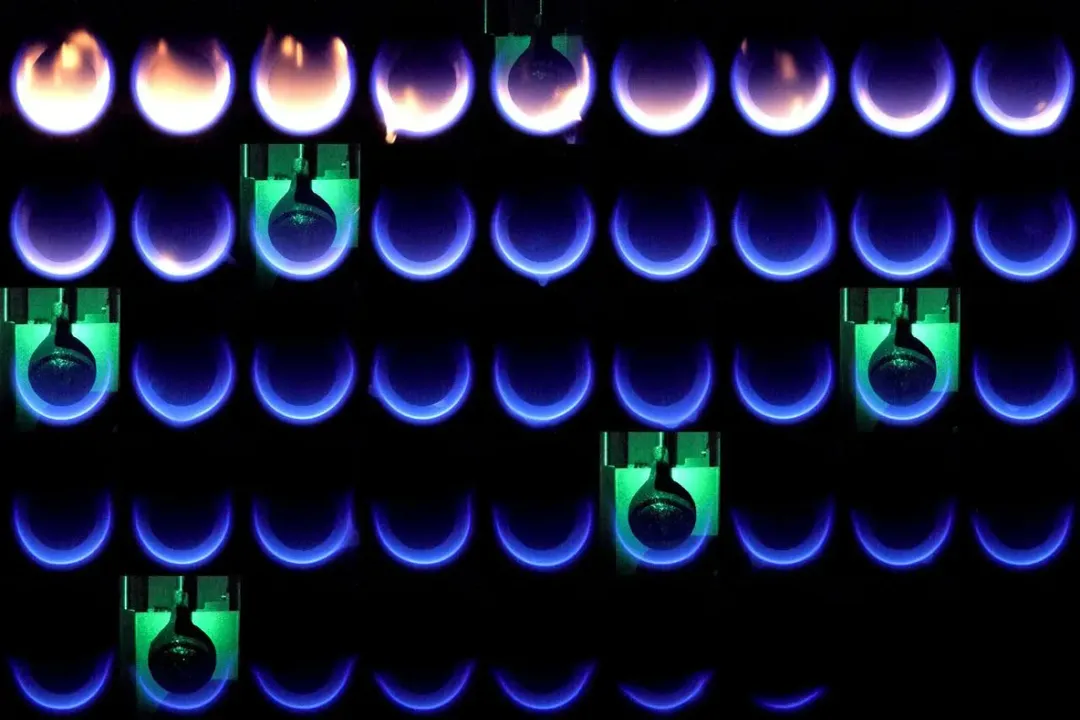
The most fascinating aspect of space-based combustion, and the area of greatest scientific study, involves the absence of gravity’s influence on the flame structure itself. [10] When convection ceases in microgravity, the entire mechanism of flame propagation changes fundamentally. [5][8]
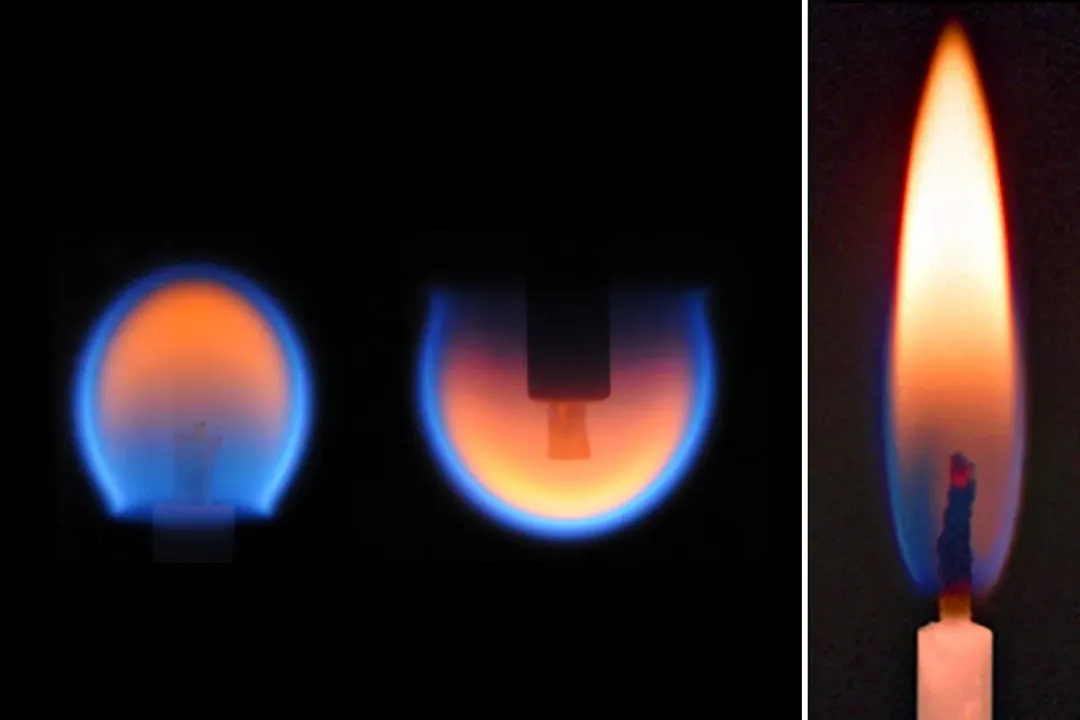
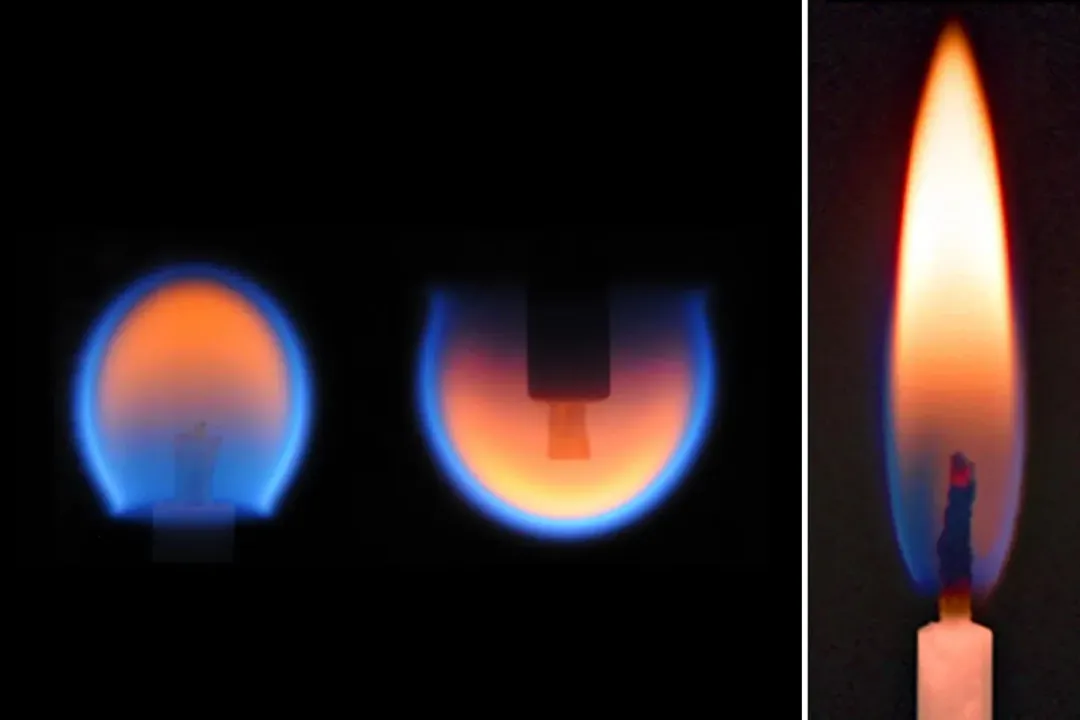
On Earth, a candle flame exhibits a distinctive teardrop shape, with the brightest, hottest part near the base where the fresh air is being drawn in. In the microgravity of the ISS, however, flames adopt a nearly perfect spherical shape. [5][10] This happens because there is no natural tendency for hot gases to rise or for cold air to sink. Instead of convection, the transfer of oxygen to the flame and the removal of combustion byproducts rely solely on the much slower process of molecular diffusion. [5][8]
The diffusion-limited nature of microgravity flames leads to several observable differences:
- Slower Burning Rate: The reaction proceeds much more sluggishly because the supply of fresh oxygen is limited by how fast oxygen molecules can diffuse across the boundary layer to the fuel source. [5][8]
- Lower Temperatures: The resulting heat release is spread out, leading to cooler overall flame temperatures compared to their terrestrial counterparts. [10]
- Smothering Effect: Since the and water vapor produced cannot easily float away, they build up a layer around the burning material. This gaseous shroud effectively smothers the flame unless an external force, like a fan or a dedicated air vent, actively pushes the waste products away. [5][8]
When scientists deliberately removed forced airflow in experiments, they observed that even seemingly vigorous flames would rapidly shrink and extinguish themselves because the slow diffusion of oxygen could not keep pace with the reaction rate. [10] It’s a counterintuitive situation where the fire essentially suffocates itself in its own exhaust, a scenario rarely observed on Earth. [1] If you were to place a burning cigarette in an airless chamber on Earth, the flame would die almost instantly; inside a spaceship, you could theoretically keep a very small flame going much longer just by having a low-speed fan gently blowing across it. [1]
# Rocket Fire
There is one common scenario where combustion occurs outside a contained atmosphere, and that is the firing of a rocket engine. [3] A rocket engine is a self-contained system designed to overcome the vacuum of space. Unlike a candle, a rocket does not rely on atmospheric oxygen. [4]
Rocket propulsion works by mixing a fuel (like refined kerosene, liquid hydrogen, or solid compounds) with a powerful oxidizer (such as liquid oxygen or nitrogen tetroxide) carried onboard in separate tanks. [3] The mixture is injected into the combustion chamber, ignited, and the resulting superheated, high-pressure gas is expelled through a nozzle, creating thrust. [3] Because the oxidizer is stored alongside the fuel, the engine can maintain the reaction even in the complete vacuum of space, as it brings everything it needs for the reaction with it. [9] The comparison here is stark: a candle flame is a weak, diffuse process relying on the environment; a rocket plume is an intense, engineered explosion designed to be entirely independent of it. [4]
# Safety Science
The research NASA conducts on fire in microgravity isn't just academic curiosity; it directly impacts astronaut safety and the efficiency of future hardware. [2] Experiments conducted on the Space Shuttle and ISS, often using small solid fuels like candle wicks or unique materials in controlled chambers, help establish a baseline understanding of combustion hazards. [2][8]
One key area involves studying flammability limits. On Earth, we know the minimum and maximum concentrations of oxygen in the air required for something to burn. In microgravity, these limits change because the fluid dynamics are different. [2] A gas mixture that would be too lean (not enough oxygen) to sustain a flame in one-g might actually burn readily in microgravity if the diffusion process is slightly more efficient under those specific conditions, or vice versa. For instance, studies have shown that some flames that struggle to ignite in normal gravity can be ignited more easily under slightly reduced pressure in microgravity, a finding that challenges simple terrestrial intuition. [10]
Consider an analysis of how an accidental fire might spread in a habitat. On Earth, a small fire grows quickly because convection rapidly spreads heat upward, igniting new material above the source. In a spacecraft, without that upward draft, the heat transfer relies more on radiation and conduction through the structure, which might initially slow the spread to nearby objects that are not directly touching the flame, providing a potentially longer response window. [1] However, the resulting spherical soot particles and toxic gas buildup remain a significant threat that air circulation systems must manage aggressively.
# Designing for Zero-G
For engineers designing habitats for Mars missions or deep-space exploration, understanding these combustion quirks is essential for materials selection and fire control system placement. If we cannot rely on natural heat movement, we must rely on active intervention. [2] This means designing fire detection systems that account for the slower, cooler, and non-directional nature of microgravity flames. Standard smoke detectors might react differently to a slow, cold-burning sphere of than to a rapidly billowing Earth fire. [1]
A practical design consideration arising from this research relates to the design of ventilation. Since diffusion is the dominant factor, an effective fire suppression system in a deep-space habitat must ensure a high degree of forced airflow across all surfaces, not just in general atmospheric circulation. This localized air movement is necessary to physically sweep away the inert layer that insulates the fuel source. [8] Designing a containment vessel or fire extinguisher that effectively blasts air across a burning surface, rather than just spraying an extinguishing agent onto a vaguely defined "top" of the flame, becomes the engineering standard. This shift in focus from natural convection management to forced diffusion management is a direct outcome of observing fire in space. [5]
This fundamental difference in how heat and mass are transferred dictates that any future long-term habitat must treat fire not as an upward-traveling threat, but as a spreading bubble of chemical reaction that requires constant, systematic physical interruption to stop. [10] The physics of fire in orbit provide a clear mandate: redundancy in airflow and localized, targeted suppression are non-negotiable elements of survival far from Earth.
#Videos
How Fire Burns in Space - YouTube
#Citations
How does combustion work in space? - Reddit
Why NASA is studying flames in space.
How can fire burn in space when in space there's no air for ... - Quora
Combustion in Space | Research Starters - EBSCO
Great balls of fire: How flames behave in space - Astronomy Magazine
How Fire Burns in Space - YouTube
How does burning occur in space without oxygen? - Facebook
Fire in space and flames in microgravity | BBC Sky at Night Magazine
Could burning debris keep burning in space?
Fire in Microgravity | American Scientist