Can ice form in a vacuum?

Water, in its solid form, absolutely can and does exist in a vacuum, a setting often imagined as completely empty space. [3] The immediate mental image might be that of ice cube placed in an empty box, where the vacuum would cause immediate boiling or melting. However, the reality of how water behaves under extremely low pressure is governed by fundamental thermodynamic principles, primarily centered on the concepts of phase transitions and the triple point. [2][8] When we move away from standard atmospheric pressure, the familiar relationship between temperature and the state of water—solid, liquid, or gas—changes dramatically. [8]
# Pressure Physics
The environment of space is essentially a vacuum, meaning the ambient pressure is incredibly low compared to the standard atmosphere we experience on Earth at sea level (about $101.3$ kPa). [1][8] This low pressure fundamentally alters how water can exist. [2] Under normal conditions, if you cool water below (), it freezes into ice. [8] In a vacuum, however, the pressure dictates the possibility of the liquid state existing at all. [2]
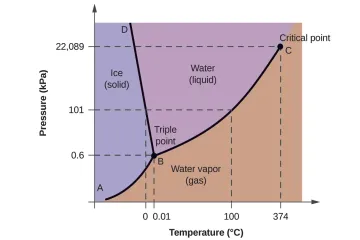
For water, the critical boundary separating the solid/liquid phase region from the liquid/gas phase region is defined by the triple point. [2][8] This point is unique because it is the only combination of temperature and pressure where all three phases—solid, liquid, and gas—can coexist in thermodynamic equilibrium. [8] For water, this condition occurs at a pressure of approximately $611.7$ Pascals (Pa) and a temperature of . [2][8]
# Triple Point
If the surrounding pressure drops below this triple point pressure, the liquid phase of water simply cannot exist. [2][8] If you have ice at a temperature above the triple point temperature but at a pressure far below the triple point pressure, the ice cannot melt into liquid water; instead, it must transition directly into water vapor, a process known as sublimation. [1][3] This is the dominant process ice undergoes in the vacuum of space or within a strong vacuum chamber. [1]
Consider an ice cube in the vacuum of space, where the pressure is negligible compared to . If the ice temperature is, say, (which is below ), it will not melt into liquid water because the pressure is too low for liquid water to form. [2][8] The water molecules on the surface gain enough energy to break away from the solid structure and escape directly into the gas phase. [3]
Interestingly, if the ice temperature were significantly above the triple point temperature, say , and the environment was a vacuum, the ice would still sublimate, but this sublimation process would be coupled with rapid evaporative cooling, potentially causing the remaining solid to freeze rapidly or even shatter due to the energy loss, which is why one might observe rapid boiling followed by freezing when depressurizing water. [6][7] The speed at which this transition happens is a function of both the temperature difference driving the sublimation and the ability of the resulting vapor to escape the immediate vicinity. [3]
# Rapid Cooling
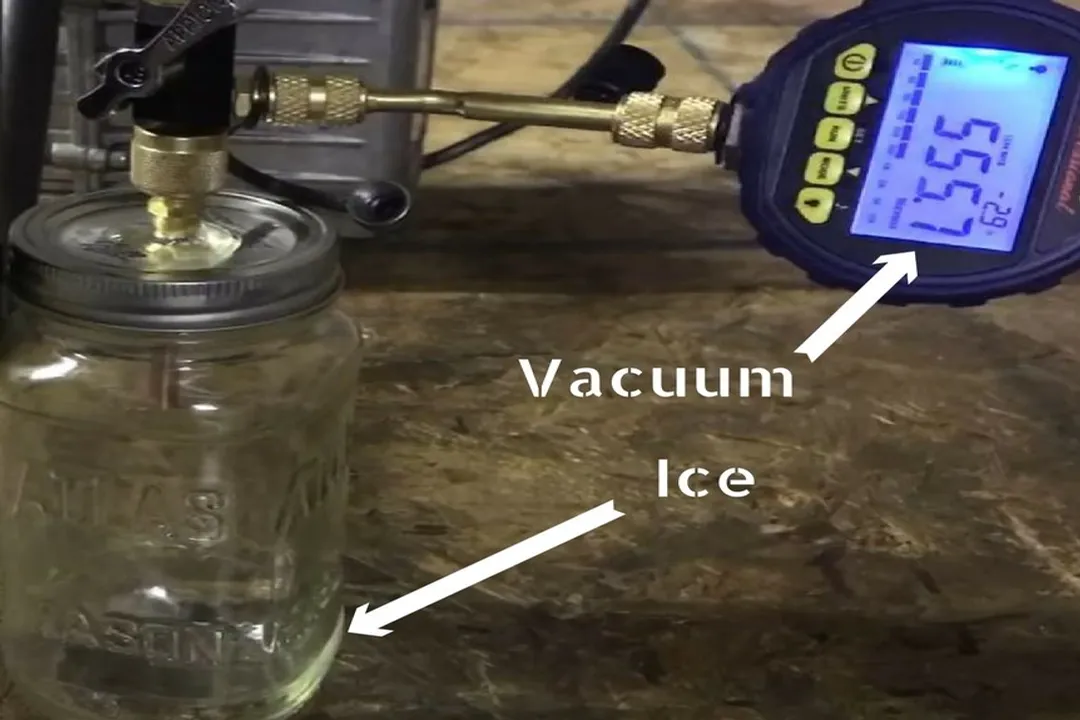
The phenomenon of vacuum freezing is often demonstrated outside of outer space environments, such as in industrial processes or science demonstrations involving vacuum pumps. [6] When a container of liquid water is rapidly exposed to a strong vacuum, the pressure drops suddenly below the triple point. [7] Because the boiling point of water drops with decreasing pressure, the liquid water will begin to boil vigorously, even if its temperature is near room temperature. [6]
This vigorous boiling is extremely effective at removing thermal energy from the remaining water—it is evaporative cooling at its most dramatic. [7] If enough energy is removed quickly enough, the remaining liquid water will reach its freezing point and turn into ice before all of it has boiled away. [6] This is sometimes described as water boiling and freezing simultaneously under vacuum conditions. [4][7] A helpful comparison point is realizing that pulling a vacuum on a system containing moisture works because the vacuum actively lowers the pressure, forcing the moisture to vaporize quickly, a process that can lead to rapid temperature drops if the system is not actively heated. [6]
For instance, imagine a closed container of liquid water at . If the surrounding chamber is quickly evacuated, the pressure drops, the water boils, and the temperature of the remaining water plummets. If the initial pressure drop is severe enough, this rapid cooling can cause the water that hasn't yet turned to steam to solidify into ice. [7] This is not ice forming because it got cold in the conventional sense, but because the pressure change forced a phase shift accompanied by massive energy removal. [2]
# Sublimation Rates
In a near-perfect vacuum, like that found in interstellar or interplanetary space, ice loss is dominated by sublimation. [1][3] However, the rate of this loss is not uniform across all vacuum conditions. A key factor not always immediately obvious is the density of the surrounding environment. While space is a vacuum, the conditions inside a laboratory vacuum chamber, even a very good one, are technically different from deep space. [1]
When considering how long an ice sample would last, one must account for the mean free path of the water molecules. [1] In an extremely high vacuum chamber, the water molecules escaping the ice have a very long path before they hit a chamber wall or another molecule, leading to very efficient removal from the solid surface. This results in rapid sublimation. [1]
What I find particularly insightful when comparing these two scenarios is that even a very thin background atmosphere, like the trace gases that might exist in a simulation chamber or near a planetary body, can actually impede the sublimation rate compared to the deepest void of space, simply by providing molecules for the escaping water vapor to collide with, effectively slowing the net outward diffusion of gas away from the ice surface. [1] The true vacuum of space offers no such impediment, allowing the escaping molecules to accelerate away unimpeded.
This principle is actively applied in food science through lyophilization, or freeze-drying. [6] In this controlled process, water (or ice) is deliberately put into a vacuum below the triple point, allowing it to sublime away slowly. The ability to control the vacuum level and temperature allows engineers to remove almost all the water content while preserving the structure of the material, turning a potentially destructive process (like rapid outgassing in space) into a method for long-term preservation. [6] This controlled environment allows for a predictable rate of transition, unlike the more chaotic initial exposure of a block of ice to a sudden vacuum change.
To summarize the phase behavior, the conditions dictate the outcome, not just the temperature alone:
| Condition | Pressure Relative to Triple Point () | Primary Phase Change | Example Environment |
|---|---|---|---|
| Standard Atmosphere | Much Higher | Melting/Boiling | Earth Surface |
| Vacuum (Space/Chamber) | Much Lower | Sublimation (Solid Gas) | Outer Space |
| Rapid Depressurization | Drops Below | Flash Boiling then Freezing | Vacuum Pump Experiment |
Therefore, ice not only can form in a vacuum (through rapid cooling/freezing of depressurized water) but it must exist as ice (or vapor) if the pressure is below the triple point, as the liquid phase is thermodynamically unstable under those conditions. [2][8] Its continued survival depends on its temperature and the extent of the vacuum, with sublimation being the persistent threat to its existence. [3]
#Videos
What Will Hapen If You Put ICE CUBES In VACUUM CHAMBER
Related Questions
#Citations
How can water ice exist in a vacuum, like on Europa and comets ...
Vacuum freezing of water - Physics Stack Exchange
Can ice survive in a vacuum (space) without sublimating? - Quora
What Will Hapen If You Put ICE CUBES In VACUUM CHAMBER
Vacuuming too fast can make ice form - Facebook
Can Pulling a Vacuum too Fast Freeze Water/Moisture?
Melting Ice In A Vacuum - CR4 Discussion Thread
[PDF] Ice Layer formation rate in vacuum environments