What role do clusters play in cosmology?
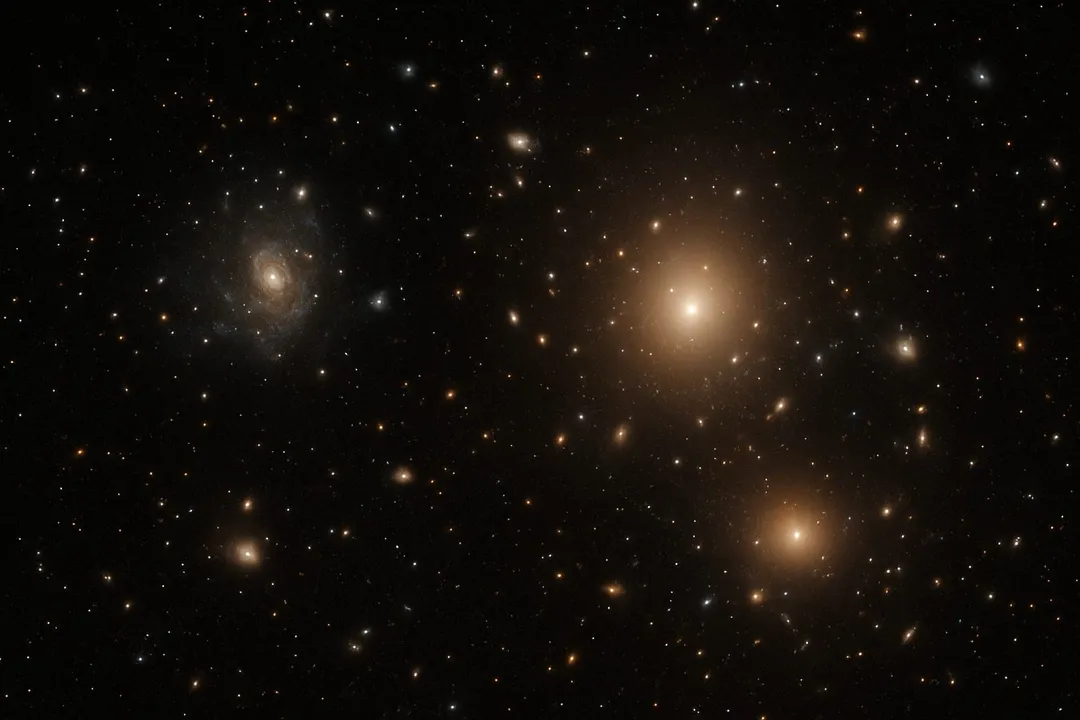
The largest gravitationally bound structures we observe in the cosmos are galaxy clusters, and their importance to cosmology cannot be overstated; they are essentially the scaffolding upon which the universe is built and the clearest windows we have into its fundamental constituents, like dark matter. These colossal groupings are not just collections of hundreds or even thousands of galaxies; they are vast cosmic neighborhoods where the entire history of structure formation is written in the distribution of their mass and the temperature of their gas. To understand the universe on the grandest scales—how it started, what it's made of, and where it's headed—we must study these immense city-states of galaxies.
# Cosmic Giants
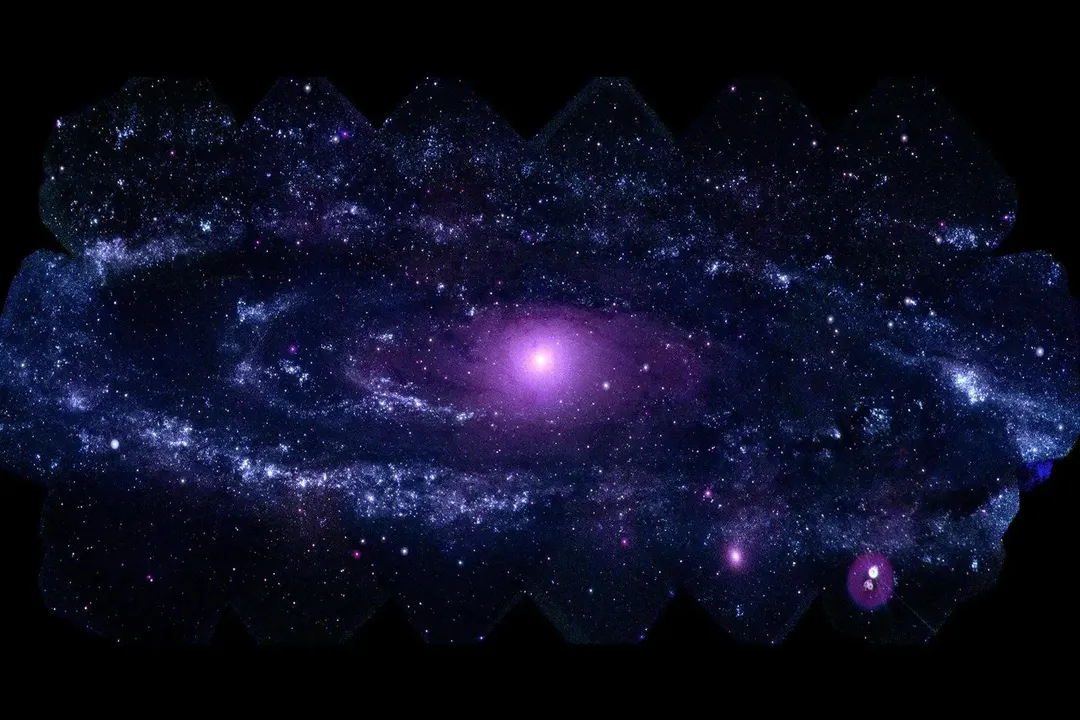
A galaxy cluster represents a significant jump in scale from the smaller groupings we might observe closer to home, such as our own Local Group, which contains only a handful of significant galaxies. Clusters can house anywhere from a few hundred to several thousand galaxies, all swimming in an immense ocean of material that is largely invisible to optical telescopes. The typical mass of a well-established cluster is staggering, falling in the range of to times the mass of our Sun ().
These structures sit at the very top of the hierarchy of cosmic structure. Imagine the universe mapped out: galaxies cluster together into groups, those groups assemble into massive clusters, and those clusters themselves are strung together by vast filaments of matter, forming a vast, sponge-like architecture known as the cosmic web. The clusters are the densest knots where these filaments intersect.
To put this scale into perspective, consider a rough comparison of typical mass concentrations:
| Structure Type | Typical Mass Range () | Dominant Component |
|---|---|---|
| Galaxy Group (e.g., Local Group) | to | Galaxies and Dark Matter |
| Galaxy Cluster | to | Dark Matter, Hot Gas, Galaxies |
| Supercluster (Filament Node) | or more | Multiple Clusters and Groups |
This table highlights that a cluster is already an object of immense gravitational power, fundamentally different from the smaller associations of galaxies bound by gravity.
# Mass Mystery
Perhaps the most scientifically compelling aspect of galaxy clusters is their mass composition, which offers a direct and unavoidable probe into the nature of dark matter. When we look at a cluster, we see the visible galaxies, but these account for only a small fraction of the total gravitational pull required to keep the structure bound.
The total mass budget of a cluster is separated into three primary components: the galaxies themselves, the hot intracluster medium (ICM), and dark matter. The ICM is a superheated plasma, typically reaching millions of degrees Celsius, that fills the space between the galaxies, emitting strongly in X-rays. While this gas is much more massive than the combined light of all the cluster's galaxies, it still doesn't account for the majority of the mass.
The overwhelming majority—often estimated to be between 80% and 90% of the cluster's total mass—is attributed to dark matter. Because clusters are the largest structures dominated by dark matter's gravity, they serve as unparalleled laboratories for studying this mysterious substance. The gravitational lensing effect—the bending of light from background objects around the cluster—provides a map of the total mass, allowing astronomers to subtract the known contributions from stars and gas to isolate the dark matter distribution. Studying how this dark matter is distributed within a cluster provides critical evidence supporting the standard cosmological model, which requires this unseen mass component to explain how structures formed as quickly as they did after the Big Bang.

# Web Growth
The very existence and distribution of galaxy clusters throughout space and time are intrinsically linked to the physics of the early universe. The standard model of cosmology, CDM (Lambda Cold Dark Matter), posits that the early universe contained tiny, quantum-scale density fluctuations. Over cosmic time, gravity amplified these slightly over-dense regions, causing matter to pool together.
Clusters form at the intersection points of the cosmic web’s filaments, making them the largest gravitationally bound entities that reflect the initial conditions of the universe. Because gravity acts slowly across vast distances, the largest structures, like clusters, are the most recently assembled and offer a clear record of structure growth over billions of years. The rate at which these clusters have appeared and merged across cosmic history is highly sensitive to cosmological parameters, particularly the total matter density () and the influence of dark energy (). If there were significantly more matter, structure growth would have been faster; if dark energy was stronger earlier on, it would have suppressed this growth. Therefore, mapping the cluster population at various distances (or look-back times) directly tests the CDM predictions for structure formation. This is a subtle but incredibly powerful aspect of their role: observing clusters at high redshift provides a fossil record of structure growth that lets cosmologists test the fundamental drivers of cosmic expansion.
# Tracing Parameters
This sensitivity to mass and expansion history makes clusters excellent "standard rulers" and "standard candles" of cosmology, albeit more complex ones than single stars or supernovae. While individual galaxies evolve in complex ways, the overall statistical properties of cluster populations—how many exist at a given epoch and how massive they are—are powerful statistical probes. By counting the number of massive clusters present at different times, scientists can place constraints on the amplitude of primordial density fluctuations (), a key parameter describing the lumpiness of the universe. A universe with too few massive clusters today suggests the expansion accelerated too quickly, while too many suggests matter was too densely packed initially.
Furthermore, the study of the intracluster medium itself offers independent checks on cosmological models. The physics governing the cooling and heating of this X-ray gas provides data points that must align with the cluster's overall mass profile derived from lensing, which in turn must align with the expansion history derived from supernovae. This layered verification process—using galaxies, gas, and lensing—all contained within the cluster environment, builds robust trust in the final cosmological parameters derived from these observations.

# Galactic Environment
Clusters aren't just inert piles of matter; they are dynamic environments that profoundly reshape the galaxies within them. The sheer density of galaxies means that encounters are far more frequent than in the relatively isolated space of our own neighborhood. These high-speed interactions lead to mergers and tidal stripping, fundamentally altering the morphology and star formation history of the constituent galaxies.
A crucial mechanism at work is ram-pressure stripping, driven by the hot ICM. As a gas-rich galaxy plows through this dense, hot plasma, the pressure exerted on the galaxy's own interstellar gas cloud is immense. This pressure can effectively strip away the cold gas reservoir needed to fuel new star formation, a process believed to be a primary driver in turning spiral galaxies into the red, passive elliptical galaxies often found near the centers of massive clusters. This environmental effect means that clusters act as cosmic evolutionary accelerators, forcing galaxies through rapid evolutionary phases that might take much longer in sparser regions. Observing the ratio of blue, actively star-forming spirals versus red, quiescent ellipticals as a function of a galaxy's distance from the cluster center provides a clear census of this environmental evolution.
# System Dynamics
Because clusters are defined as gravitationally bound structures, they are inherently dynamic systems, constantly evolving through violent mergers and accretion events. When two clusters collide, the event is incredibly energetic, sending shockwaves through the ICM that heat the gas even further, sometimes creating observable X-ray features like "cold fronts" or "sloshing" gas plumes. These merger dynamics are important because the structure and temperature profile of the gas can be used to estimate the total mass, provided we understand the physics of the shockwaves involved.
The long-term fate of a cluster depends heavily on the geometry and expansion history of the universe as a whole. In a universe dominated by matter, all clusters would eventually settle into a more relaxed, stable configuration over vast timescales, perhaps merging with nearby superclusters or growing into even larger structures. However, the accelerating expansion driven by dark energy complicates this picture. While the internal gravity of the cluster is strong enough to overcome the local expansion trying to pull its members apart, the expansion of space between clusters means that merging with structures that are currently far away might eventually become impossible as those structures recede faster than light speed. The cluster itself, being gravitationally bound, will remain intact, but the cosmic environment surrounding it will become increasingly sparse. The energy involved in these collisions—how kinetic energy from the merger is partitioned into heating the gas versus the overall gravitational potential—is a key area of research today.
In summary, galaxy clusters are far more than just pretty pictures of hundreds of galaxies; they are indispensable tools in modern cosmology. They function simultaneously as the largest gravitationally stable systems, enabling the measurement of dark matter dominance; as relics of early density fluctuations, constraining cosmological parameters; and as extreme environments that dictate the evolution of the galaxies they contain.
#Videos
What Role Do Galaxy Clusters Play In Galaxy Evolution?
Related Questions
#Citations
What Role Do Galaxy Clusters Play In Galaxy Evolution?
Large Scale Structures
Galaxy cluster
Galaxy Clusters | Center for Astrophysics | Harvard ...
Galaxy Clustering
What is the ultimate fate of a cluster of galaxies?
Clusters of Galaxies: Physics and Cosmology | Workshop
Galaxy Clusters
Understanding Galaxy Clusters: The Cosmic Neighborhoods ...
Why are Galaxy clusters important for dark matter studies?